
Quick Summary:Quartz is often the safer long-term surface choice for multi-family apartment vanity tops because it offers stronger moisture resistance, lower water absorption, better stain resistance, reliable bulk supply consistency, and easier replacement matching than many engineered marble surfaces. Engineered Marble can work for budget-sensitive projects, but Quartz is usually stronger for tenant-use bathrooms, property turnover, and long-term maintenance control.
A developer is preparing 480 apartment bathrooms. The model room needs a clean, bright vanity surface. The procurement team is comparing Engineered Marble and Quartz. Engineered Marble looks attractive on the initial spreadsheet, but the property manager sees the real battlefield: tenant misuse, water splashing, makeup, toothpaste, hair dye, cleaning chemicals, sink cut-outs, replacement matching, maintenance calls, and turnover speed.
That is where the surface decision becomes more than a design question. In multi-family projects, a bathroom vanity top is not a showroom sample. It is a daily-use surface handled by hundreds of tenants over years of leasing cycles. It must survive moisture, cleaning, cosmetics, soap residue, hard water, accidental impact, and quick maintenance routines. Pretty is good. Predictable is better. Pretty and predictable? That is where Quartz earns its rent.
This guide compares Engineered Marble vs. Quartz from a multi-family project perspective. The goal is not to say Engineered Marble is useless. It can be suitable for budget-focused projects with controlled expectations. But for apartment vanity tops, moisture-prone bathrooms, bulk supply, and long-term property operations, apartment vanity quartz is often the stronger specification.
For buyers comparing stone surface options before choosing bathroom vanity tops, kitchen counters, or apartment project surfaces, this Quartz slabs category provides a practical starting point for reviewing engineered quartz colours, patterns, and project-ready slab options.

What Is Engineered Marble?
A Practical Definition for Developers
Engineered Marble is a man-made surface typically made from crushed marble, stone powder, resin, pigments, and sometimes a protective gel coat or surface layer. It is designed to imitate natural marble at a more controlled cost and with more predictable production than quarried stone.
In apartment projects, Engineered Marble is often used for vanity tops, bathroom counters, prefabricated sink tops, and budget-friendly renovation surfaces. It can offer a smooth appearance and marble-like tone without the price and variation of natural marble.
Why Engineered Marble Is Used in Apartment Bathrooms
Engineered Marble is popular because it can be manufactured in standard vanity dimensions, supports consistent colour, and may be cost-effective for large-volume projects. It can be suitable for low-to-medium-use bathrooms, short-cycle rental properties, or projects where initial budget is the strongest purchasing factor.
For developers building entry-level rental units, Engineered Marble may appear attractive because it helps keep initial surface costs under control. However, multi-family buyers should not stop at the first quotation. They should evaluate surface durability, stain risk, moisture behaviour, gel coat quality, edge performance, cleaning compatibility, and future replacement matching.
Where Engineered Marble Can Struggle
Engineered Marble performance depends heavily on resin quality, surface coating, manufacturing consistency, polishing quality, and installation details. If the gel coat scratches, dulls, chips, or wears down, the surface may become more vulnerable to stains and moisture. In bathrooms, this matters because tenant use is rarely gentle. Hair dye, cosmetics, toothpaste, perfume, soap, standing water, and cleaning products are common.
Engineered Marble can work when expectations are realistic and supplier quality is stable. But if the project needs stronger moisture resistance, better long-term appearance, and fewer maintenance calls, Quartz usually becomes the safer material decision.
What Is Quartz?
A Practical Definition for Multi-Family Buyers
Quartz is an engineered stone surface made from quartz minerals, resin binders, pigments, and performance additives. It is designed to combine stone-like appearance with durability, low absorption, stain resistance, and strong consistency across large orders.
In multi-family housing, Quartz is widely used for apartment vanity tops, kitchen countertops, bathroom counters, laundry room surfaces, commercial amenity counters, and renovation projects. It is especially useful when buyers need the same surface installed across hundreds of units with consistent colour, thickness, finish, and fabrication quality.
For apartment kitchens and upgraded rental units where countertop appearance affects leasing photos and perceived property value, this guide on Quartz colors for luxury apartment kitchens can help developers match surface colours with cabinetry, flooring, lighting, and rental positioning.
Why Quartz Is Popular in Apartment Vanity Projects
Quartz is popular in apartment vanity projects because it offers low water absorption, strong hardness, better stain resistance than many coating-dependent surfaces, and reliable repeatability for bulk orders. It also supports a cleaner, more modern look that fits today’s rental market, from standard apartments to Class A multi-family developments.
For property managers, Quartz is practical because it can help reduce maintenance friction. A vanity top that cleans quickly, resists common stains, and matches future replacements is more valuable than a surface that only wins the model room photo.
Typical Quartz Formulation
Quality engineered Quartz often contains high mineral content, commonly around 88%–94% by weight, depending on manufacturer, product grade, and design style. Resin binder usually supports slab cohesion, fabrication, edge shaping, and long-term surface performance. Exact formulation varies, so buyers should request technical data sheets, water absorption data, and supplier documentation before confirming bulk orders.
| Surface Type | Typical Composition | Project Meaning |
|---|---|---|
| Quartz | Quartz minerals, resin binder, pigments, additives | Strong durability, low absorption, reliable consistency |
| Engineered Marble | Marble powder or stone powder, resin, pigments, coating | Budget-friendly look, performance depends on surface quality |
Engineered Marble vs. Quartz: Core Material Difference
Composition and Structure
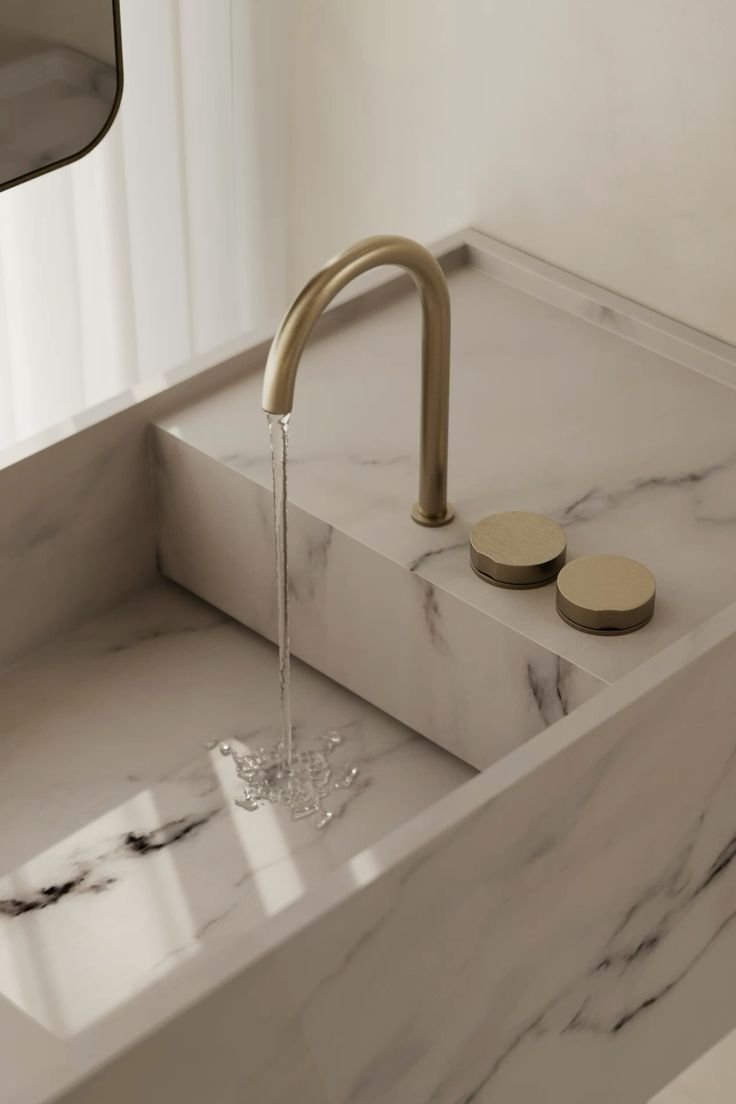
The key difference between Engineered Marble and Quartz starts with material structure. Engineered Marble often relies on marble powder, resin, pigments, and surface protection. Quartz uses harder quartz minerals combined with resin binders and pigments. This gives Quartz stronger surface hardness and better suitability for high-use apartment bathrooms and kitchens.
Engineered Marble can look clean and attractive, especially in standard vanity formats. But when the surface coating is damaged, long-term performance may decline. Quartz generally has stronger material-through performance rather than relying heavily on a protective surface layer.
Hardness and Scratch Resistance
Quartz usually has a Mohs hardness around 6–7, while marble-based engineered materials can vary and are often more coating-dependent. In apartment bathrooms, scratch resistance matters because tenants may place razors, bottles, hair tools, toothbrush cups, cosmetic containers, and cleaning items directly on vanity tops.
A small scratch in one model room is not alarming. A repeated scratch pattern across 480 units is a property management headache wearing a tiny hard hat.
Water and Moisture Resistance
Moisture resistant quartz surfaces are especially valuable in apartment bathrooms. Quality Quartz usually has very low water absorption, often around ≤0.05% depending on product and test standard. Engineered Marble may resist moisture when its surface coating remains intact, but damaged coating, weak edges, poor sink cut-outs, or low-quality finishing can create long-term risk.
Multi-family bathrooms are moisture-heavy environments. Water sits around faucets. Tenants do not always wipe surfaces. Cleaning teams may use repeated products. Around sink openings, backsplashes, seams, and faucet holes, the surface must resist moisture consistently.
Stain and Chemical Resistance
Quartz usually performs better against common bathroom stains such as makeup, soap residue, toothpaste, skincare products, perfume, and mild cleaning agents. Engineered Marble may stain if the coating is damaged or if the surface quality is inconsistent. Harsh chemicals should be avoided on both materials, but Quartz typically provides a stronger margin of safety for tenant-use environments.
| Performance Factor | Quartz | Engineered Marble | Multi-Family Meaning |
|---|---|---|---|
| Hardness | Higher, often Mohs 6–7 | Usually lower / coating-dependent | Quartz resists tenant wear better |
| Water Absorption | Very low in quality products | Surface-dependent | Quartz is safer for bathrooms |
| Stain Resistance | Stronger | Can vary | Quartz reduces maintenance calls |
| Pattern Consistency | Strong | Strong but product-dependent | Both can work for bulk projects |
| Maintenance | Lower | Medium | Quartz is easier for property teams |
| Long-Term Appearance | Strong | Can dull or yellow depending on quality | Quartz supports better turnover value |
Why Quartz Performs Better for Apartment Vanity Tops
Apartment Bathrooms Are High-Risk Moisture Zones
Apartment bathrooms are exposed to daily water splashing, humidity, soap, toothpaste, cosmetics, and cleaning routines. Around sink openings and faucet holes, water exposure is constant. A surface that performs well in a showroom may not perform the same way after years of tenant use.
Quartz is a safer option because its low absorption and stable surface performance help reduce moisture-related surface issues. Proper fabrication and installation still matter, but Quartz provides a stronger material foundation for wet-area use.
Quartz Handles Tenant Behaviour Better
Rental properties cannot assume careful owner-level maintenance. Tenants may leave makeup, hair dye, razors, soap, toothpaste, hot styling tools, cleaning products, and wet towels on vanity tops. Quartz gives developers and property managers a better defence against this everyday misuse.
For apartment bathroom and kitchen surfaces where tenants expect a modern, clean, stone-like look, Quartz countertops can support both daily durability and consistent project aesthetics across multiple units.
Quartz Supports Faster Turnover
Apartment turnover is a business process. When a tenant moves out, the property team needs fast cleaning, fast inspection, and minimal repair. A vanity surface that stains, dulls, chips, or mismatches replacements can slow turnover and increase labour cost. Quartz helps simplify cleaning and replacement planning, especially when bulk order records are maintained.
Buyer Decision Logic
If the project is extremely budget-sensitive and has a short lifecycle, Engineered Marble may be considered. If the project needs moisture resistance and lower maintenance, choose Quartz. If the project includes mid-to-high-end apartments, Quartz is usually the safer specification. If property managers want fewer tenant damage claims and faster turnover, Quartz is the stronger choice.
Bulk Supply: Why Consistency Matters Across Hundreds of Units
Multi-Family Projects Need Repeatability
A 300-unit apartment project may require hundreds of vanity tops. Developers need consistent colour, size, finish, thickness, packaging, and delivery timing. One mismatched batch can create visible inconsistency across rooms. One delayed shipment can affect installation schedules. One poor packing method can turn the jobsite into a very expensive puzzle.
This is where bulk quartz supply becomes a major advantage. A reliable Quartz supplier can support repeated colour standards, controlled production batches, standard vanity dimensions, and cut-to-size fabrication for apartment bathrooms.
Standard Sizes vs Custom Vanity Tops
Multi-family projects may use standard vanity tops, custom cut-to-size surfaces, sink cut-outs, faucet holes, backsplashes, side splashes, edge profiles, and prefabricated packages. Quartz can support these requirements when the supplier has proper fabrication capability and project planning experience.
For large apartment projects, buyers should provide unit counts, vanity dimensions, sink type, faucet hole layout, backsplash design, side splash requirements, edge profile, packing method, delivery schedule, and replacement quantity expectations before quoting.
Batch Matching and Replacement Planning
Future replacements should match original installations as closely as possible. Quartz suppliers should support batch records, colour consistency, and repeat orders. Property managers benefit when replacement vanity tops are easier to source later.
| Project Requirement | Why It Matters | Quartz Advantage |
|---|---|---|
| Colour Consistency | Rooms must look uniform | Strong batch control |
| Standard Vanity Sizes | Speeds installation | Supports prefab production |
| Moisture Resistance | Reduces bathroom damage risk | Low absorption surface |
| Replacement Planning | Helps future maintenance | Repeatable supply options |
| Packaging Control | Reduces breakage | Factory packing support |
Moisture Resistance: The Hidden Cost Factor in Apartment Bathrooms
Why Moisture Resistance Affects Long-Term ROI
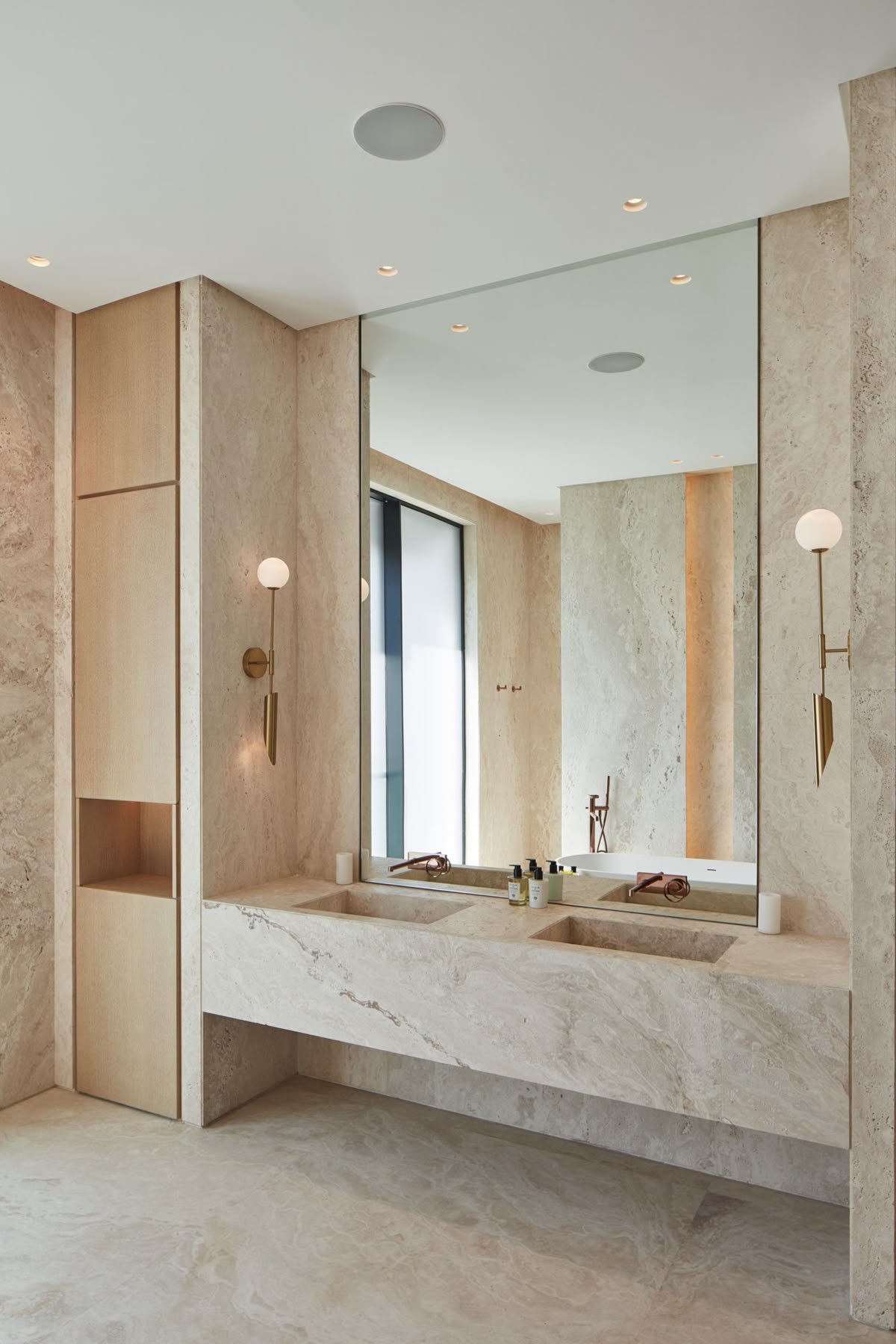
Moisture resistance affects more than the surface itself. Bathroom surface failure can lead to maintenance calls, tenant complaints, cabinet damage, wall damage, mould concerns, turnover delays, and lower perceived unit quality. If a vanity top fails around the sink, the cost may include labour, replacement material, cabinet repair, and lost leasing time.
Quartz helps reduce these risks because it offers low water absorption and stable surface performance. It does not remove the need for good installation, but it gives property teams a more durable starting point.
Sink Areas and Faucet Cut-Outs
Sink cut-outs and faucet holes are vulnerable points. Poor polishing, rough internal edges, weak sealing, and low-quality installation can create moisture problems even with good material. Quartz performs well when properly cut, polished, supported, and installed.
For premium apartments, edge details matter visually as well as functionally. Through-body and edge technology are increasingly important when developers want vanity tops and kitchen surfaces to look more realistic after fabrication. This article on through-body vein technology explains why deeper pattern continuity is becoming important for modern quartz aesthetics.
Cleaning Chemicals and Daily Use
Property teams use repeated cleaning routines. Surfaces must resist mild cleaners, soap residue, cosmetics, toothpaste, and water marks. Harsh chemicals should still be avoided, but Quartz is generally more forgiving than many coating-dependent materials.
Recommended Specification Checklist
For apartment vanity Quartz, buyers should request low water absorption data, suitable finish, proper edge polishing, sink cut-out quality, backsplash design, installation sealant guidance, cleaning instructions, replacement planning, and batch control records. These details look small on paper but become very large when multiplied by hundreds of apartments.
Cost Analysis: Initial Price vs Long-Term Property Value
Why Low Initial Cost Can Be Misleading
Engineered Marble may appear attractive because the initial cost can be lower. But multi-family buyers should compare total lifecycle cost, not only material price. A cheaper surface that stains, dulls, scratches, or slows turnover can become more expensive over the holding period of the property.
Quartz may cost more upfront, but it can reduce maintenance friction, replacement frequency, cleaning difficulty, and tenant complaint risk. In multi-family projects, the winning material is often the one that saves problems later, not the one that saves a little today.
Lifecycle Cost Factors
Developers should compare material cost, fabrication cost, installation cost, cleaning labour, repair frequency, replacement matching, tenant satisfaction, unit turnover time, warranty claims, and long-term rental positioning. A vanity surface affects more than the bathroom. It affects the property’s maintenance rhythm.
| Cost Factor | Engineered Marble | Quartz | Developer Impact |
|---|---|---|---|
| Initial Cost | Often lower | Medium to higher | Engineered Marble may win upfront |
| Maintenance | Medium | Lower | Quartz reduces property workload |
| Stain Risk | Higher if coating is damaged | Lower | Quartz supports tenant use |
| Replacement Matching | Supplier-dependent | Usually easier | Quartz supports future repairs |
| Turnover Speed | Can slow if damaged | Faster cleaning | Quartz helps operations |
Design and Market Trends in Multi-Family Quartz Surfaces
White and Light Grey Quartz for Clean Apartment Bathrooms
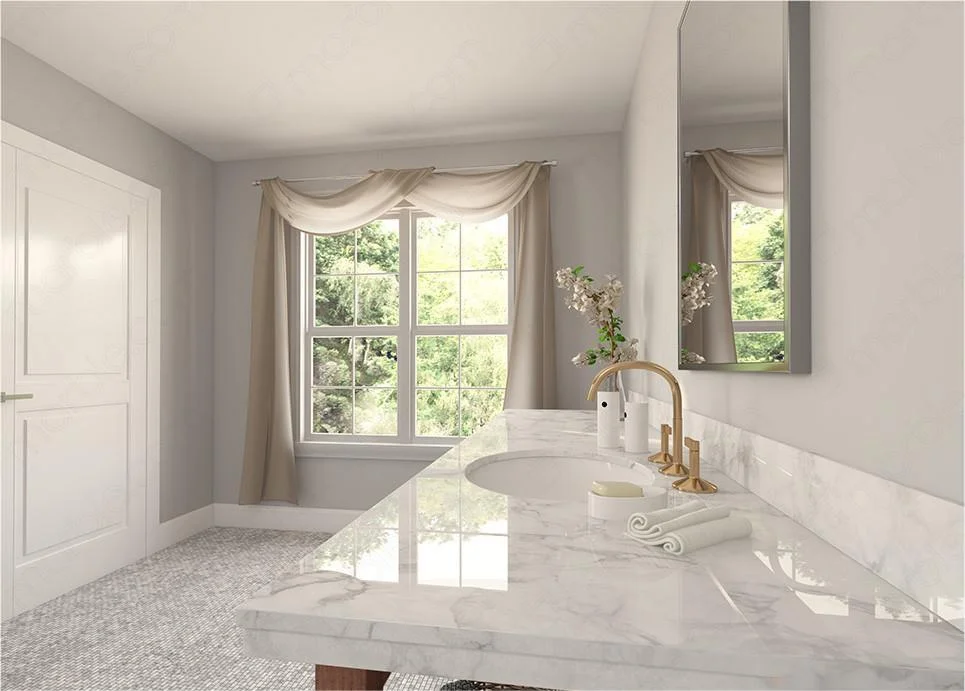
White and light grey Quartz remain popular because they make small bathrooms feel brighter and cleaner. They also photograph well for rental listings, which matters because many tenants now judge apartments online before visiting in person.
Marble-Look Quartz for Higher-End Units
Calacatta-style and subtle veined Quartz add premium appeal to Class A apartments and luxury rentals. Developers can create a marble-inspired bathroom or kitchen look without accepting the same level of maintenance sensitivity as natural or engineered marble surfaces.
Warm Neutral Quartz for Soft Modern Design
Beige, cream, warm grey, and soft taupe Quartz surfaces are becoming more common in 2026 multi-family design. They pair well with wood vanities, brushed nickel, champagne metal, matte black hardware, and warm lighting. These tones feel less cold than pure white while still supporting a clean apartment aesthetic.
Bulk Project Aesthetic Strategy
If the project targets budget apartments, choose simple, clean, consistent Quartz. If it targets mid-market apartments, choose light grey or soft white Quartz. If it targets luxury rentals, choose marble-look Quartz with stronger design depth. If the project is senior living or student housing, choose durable, easy-clean Quartz with subtle patterning and strong replacement support.
Compliance and Documentation for Apartment Projects
What Documents Buyers Should Request
Multi-family buyers should request technical data sheets, SDS documents, water absorption reports, stain resistance data, low-VOC documentation if required, NSF certificates if applicable, fabrication tolerance, packing lists, inspection photos, warranty terms, and project-specific order records.
Low-VOC and Indoor Air Quality
Multi-family buildings may require indoor air quality consideration, especially in projects targeting green building standards, long-term rental quality, or health-conscious buyers. Since Quartz contains resin binders, low-VOC documentation may be relevant depending on the project location and specification requirements.
Building Code and Project Specification
Countertop materials should align with project specifications, wet-area detailing, vanity design, accessibility requirements, fire or safety documentation where relevant, and installation standards. Project buyers should not treat vanity surfaces as simple decorative items. In multi-family bathrooms, they are part of the operational system.
| Document | Why It Matters | Buyer Risk If Missing |
|---|---|---|
| TDS | Confirms performance data | Weak specification |
| SDS | Safety and handling | Import or project documentation issue |
| Water Absorption Report | Supports moisture resistance | Bathroom risk |
| Low-VOC Report | Supports indoor air quality | Compliance concern |
| Inspection Photos | Confirms order quality | Delivery disputes |
Common Buyer Mistakes When Choosing Apartment Vanity Surfaces
Choosing Only by Initial Price
Initial price matters, but it should not be the only decision factor. A lower-cost surface can become expensive if it increases repairs, replacements, tenant complaints, or turnover delays.
Ignoring Moisture Resistance
Bathrooms are wet zones. Ignoring moisture resistance can lead to staining, surface damage, cabinet problems, and maintenance calls. Quartz provides a stronger safety margin for wet apartment vanity areas.
Choosing a Surface That Looks Good Only in the Sample Room
Some surfaces look excellent in a model unit but struggle after real tenant use. Developers should think beyond the opening presentation and evaluate what the surface will look like after one, three, or five leasing cycles.
Not Planning Bulk Replacement
Future replacements need colour and size consistency. If the supplier cannot support repeat orders or keep records, property teams may struggle to match damaged tops later.
Ignoring Supplier Production Capacity
Bulk apartment projects require reliable production capacity. Delays, inconsistent batches, poor cut-outs, and weak packaging can affect the construction schedule.
Not Checking Cut-Out and Edge Quality
Sink cut-outs and edges are where cheap fabrication shows quickly. Poor edge polishing can hurt both appearance and moisture performance. This is especially important for modern apartment projects where clean lines and easy maintenance matter.
For developers concerned about edge continuity and exposed details, this article on 3D Full Body Quartz vs surface printing explains why edge profile performance matters when comparing full-body quartz technology with surface-level printed designs.
Treating Quartz as Completely Maintenance-Free
Quartz is low maintenance, not zero maintenance. Harsh chemicals, extreme heat, poor installation, and careless use can still cause problems. Good suppliers should provide cleaning and care guidance for property teams.
How to Choose a Quartz Supplier for Multi-Family Projects
What a Reliable Quartz Supplier Should Provide
A reliable supplier should provide slab photos, sample support, colour consistency, standard and custom sizes, 2cm and 3cm thickness options, cut-to-size capability, sink cut-outs, faucet holes, backsplash options, side splash options, edge profiles, technical data sheets, water absorption data, low-VOC documentation if needed, packing photos, project inspection, export experience, bulk delivery planning, replacement support, and fast communication.
For buyers checking supplier background, production capability, and project experience, the Quartz manufacturer page can help evaluate whether the supplier is suitable for long-term apartment, vanity, and bulk surface projects. For quotation, samples, drawings, or multi-family project discussions, developers can contact a Quartz supplier with unit count, vanity sizes, thickness, finish, cut-out details, and delivery schedule.
Supplier Evaluation Scorecard
| Evaluation Factor | Weight | What to Check |
|---|---|---|
| Product Performance | 20% | Absorption, hardness, stain resistance |
| Bulk Supply Capacity | 20% | Quantity, schedule, repeat orders |
| Fabrication Support | 15% | Cut-outs, edges, backsplashes |
| Batch Consistency | 15% | Colour and pattern control |
| Documentation | 10% | TDS, SDS, low-VOC, reports |
| Packing Quality | 10% | Crates, protection, labels |
| Communication | 10% | Fast, accurate project support |
Practical Recommendation: Engineered Marble or Quartz for Multi-Family?
Choose Quartz If
Choose Quartz if the project needs moisture resistance, apartment vanity tops face daily tenant use, property managers want fewer maintenance calls, bulk supply consistency matters, replacement matching matters, mid-to-high-end rental positioning matters, or documentation support is needed.
Consider Engineered Marble If
Consider Engineered Marble if the project is very budget-sensitive, use intensity is low, lifecycle expectations are short, supplier quality is verified, and the maintenance team accepts higher surface risk. It can work, but the buyer should understand the performance trade-off.
Use Quartz as the Safer Default for Apartment Vanities
For multi-family bathrooms, Quartz is often the safer specification because it supports moisture resistance, batch consistency, easier cleaning, and long-term value. Developers buying in bulk should prioritise lower operational risk, not only lower purchase price. In rental housing, the cheapest surface is not always the lowest-cost surface. Sometimes it is just the first invoice wearing a disguise.
Final Recommendation: For Multi-Family Bathrooms, Quartz Wins on Operational Predictability
Engineered Marble can be useful for budget-driven projects, especially when the developer understands the limits and works with a reliable supplier. But for multi-family apartment vanity tops, Quartz usually delivers stronger long-term value. It offers low water absorption, better stain resistance, stronger durability, reliable colour consistency, and better support for bulk supply and replacement planning.
If the project involves hundreds of bathrooms, repeated tenant turnover, moisture exposure, and long-term property management, choose Quartz. If the surface must support a higher-end apartment image, choose modern Quartz colours, marble-look Quartz, or through-body vein technology. If the procurement team needs samples, bulk supply planning, and cut-to-size support, work with a supplier that understands multi-family project execution from slab selection to packing and replacement.
FAQ About Quartz and Engineered Marble for Multi-Family Projects
1. Is Quartz better than engineered marble for apartment vanity tops?
Yes, Quartz is usually better than engineered marble for apartment vanity tops in mid-to-high-use multi-family bathrooms. Quartz typically offers stronger hardness, lower water absorption, better stain resistance, easier cleaning, and more reliable long-term appearance. Engineered marble can work for budget-sensitive projects, but its performance depends heavily on surface coating, resin quality, and maintenance conditions.
2. Is Quartz moisture resistant?
Yes, quality Quartz is moisture resistant because it usually has very low water absorption compared with many other vanity surface materials. This makes it suitable for apartment bathrooms, vanity tops, and wet-area surfaces. However, proper fabrication and installation still matter. Sink cut-outs, faucet holes, backsplashes, seams, and sealant details should be handled correctly to prevent water-related problems.
3. Is engineered marble good for bathrooms?
Engineered marble can be good for bathrooms when the project is budget-sensitive, use intensity is moderate, and supplier quality is well controlled. It can provide a clean marble-like appearance for vanity tops. However, if the surface coating becomes scratched, dull, cracked, or chemically damaged, stain and moisture risks may increase. For heavy tenant use, Quartz is usually the safer option.
4. What countertop material is best for rental apartments?
Quartz is one of the best countertop and vanity top materials for rental apartments because it balances durability, low water absorption, stain resistance, easy cleaning, design consistency, and replacement planning. For property managers, Quartz can help reduce maintenance calls and speed up unit turnover. The best choice still depends on project budget, apartment positioning, usage intensity, and supplier support.
5. How do I order Quartz vanity tops in bulk?
To order Quartz vanity tops in bulk, prepare the unit count, vanity sizes, slab thickness, colour requirement, finish, sink cut-outs, faucet hole layout, backsplash and side splash details, edge profile, packing requirements, delivery schedule, inspection standard, and replacement quantity. Buyers should also request samples, batch control confirmation, water absorption data, low-VOC documentation if needed, packing photos, and supplier production capacity before confirming the order.
References
1. Engineered Stone Countertops: Material Properties and Fabrication Guidance, Natural Stone Institute, Technical Resource.
2. Multi-Family Housing Design and Construction Standards, National Apartment Association, Industry Resource.
3. Countertop Materials Performance and Maintenance Guide, National Kitchen & Bath Association, Design Resource.
4. Indoor Air Quality and Volatile Organic Compounds in Building Materials, U.S. Environmental Protection Agency, IAQ Resource.
5. Quartz Surfacing Material Specification Guidelines, International Surface Fabricators Association, Industry Guide.
6. Bathroom Design and Wet Area Material Selection, National Kitchen & Bath Association, Planning Guide.
7. Surface Materials for Multi-Family Housing: Durability and Maintenance Considerations, Building Design + Construction, Technical Review.
8. Engineered Stone Fabrication and Installation Manual, Stone World Technical Resource.
Strategic Insight: How Multi-Family Buyers Should Choose Between Engineered Marble and Quartz
What is the main difference? Engineered Marble is usually made from marble powder or stone powder mixed with resin and surface protection, while Quartz uses harder quartz minerals, resin binders, pigments, and additives. Quartz generally offers stronger hardness, lower water absorption, better stain resistance, and better long-term suitability for apartment vanity tops.
Why does moisture resistance matter? Apartment bathrooms face daily water splashing, humidity, soap, toothpaste, cosmetics, cleaning products, and tenant misuse. A moisture resistant quartz surface helps reduce bathroom maintenance risk, especially around sinks, faucet holes, seams, and backsplashes.
How should developers decide? If the project is low-budget and short-cycle, Engineered Marble may be considered. If the project needs long-term durability, bulk supply consistency, lower maintenance, replacement matching, and better tenant-use performance, Quartz is usually the safer specification.
What should buyers verify before bulk ordering? Buyers should confirm slab size, 2cm or 3cm thickness, vanity dimensions, sink cut-outs, faucet holes, backsplashes, side splashes, edge profiles, water absorption data, low-VOC documentation if required, packing method, inspection photos, and replacement support.
What mistakes should buyers avoid? Avoid choosing only by initial price, ignoring moisture resistance, approving only small samples, failing to plan replacement matching, overlooking supplier capacity, accepting poor cut-out quality, and treating Quartz as completely maintenance-free.


