
Introduction
Quartz edge profiles are more than just a decorative feature for countertops and commercial surfaces—they are critical to both the aesthetics and durability of the installation. Whether you are designing a high-end residential kitchen, a hotel bar, or a commercial workspace, the choice of edge profile directly impacts the longevity, safety, and visual harmony of the surface. In many projects, buyers underestimate the influence of edge design on installation complexity, maintenance requirements, and compliance with modern building codes.
For contractors, designers, and facility managers, understanding the nuances of 3D full body quartz edges versus surface printed quartz edges is essential. This article explores the differences, highlighting the strengths, limitations, and practical considerations of each approach. By integrating the latest industry standards and performance data, it provides a buyer-centric guide that helps you make informed decisions while minimizing common mistakes.
Understanding Quartz Edge Profiles
What Are Quartz Edge Profiles?
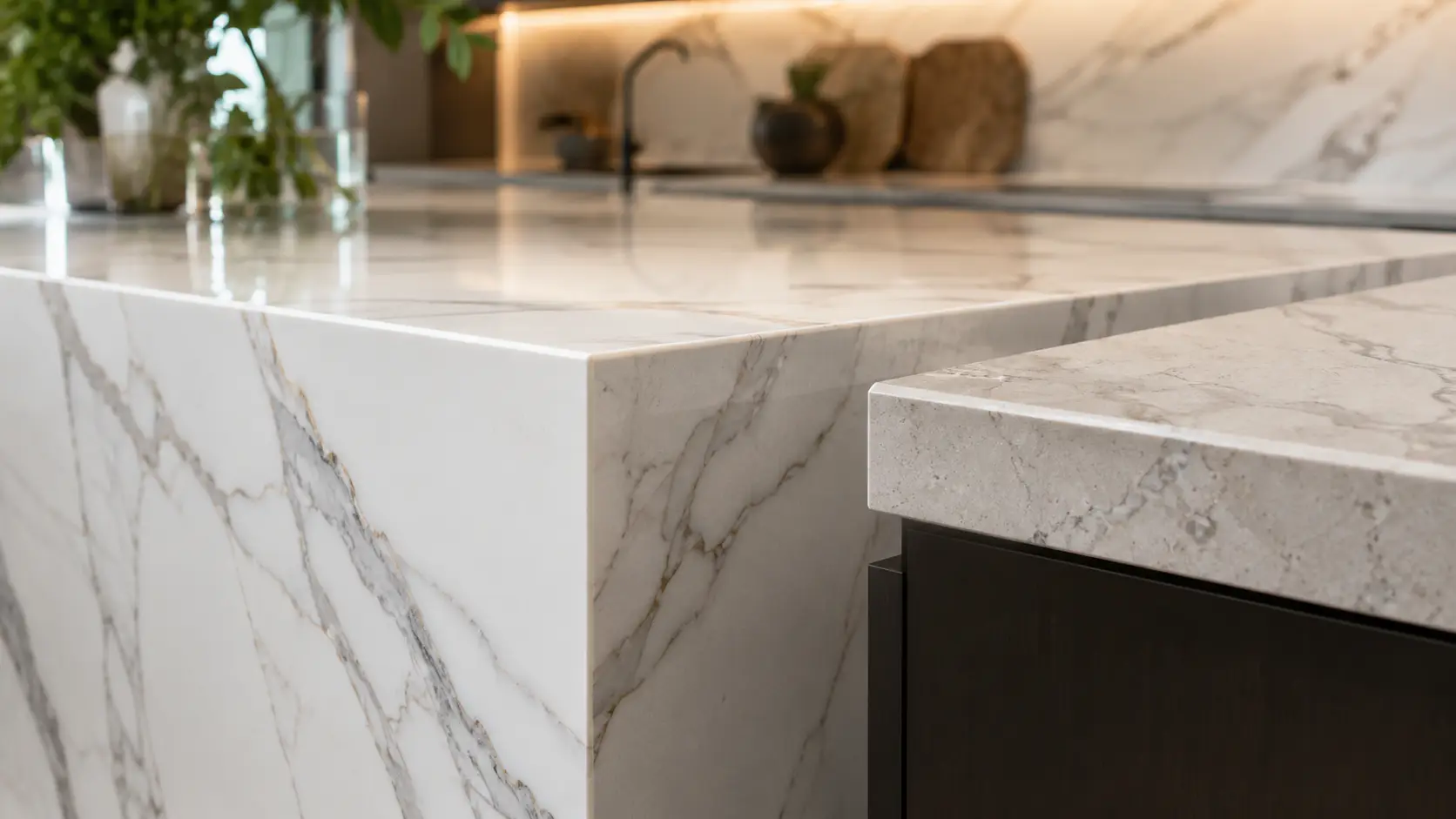
Quartz edge profiles refer to the contour or finish applied to the visible edges of quartz countertops and slabs. Common types include straight, beveled, bullnose, ogee, and 3D full body designs. While traditional quartz edges focus primarily on the surface layer, full body quartz edges extend the design and material consistency through the entire slab thickness. In contrast, surface printed quartz edges achieve decorative effects primarily through printed surface layers.
Edge profiles are not merely stylistic choices—they also influence structural integrity, resistance to chipping, and the ease of cleaning. Misalignment between design intent and material capability can lead to costly repairs, early wear, or aesthetic degradation over time.
Why Edge Profiles Matter for Projects
Edge profiles play a crucial role in both residential and commercial projects. In high-traffic environments such as restaurants, hotels, and office reception areas, poorly chosen edges are more susceptible to impact damage, chipping, or delamination. Residential kitchens and bathrooms also demand careful selection to prevent water infiltration and staining along edges.
Data from recent durability tests indicate that full body quartz edges consistently outperform surface printed edges in scratch resistance, edge chipping under impact, and long-term color retention. Projects with high aesthetic and functional requirements, such as luxury apartments or bespoke commercial installations, benefit from investing in edges that ensure both visual consistency and long-term performance.
3D Full Body Quartz Edges
Manufacturing Process
Full body quartz edges are produced by integrating the edge design directly into the entire slab. During manufacturing, natural quartz aggregates, resins, and pigments are combined under controlled pressure and temperature. The edge is shaped simultaneously with the slab, allowing veins, patterns, and coloration to continue seamlessly from the surface to the sides.
This method ensures a consistent appearance, reducing the risk of edge peeling or visible layer separation. For high-end projects, this consistency is critical, particularly when installing mitered corners, waterfall edges, or integrated sink cutouts.
Performance Advantages
Durability: Full body quartz edges exhibit exceptional resistance to scratches, chips, and cracks. Industry testing demonstrates that even under repeated impacts from standard kitchen utensils or minor dropping incidents, the edges retain structural integrity.
UV and Color Stability: Unlike surface printed edges, the color and pattern in full body quartz remain stable over time, resisting fading or yellowing, which is particularly important for sunlit areas or commercial display environments.
Installation Flexibility: The uniformity of full body quartz allows for more complex edge designs without compromising strength. Waterfall edges, curved contours, and multi-angle bevels are feasible without the risk of exposing weaker layers.
Maintenance Simplicity: Smooth full body quartz edges are easier to clean, and the integrated design prevents liquid penetration, reducing the likelihood of staining or mold growth in kitchens and bathrooms.
Potential Risks and Common Buyer Mistakes
Despite its advantages, buyers often make mistakes when selecting full body quartz edges:
- Mistake 1: Assuming all full body quartz edges are identical. Quality varies depending on quartz content, resin ratios, and manufacturing precision.
- Mistake 2: Underestimating installation complexity. Advanced edge profiles may require specialized tools or certified installers.
- Mistake 3: Overlooking project scale. Large islands or commercial installations demand precise handling and support to prevent stress fractures.
Decision Logic: If your project prioritizes long-term durability, complex edge designs, or high aesthetic requirements → choose 3D full body quartz edges. If the priority is primarily visual effect with lower usage intensity → surface printed may suffice.
Surface Printed Quartz Edges
Manufacturing Process
Surface printed quartz edges use a printed layer or veneer to create the desired appearance. While this technique can replicate natural stone patterns, the decorative layer often sits atop a core material, which may differ in hardness, color, or composition. The printing process allows for rapid pattern customization and can simulate exotic marble or designer motifs at a lower cost.
However, because the pattern is concentrated on the surface, the underlying material may be more susceptible to impact or abrasion, especially on exposed edges.
Performance Characteristics
Visual Advantages: Surface printed edges can replicate complex patterns or designer aesthetics, making them attractive for projects emphasizing immediate visual appeal.
Limitations: Compared to full body quartz, these edges are more prone to wear over time. Repeated cleaning with abrasive materials or minor impacts can damage the printed layer, revealing the base material underneath.
Project Suitability: Ideal for short-term projects, display counters, or areas where high durability is not the primary requirement.
Buyer Considerations
Common buyer mistakes include:
- Mistake 1: Selecting surface printed edges purely for cost savings without accounting for maintenance or durability.
- Mistake 2: Ignoring edge thickness and core consistency, which can affect lifespan and installation options.
- Mistake 3: Misunderstanding warranty coverage—some printed surfaces have limited protection against chipping or color fading.
Decision Logic: If the project prioritizes visual customization and lower upfront cost, and long-term wear is secondary → surface printed quartz edges may be appropriate. For high-traffic, high-end, or multi-year projects → consider full body quartz edges.
Full Body Quartz vs Surface Printed: Comparative Analysis
Performance Comparison Table for Quartz Edge Profiles
For buyers comparing different quartz edge profiles, the most important question is not only how the surface looks in a showroom, but how the edge performs after cutting, polishing, mitering, and long-term use. The table below shows the key practical differences between 3D Full Body Quartz and Surface Printed Quartz in project applications.
| Evaluation Factor | 3D Full Body Quartz | Surface Printed Quartz | Buyer Impact |
|---|---|---|---|
| Edge Pattern Continuity | Pattern effect continues deeper into the slab body | Pattern is mainly concentrated on the top printed layer | Full body quartz is safer for visible edges, mitered corners, and waterfall panels |
| Best Edge Applications | Mitered edge, waterfall edge, exposed side panels, thick countertops | Straight edge, eased edge, simple decorative surfaces | Choosing the wrong material may create visible mismatch after fabrication |
| Long-Term Visual Stability | More stable after polishing, edge wear, and minor refinishing | Printed effect may look weaker if the edge surface is scratched or over-polished | Full body quartz reduces the risk of complaints in premium projects |
| Fabrication Risk | More suitable for complex edge fabrication when processed correctly | Requires careful edge planning to avoid exposing the printed-layer limitation | Buyers should request finished edge samples before bulk ordering |
| Recommended Project Type | Luxury kitchens, hotels, apartments, commercial reception counters | Light-use residential surfaces, decorative displays, simple countertop layouts | Project type should decide the material system before edge style is finalized |
Durability & Hardness Comparison
When comparing 3D full body quartz edges with surface printed edges, durability is the most critical factor for both residential and commercial buyers. Full body quartz edges maintain uniform hardness throughout the slab, typically rating 7–8 on the Mohs scale, making them highly resistant to scratches, chipping, and daily wear. Surface printed edges, while visually appealing, concentrate durability only in the core quartz layer, leaving the printed surface more vulnerable to abrasion or impact damage.
Data from recent laboratory tests indicate that full body edges withstand up to 30% more impact force than printed edges before exhibiting visible damage. For commercial kitchens, hotel countertops, and high-traffic public areas, this difference directly translates into reduced maintenance costs, fewer repairs, and longer project lifespan.
Design & Customization Options
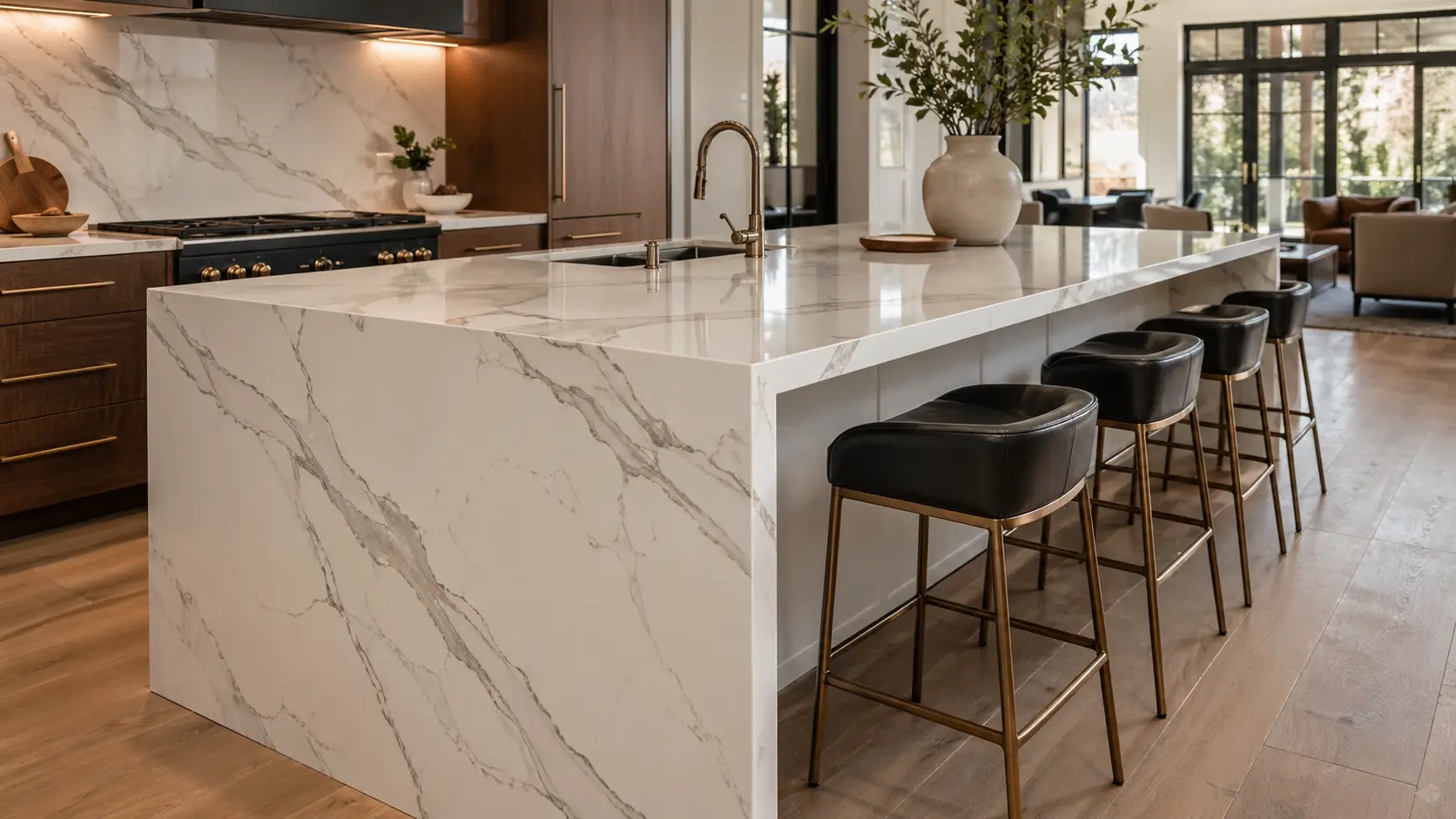
Full body quartz edges offer extensive design flexibility. Vein patterns, 3D textures, and waterfall edges can be executed without compromising structural integrity. Book-matched slabs, mitered corners, and multi-angle bevels are fully achievable, allowing designers to match high-end aesthetic expectations.
Surface printed edges excel in visual customization for projects where pattern replication is the primary concern. They can mimic rare marbles, exotic stones, or designer motifs with precision. However, these edges are less adaptable for complex edge shaping or integrated sink cutouts.
Decision Insight: For projects requiring complex, long-term, and visually seamless edges, full body quartz is the safer choice. For projects prioritizing rapid visual impact and budget efficiency, surface printed edges can be a viable option.
Installation & Maintenance
Installation complexity varies significantly between edge types. Full body quartz edges require skilled installers familiar with heavy slabs and precise edge alignment to avoid stress fractures or misalignment. Surface printed edges are easier to handle but demand careful surface protection during installation to prevent printed layer damage.
Maintenance practices differ as well: full body edges are simpler to clean, resist staining, and maintain color consistency, while printed edges may require specialized cleaners to preserve the printed design. Ignoring these considerations can lead to premature wear or aesthetic degradation.
Tip for Buyers: Always request installation guidance and recommended maintenance from the supplier. If long-term durability is a priority → full body quartz with professional installation is recommended.
Regulatory & Industry Trends
Recent changes in building codes and environmental standards are influencing quartz edge selection. Many regions now enforce low-emission resins, formaldehyde limits, and fire resistance standards for countertop materials. Full body quartz edges typically comply with these updated regulations due to controlled manufacturing processes, while surface printed edges require careful verification to ensure the printed layers meet compliance standards.
Industry trends highlight growing adoption of full body quartz in luxury residential kitchens, hospitality projects, and commercial workspaces, driven by increased demand for durability, sustainability, and regulatory compliance. Surface printed quartz remains popular in mid-range projects where aesthetics are prioritized over long-term resilience.
Data Insight: A 2025 market report showed a 35% increase in full body quartz edge adoption in high-end projects compared to 2019, largely due to durability and regulatory compliance considerations.
Regulatory and Market Signals Affecting Quartz Edge Profile Decisions
The quartz surface industry is moving toward safer fabrication, stronger documentation, and lower-risk material selection. For buyers, this means edge profile decisions are no longer only about appearance. Complex edges require more cutting and polishing, which makes fabrication safety, dust control, and supplier documentation more important in project procurement.
| Market / Regulatory Signal | What Is Changing | Impact on Quartz Edge Profiles | Buyer Recommendation |
|---|---|---|---|
| Silica Dust Regulation | Fabrication shops face stricter expectations for respirable crystalline silica exposure control | Complex edge profiles, cutouts, and mitered work increase processing steps | Work with suppliers and fabricators that can provide safety and processing guidance |
| Australia Engineered Stone Ban | Australia banned the use, supply, and manufacture of engineered stone benchtops, panels, and slabs from 1 July 2024 | Global buyers are paying more attention to silica content, fabrication risk, and alternative surface materials | Check target-market compliance before selecting quartz for international projects |
| Demand for Premium Stone-Like Surfaces | Designers increasingly prefer surfaces that combine natural visual depth with predictable performance | Visible edge continuity becomes more important in waterfall islands and slab-style interiors | Use 3D Full Body Quartz when edge exposure is part of the design language |
| Commercial Fit-Out Risk Control | Hotels, apartments, and retail projects need fewer callbacks, easier maintenance, and stable handover quality | Poor edge continuity may cause complaints even when the top surface looks acceptable | Approve finished edge samples, not only flat slab samples |
Recommendations for Buyers
Choosing the right quartz edge profiles should not start from a showroom photo alone. The real performance of a quartz surface becomes visible after cutting, polishing, mitering, and installation. For buyers working on kitchen countertops, hotel bars, apartment projects, or commercial reception counters, the edge is often where material quality, fabrication accuracy, and long-term design value are truly tested.
Start with the Project Type
Residential kitchens, hospitality interiors, commercial counters, and apartment projects do not place the same demands on quartz surfaces. A private kitchen may only need a clean eased edge or bevel edge for daily cooking and cleaning. A hotel bar, retail counter, or office reception desk will face heavier traffic, more frequent cleaning, and greater visual exposure. In these higher-use spaces, 3D Full Body Quartz is usually a more reliable choice because the edge profile can maintain stronger pattern continuity after fabrication.
Check How Visible the Edge Will Be
If the edge is barely visible, Surface Printed Quartz may still perform well in many decorative or light-use applications. But if the design includes waterfall islands, mitered corners, thickened countertops, exposed side panels, or integrated sink cutouts, the edge becomes part of the main design language. In these cases, buyers should not only ask whether the top surface looks attractive. They should confirm whether the side profile still looks natural after cutting and polishing.
Match the Material to Usage Intensity
Usage intensity has a direct impact on long-term performance. Hotel counters, restaurant surfaces, multifamily apartment kitchens, and commercial worktops are cleaned and touched far more often than low-use residential surfaces. A surface printed pattern may look strong at first, but repeated cleaning, edge contact, and small impacts can expose weaknesses over time. For projects where durability, maintenance control, and long service life matter, full body quartz edges are generally the safer option.
Do Not Judge the Slab by the Top Surface Only
One of the most common buyer mistakes is approving a quartz slab based only on a small top-surface sample. This can be risky because the top surface does not always show how the edge will look after fabrication. Before confirming a bulk order, buyers should request finished edge samples, mitered corner photos, slab cross-section details, polishing quality checks, and real project references. These details help reduce the risk of visible edge mismatch after installation.
Consider Long-Term Maintenance and Rework Risk
A lower initial material cost does not always mean a lower project cost. If an exposed edge looks disconnected, wears faster, or requires replacement after installation, the final cost may become much higher than expected. This is especially true in hotel, apartment, retail, and commercial fit-out projects, where rework can affect handover schedules and client satisfaction. Buyers should evaluate quartz edge profiles based on lifecycle performance, not only the first quotation.
Choose the Material System Before Choosing the Edge Style
The smarter approach is to decide whether the project needs deep body consistency before finalizing the edge profile. If the project uses simple straight edges and the side view is not a design focus, Surface Printed Quartz may be enough. If the project requires visible edges, mitered corners, waterfall panels, or premium stone-like detailing, 3D Full Body Quartz is usually the stronger choice. MIYA STONE can support project buyers with sample review, edge profile suggestions, and application-based material selection before production.
Case Studies / Real-World Applications
High-End Residential Kitchen Islands
A luxury apartment renovation used 3D full body quartz edges for waterfall islands. The full body continuity allowed seamless mitered corners and durable surfaces resistant to daily use. The result: consistent visual effect and zero edge damage after two years.
Hotel Bar and Restaurant Counters
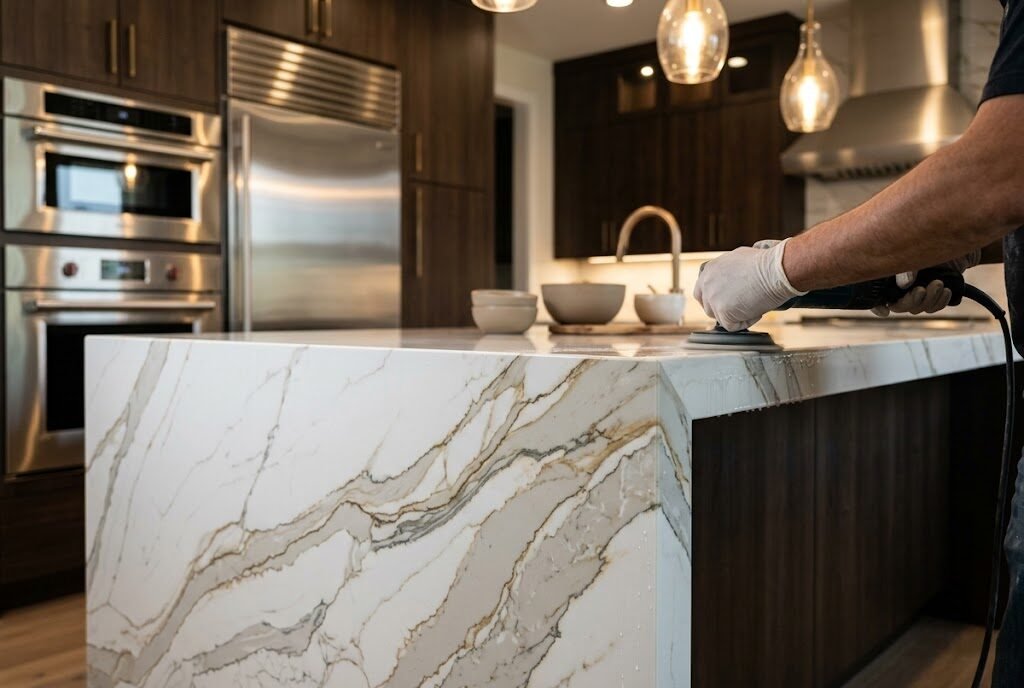
Surface printed quartz edges were selected for aesthetic replication of rare marble. The edges achieved the desired visual effect at a lower cost, but careful handling and protective maintenance were required to avoid printed layer wear in high-traffic zones.
Office Reception Areas
Full body quartz edges ensured long-lasting durability in corporate lobbies with heavy foot traffic and frequent cleaning. The edges maintained visual appeal and structural integrity for over three years without significant maintenance.
Frequently Asked Questions
1. What are quartz edge profiles?
Quartz edge profiles refer to the finished shape and contour applied to the exposed edges of quartz countertops, vanity tops, island panels, backsplashes, and commercial surfaces. Common quartz edge profiles include straight edge, eased edge, bevel edge, bullnose, half bullnose, ogee, mitered edge, and waterfall edge. For buyers, the edge profile is not only a design detail. It affects durability, cleaning convenience, fabrication complexity, installation risk, and the final visual quality of the project.
2. Why do quartz edge profiles become a problem with surface printed quartz?
Surface printed quartz can look beautiful on the top surface, but the edge area may expose the limitation of the printing process. When the printed design does not continue through the slab body, mitered edges, thickened edges, sink cutouts, and waterfall panels may show visual breaks or weaker pattern continuity. This is why some buyers discover the “edge problem” only after fabrication. For high-end kitchens, hotel counters, and luxury apartment projects, this mismatch can reduce the perceived quality of the entire installation.
3. How is 3D full body quartz different from surface printed quartz?
3D full body quartz is designed so the color, texture, or vein effect continues deeper through the slab body, making the edge profile look more natural after cutting, shaping, and polishing. Surface printed quartz mainly relies on a decorative top layer, so the edge may not show the same depth or pattern continuity. If the project requires visible edges, waterfall islands, thick countertops, or complex profiles, 3D full body quartz usually provides a more convincing and durable result.
4. Which quartz edge profile is best for kitchen countertops?
For most modern kitchen countertops, eased edge, bevel edge, and mitered edge are practical choices because they balance appearance, safety, and cleaning convenience. A mitered edge is often preferred for luxury islands because it creates a thicker, more architectural look. However, if a mitered edge is used with surface printed quartz, buyers should check whether the side appearance matches the top surface. For a more seamless result, 3D full body quartz is generally the safer choice.
5. Are 3D full body quartz edge profiles more durable?
In most high-use applications, 3D full body quartz edge profiles offer better long-term visual durability because the pattern is not limited to a thin surface layer. Even after edge polishing, minor wear, or future refinishing, the edge can maintain a more consistent appearance. This does not mean every full body quartz product is automatically superior, because resin quality, quartz content, fabrication precision, and polishing technique still matter. Buyers should always request samples, edge photos, and fabrication details before placing a bulk order.
6. Can surface printed quartz still be used for edge profiles?
Yes, surface printed quartz can still be used successfully when the edge profile is simple and the project does not require deep pattern continuity. It can work well for straight edges, light-duty residential use, decorative surfaces, or projects where the top visual effect is more important than the side view. The risk increases when buyers choose thick edges, waterfall designs, exposed side panels, or complex fabrication without checking how the printed pattern behaves after cutting.
7. What mistakes should buyers avoid when choosing quartz edge profiles?
The most common mistake is choosing quartz only by looking at the top surface sample and ignoring the edge after fabrication. Buyers should also avoid selecting complex profiles without confirming slab structure, installer capability, polishing quality, and pattern continuity. Another mistake is assuming that all quartz slabs perform the same. For projects where edge visibility matters, a small sample is not enough. Buyers should request finished edge samples, mitered corner photos, and real project references.
8. Which option is better for commercial projects: 3D full body quartz or surface printing?
For commercial projects such as hotel bars, apartment kitchens, retail counters, office reception desks, and restaurant surfaces, 3D full body quartz is usually the stronger option when durability, repeated cleaning, and premium appearance are important. Surface printed quartz may be suitable for decorative or lower-impact areas where cost control and visual variety matter more. The better choice depends on the usage intensity, edge visibility, expected service life, and whether the buyer wants a premium stone-like finish after fabrication.
Final Insight: The Edge Is Where Quartz Quality Becomes Visible
The real issue is not only the edge shape. In countertop fabrication, the edge is often where a quartz slab proves its quality. A surface may look convincing from the top, but once it is cut, polished, mitered, or used as a waterfall panel, the side profile can reveal whether the pattern has real depth or only sits on the surface.
Full-body design performs better when the edge is part of the design. 3D Full Body Quartz is more suitable for waterfall islands, thick countertops, exposed side panels, hotel bars, apartment kitchens, and premium commercial counters because the visual effect does not rely only on a printed top layer. After fabrication, the finished edge is more likely to look connected, natural, and intentional.
Surface Printed Quartz still has a practical place. It can work well for simple straight edges, light-use residential surfaces, decorative panels, and projects where the top view matters more than the side profile. The problem begins when buyers use surface printed quartz for edge-heavy designs without checking how the pattern behaves after cutting and polishing.
Buyers should match the material system to edge visibility. When the project includes mitered corners, waterfall edges, visible returns, sink cutouts, or premium stone-like detailing, 3D Full Body Quartz is usually the safer choice. When the project uses basic edge profiles and the side view is not a major design focus, Surface Printed Quartz may be enough. The smarter decision depends on traffic level, fabrication complexity, cleaning frequency, and expected service life.
Sample approval should go beyond the top surface. Before placing a bulk order, buyers should ask for finished edge samples, mitered corner photos, slab cross-section details, polishing quality checks, and real project references. This is especially important for contractors, designers, distributors, and commercial buyers who cannot afford visible edge mismatch after installation.
The market is moving toward materials that reduce project risk. In hotel, apartment, retail, and commercial fit-out projects, buyers are paying more attention to fabrication safety, long-term durability, supplier documentation, and low-maintenance performance. A quartz product that looks good on a small sample but fails at the edge can create rework, complaints, and unnecessary replacement costs.
Practical recommendation: Choose the quartz material system before finalizing the edge style. If the edge will be seen, touched, cleaned frequently, or used as part of the design language, pattern continuity should be treated as a purchase requirement, not a decorative bonus. For project buyers seeking a more reliable result, MIYA STONE can help review edge profile options, sample details, and application suitability before bulk production.


