
Quick Summary
Vietnam is becoming a stronger engineered stone production base because buyers are looking for supply chain flexibility, stable quartz manufacturing, project-ready fabrication, and clearer export documentation. A reliable Vietnam Quartz Factory should be able to support slab production, color consistency, countertop processing, packing control, and project communication.
For U.S. apartment, hotel, kitchen, and bathroom projects, the best factory is not simply the cheapest one. The better choice is a manufacturer that understands quality quartz manufacturing, batch control, cut-to-size countertops, safety expectations, and the documentation requirements of international trade.
Vietnam is no longer viewed only as an alternative sourcing destination for basic stone products. For many U.S. buyers, contractors, distributors, and project developers, Vietnam is becoming a serious manufacturing base for engineered quartz slabs, prefab countertops, bathroom vanity tops, and project-ready stone surfaces. The shift is not driven by price alone. It is being shaped by supply chain diversification, stronger export manufacturing, changing import policies, and rising expectations for quality control.
For buyers searching for a reliable Vietnam Quartz Factory, the real question is no longer “Can this supplier make quartz slabs?” A better question is: can the factory support consistent engineered stone production, stable batch color, countertop fabrication, responsible packing, clear documentation, and project-based delivery for the U.S. market?
This article explains why Vietnam is becoming an important hub for high-end engineered stone production, how the Southeast Asian stone supply chain is changing, what separates quality quartz manufacturing from basic stone processing, and how buyers can evaluate a Vietnam-based quartz factory before placing a project order.
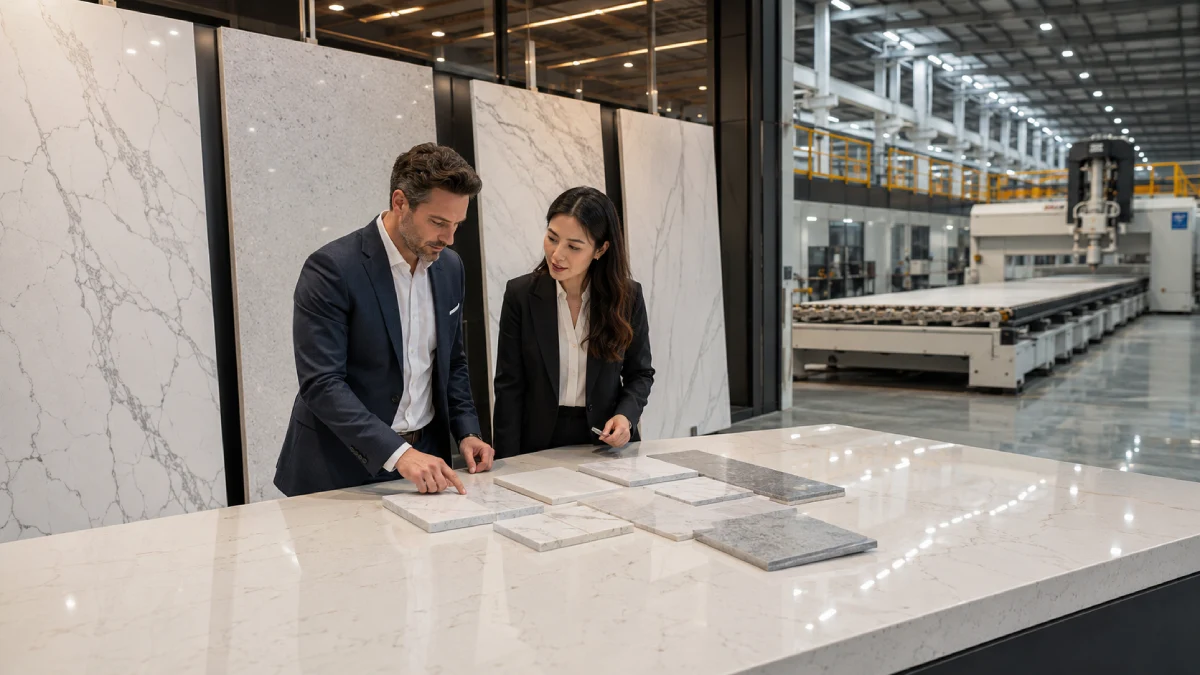
Why Global Buyers Are Shifting Attention to Vietnam Quartz Manufacturing
The global engineered stone market is changing because buyers want more than attractive quartz colors. They want production stability, supply chain security, and better risk control. In recent years, U.S. buyers have paid closer attention to Vietnam as a manufacturing base because the country sits inside a fast-growing Southeast Asian production network and has become increasingly important in export-oriented industries.
For the stone industry, this matters because quartz surfaces are not simple commodity products. A quartz slab may look clean in a catalog, but real project buyers need to know whether the factory can repeat the same color, maintain thickness accuracy, control surface finish, protect pieces during shipping, and provide documents that match the order. This is where Vietnam’s engineered stone sector is becoming more relevant.
Supply chain diversification is reshaping stone sourcing
Many U.S. buyers are reducing dependence on a single sourcing country. The reason is not only cost. It is also about import policy, delivery risk, lead time pressure, and customer expectations. When a project involves hundreds of apartment kitchens or hotel bathrooms, one delay can affect installation schedules, contractor coordination, and final delivery.
Vietnam has become more visible because it offers a practical balance of manufacturing capacity and export access. For stone buyers, the country is increasingly associated with engineered quartz slabs, cut-to-size surfaces, bathroom vanity tops, and countertop project support. A strong Vietnam engineered stone factory can become part of a buyer’s long-term sourcing strategy, especially when the buyer needs supply stability for repeated projects.
Vietnam is moving from basic processing to higher-value manufacturing
The old view of Vietnam as only a low-cost processing base is becoming outdated. In engineered stone, the higher-value work includes raw material selection, resin formulation, pigment control, vacuum pressing, curing, calibration, polishing, fabrication, packing, and export documentation. These steps require process discipline, not just labor.
High-end quartz manufacturing is not about producing one good-looking sample. It is about producing many slabs that remain consistent across a project. That difference is important for U.S. apartment and hotel buyers. A single kitchen countertop can tolerate more variation than a 300-unit apartment project. A hotel bathroom program requires repeated vanity tops, accurate sink openings, stable colors, and reliable packing. That is why buyers are now looking more closely at the actual factory process behind each quotation.
U.S. project buyers need factories, not only traders
Trading companies can be useful for sourcing, but they do not always control production. For project buyers, that can create risk. If there is a color issue, a thickness issue, a broken piece, or a documentation question, the buyer needs a supplier that can trace the problem back to the production process. A real quartz countertop factory Vietnam should be able to explain how the slabs are produced, how batches are controlled, how pieces are fabricated, and how goods are packed before shipment.
For U.S. buyers, this is not a small detail. Import policy, origin transparency, and product descriptions are becoming more important. A factory that understands documentation and production traceability gives buyers more confidence than a supplier that only sends attractive photos and a low quote.
The Regulatory Push: Why Compliance Is Changing Engineered Stone Production
Regulation is now one of the biggest forces shaping the engineered stone industry. Buyers are not only comparing color, thickness, and price. They are also looking at import risk, origin documentation, silica safety, and responsible manufacturing practices. This does not mean engineered quartz will disappear. It means the market is moving toward better-controlled production and clearer supplier accountability.
U.S. quartz surface product investigations are raising the bar
In 2026, the U.S. International Trade Commission addressed quartz surface products through a global safeguard investigation. The investigation covered quartz surface products, including slabs and fabricated quartz surface products. The remedy recommendation included a four-year tariff-rate quota structure, with a recommended first-year in-quota tariff rate of 25 percent and an above-quota tariff rate of 40 percent.
For buyers, this signals a more serious trade environment. It does not mean every quartz import is risky, but it does mean that sourcing decisions should be more disciplined. Buyers should understand where the goods are produced, what type of product is being imported, whether the description matches the shipment, and whether the supplier can provide accurate commercial and origin-related documents.
This is one reason a serious Vietnam Quartz Factory can be more valuable than a low-price supplier with unclear sourcing. When the trade environment becomes stricter, factory transparency becomes part of the product value.
Silica safety is forcing factories to improve production practices
Engineered stone production and fabrication also face stronger attention because of respirable crystalline silica exposure. OSHA and NIOSH have continued to warn that workers involved in countertop manufacturing, finishing, cutting, grinding, drilling, and installation can face silica exposure if control measures are weak.
This issue is especially relevant to engineered stone because quartz-based surfaces can contain significant crystalline silica. High-end manufacturing is no longer only about appearance. It also involves safer processing awareness, dust control, wet methods where appropriate, ventilation, worker protection, and responsible fabrication procedures.
For buyers, this creates a practical supplier question: does the factory understand modern production safety expectations? A buyer does not need to audit every internal process personally, but a professional supplier should be able to discuss fabrication methods, dust-control awareness, quality inspection, and responsible production standards in a clear way.
Australia’s engineered stone import ban shows where the industry is heading
Australia’s restrictions on engineered stone benchtops, panels, and slabs show how global markets are becoming more sensitive to engineered stone safety. From 2025, engineered stone benchtops, panels, and slabs became prohibited imports under Australian import controls. This has pushed the global industry to pay more attention to silica content, alternative materials, safety controls, and responsible sourcing.
The important lesson is not that buyers should avoid all quartz products. The lesson is that product compliance, material transparency, and manufacturing responsibility are becoming part of the sourcing conversation. For a high-end Vietnam quartz manufacturer, the future competitive edge will not come from price alone. It will come from quality, process control, documentation, lower-risk product development, and the ability to serve professional project buyers.
What Makes a Vietnam Quartz Factory Suitable for High-End Production?
Not every factory that makes quartz slabs is suitable for high-end engineered stone production. A reliable factory needs more than machines. It needs a controlled process from raw materials to packing. This section explains the production factors that matter most for buyers evaluating quality quartz manufacturing.
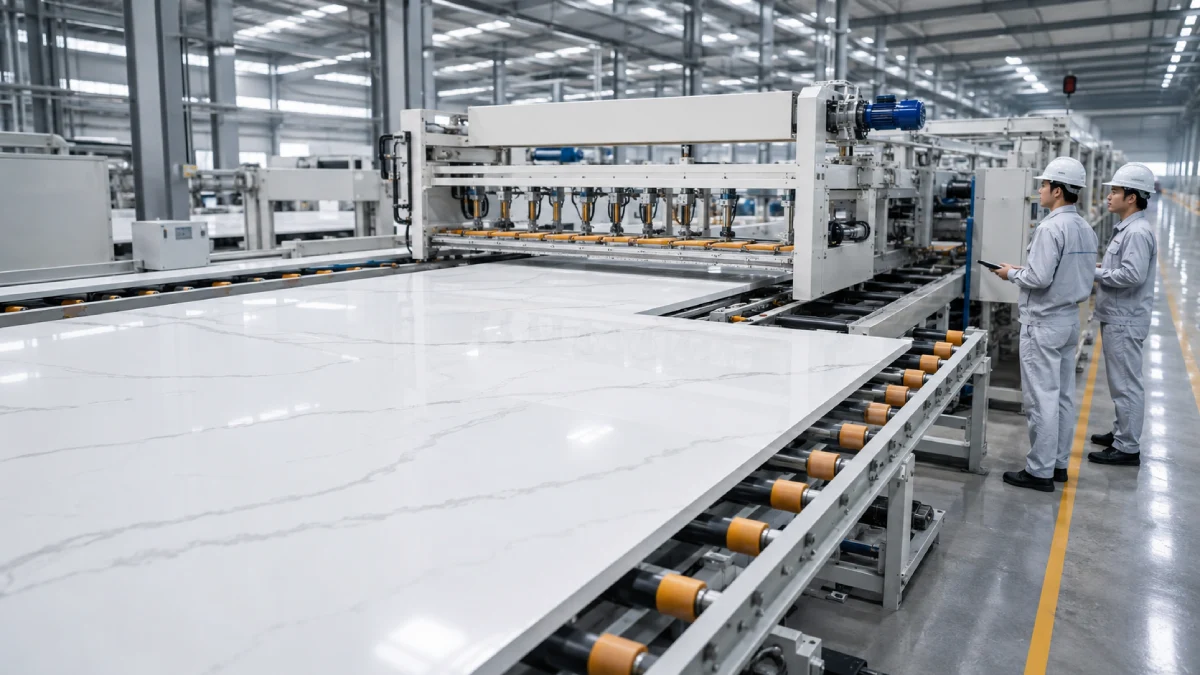
1. Controlled raw material selection
Quartz quality begins before the slab is pressed. The factory must control quartz aggregates, fillers, resin, pigments, and additives. The particle size distribution affects texture, compactness, and visual consistency. Resin quality affects bonding, surface stability, and long-term performance. Pigment stability affects whether the slab color can remain consistent from one batch to another.
For high-end engineered stone production, raw materials should not be treated casually. A factory that changes materials only to chase a lower cost can create problems in the final product. Buyers may see inconsistent color, weak surface appearance, poor polish, higher defect rates, or unstable performance during fabrication.
This is why serious buyers should ask how the factory controls raw materials. A professional Vietnam quartz slab factory should be able to explain its material selection process and how it keeps production stable for repeated orders.
2. Vacuum pressing and slab density control
Vacuum pressing is one of the key processes in engineered quartz manufacturing. The purpose is to reduce voids, improve density, and create a more stable slab structure. A dense slab is usually easier to polish, easier to fabricate, and better suited for kitchen and bathroom countertop applications.
If pressing control is weak, slabs may have hidden pores, surface defects, weak edges, or inconsistent internal structure. These issues may not always appear in a small sample. They may become visible during cutting, polishing, transportation, or installation.
For buyers sourcing quartz slabs for U.S. projects, density control matters because it affects downstream fabrication. A good-looking slab is not enough. The slab must also behave consistently when cut, edged, drilled, packed, and installed.
3. Slab calibration and thickness accuracy
Thickness accuracy is critical in project supply. Apartment countertops, kitchen islands, bathroom vanity tops, backsplashes, and hotel surfaces often require consistent thickness across many pieces. If slab thickness varies too much, fabrication becomes harder. Edge profiles may look uneven. Installation may require adjustment. Seams may become less clean.
For U.S. buyers, this is especially important in multi-unit projects. A small tolerance issue repeated across many rooms can become a major installation problem. A high-end factory should have calibration control and inspection procedures to reduce these risks.
Buyers should ask whether the factory can maintain consistent slab thickness and whether inspection records are available for project orders. This is a basic but powerful way to separate professional manufacturing from casual production.
4. Polishing quality and surface finish
Quartz surfaces are judged by the eye and by touch. A high-end engineered stone slab should have a stable gloss level, clean surface reflection, uniform polish, and minimal visible defects. Poor polishing can create cloudy areas, uneven shine, surface waves, or small imperfections that become obvious under kitchen or hotel lighting.
For buyers sourcing Calacatta quartz countertops, pure white quartz, Carrara quartz, or light grey quartz, the surface finish must be carefully reviewed. Light colors can reveal defects more easily. Gloss inconsistency can become visible when slabs are installed under strong lighting.
Buyers should not rely only on small samples. They should review full slab photos, production batch images, and pre-shipment inspection photos whenever possible. For high-end projects, the surface finish is not a minor detail. It is part of the perceived value of the interior.
5. Color matching and batch consistency
Color consistency is one of the most important factors in quality quartz manufacturing. A single approved sample does not guarantee that the full order will match. This is especially true for white quartz, marble-look quartz, grey quartz, beige quartz, and veined quartz designs.
In apartment projects, inconsistent color can make units look uneven. In hotel projects, inconsistent vanity tops can damage the design standard of the property. In kitchen projects, visible color differences between island tops, perimeter countertops, and backsplashes can create complaints after installation.
A reliable factory should manage batch grouping, sample confirmation, production photo review, slab matching, and pre-shipment inspection. Buyers should ask how the factory controls repeat colors and whether it can group slabs by project, building, room type, or unit schedule.
6. Fabrication capability for project countertops
High-end engineered stone production does not stop at slab manufacturing. Many U.S. buyers need fabricated or semi-fabricated products such as prefab quartz countertops Vietnam, bathroom vanity tops, kitchen countertops, backsplash pieces, sink cutouts, edge profiles, and hotel bathroom surface packages.
Fabrication capability is especially important when the buyer wants to reduce U.S. labor and speed up project installation. If the factory can provide accurate cut-to-size countertops, buyers may reduce handling steps after import. However, this only works if the factory understands drawings, tolerances, packaging, labeling, and inspection.
For hotel and apartment projects, fabrication errors are expensive. A wrong sink opening, wrong edge detail, or wrong size can delay installation. A good quartz countertop factory Vietnam should review drawings carefully before production and confirm fabrication details before cutting.
7. Export packing and project labeling
Packing is where many quartz orders succeed or fail. Heavy slabs and finished countertops are vulnerable to edge damage, corner chipping, surface scratching, and breakage during loading, ocean transport, unloading, and jobsite handling.
Project packaging should be planned by product type. Slabs may need strong A-frame support. Vanity tops may need reinforced wooden crates and cutout protection. Kitchen countertops may need piece-by-piece separation, corner protection, and clear labels. Apartment projects may require labels by unit, room, floor, or installation sequence.
A professional factory treats packing as part of the production process, not as an afterthought. Buyers should request packing photos, crate details, labeling plans, and loading photos before shipment. Strong packing can protect profit. Weak packing can destroy it.
Vietnam vs Other Southeast Asian Stone Manufacturing Bases
The phrase Southeast Asian stone covers many different countries, production models, and product categories. It would be too simple to say one country is always better than another. The better question is: which country and factory model fits the product you are sourcing?
Vietnam’s advantage in engineered quartz production
Vietnam’s advantage is strongest when buyers are looking for engineered stone production, quartz slab supply, fabricated countertops, and export-oriented project support. The country has developed a manufacturing base that can serve international buyers, and its export economy has become closely connected with U.S. demand.
For quartz countertops, Vietnam is attractive because buyers can find factories that support slabs, finished surfaces, custom sizes, and project packaging. This makes it relevant for apartment developers, hotel contractors, countertop distributors, cabinet companies, and wholesale surface buyers.
Where other Southeast Asian stone markets still compete
Other Southeast Asian countries may still compete strongly in natural stone, local quarry materials, low-complexity processing, regional distribution, or certain labor-intensive fabrication categories. Some markets may offer advantages in granite, marble, or local construction stone. Others may be suitable for simpler orders where customization is limited.
For buyers, the point is not to choose a country based on reputation alone. The right sourcing decision should begin with the product type. Natural stone, engineered quartz, porcelain surfaces, prefab countertops, and hotel vanity tops all have different factory requirements.
Why buyers should compare by product type, not country name
A strong sourcing strategy does not start with “Which country is cheapest?” It starts with “What exactly do we need?” If the project needs quartz slabs, the buyer should compare slab production. If the project needs kitchen countertops, the buyer should compare fabrication support. If the project needs hotel bathroom vanity tops, the buyer should compare cutout accuracy, edge finishing, packing, and batch consistency.
This is where Vietnam is becoming more important. For high-end engineered quartz, the country offers a useful combination of manufacturing capability, export experience, and project-oriented supply. But buyers still need to evaluate each factory carefully.
High-End Engineered Stone Applications Vietnam Factories Can Support
Engineered quartz is popular because it can support many interior applications while offering consistent design, easier maintenance, and project repeatability. A strong Vietnam quartz factory should be able to support several high-value application categories.
Apartment countertops
Apartment countertops require durability, color consistency, and repeatable dimensions. Multi-unit housing projects often use repeated kitchen and bathroom layouts, which makes factory coordination essential. If the same countertop size appears across many units, the supplier must keep dimensions, color, thickness, and packing consistent.
Pure white quartz, warm white quartz, light grey quartz, and Carrara-style quartz are often suitable for apartment projects because they work with many cabinet colors and help small rooms feel brighter. For developers, the goal is usually not the most dramatic design. The goal is a clean, durable, repeatable surface that supports long-term use.
Kitchen countertops
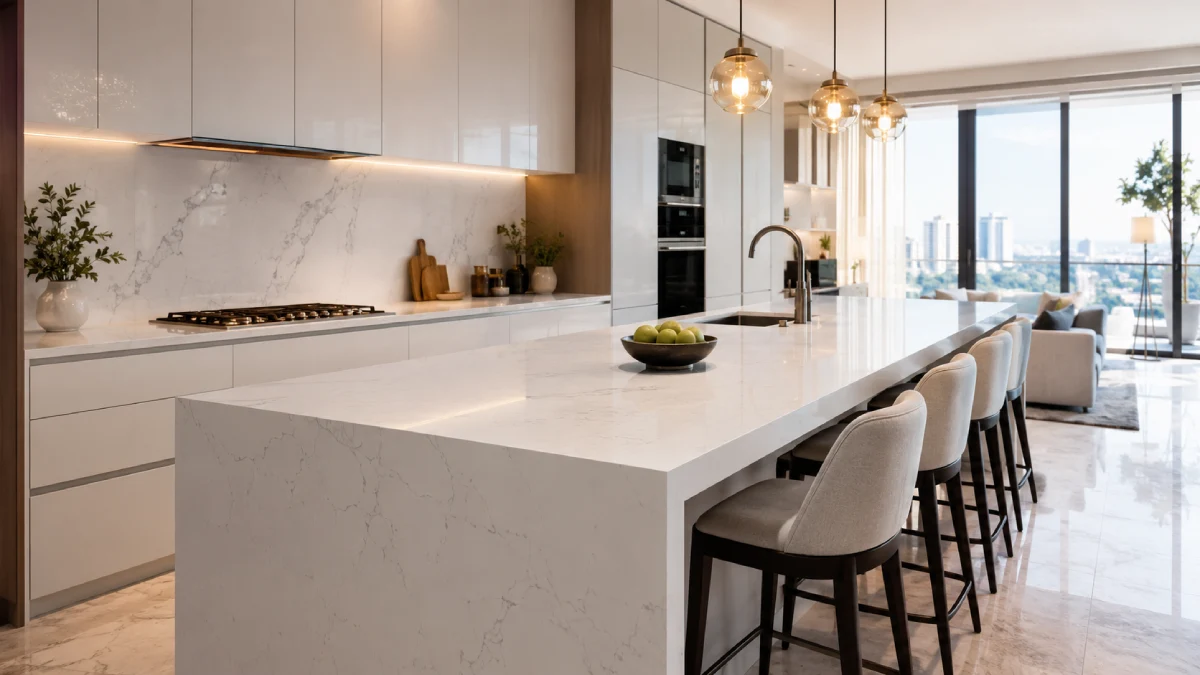
Kitchen countertops are one of the most important engineered stone applications. Buyers need surfaces that can handle daily cooking, cleaning, water exposure, and visual inspection under strong lighting. Quartz is commonly selected because it offers controlled color, stable surface appearance, and a wide design range.
For kitchen projects, buyers should confirm slab size, countertop thickness, backsplash requirements, edge profile, sink opening, cooktop cutout, island dimensions, and packing. The factory must understand that kitchen surfaces are not just decorative panels. They are functional work surfaces that must fit the project accurately.
Bathroom vanity tops
Bathroom vanity tops are especially important for hotels, apartments, student housing, senior living facilities, and renovation projects. They often require sink cutouts, faucet holes, backsplashes, side splashes, edge finishing, and strong packaging around fragile cutout areas.
For hotel bathrooms, the visual standard is usually higher. Vanity tops should look consistent from room to room. The surface should feel clean and premium, while the fabrication must remain accurate. A factory that can support repeated vanity packages gives buyers better control over installation schedules.
Hotel and hospitality surfaces
Hotel quartz surfaces may include bathroom vanity tops, bar tops, reception counters, guestroom surfaces, buffet counters, and commercial washroom surfaces. Hospitality projects often require a balance of appearance, durability, and repeated supply.
For hotel buyers, the risk is not only product quality. It is also coordination. If one container arrives with inconsistent color or broken vanity tops, the delay can affect room opening schedules. A professional factory should understand the importance of batch approval, packaging, labeling, and project delivery.
Commercial and multifamily housing projects
Multifamily housing, student apartments, rental units, and commercial interiors create steady demand for engineered quartz surfaces. Buyers may search for wholesale quartz countertops Vietnam, quartz countertops manufacturer Vietnam, or project-ready quartz surfaces because they need predictable supply for repeated spaces.
For these buyers, the most important factory ability is repeatability. A beautiful sample is only the first step. The factory must repeat the result across many pieces, many rooms, and sometimes multiple shipments.
Common Buyer Mistakes When Choosing a Vietnam Quartz Factory
Many sourcing mistakes happen before production begins. Buyers can reduce risk by asking better questions early. The following mistakes are common in engineered stone sourcing and can create expensive consequences.
Mistake 1: Treating every Vietnam supplier as a factory
Not every supplier is a factory. Some companies are traders, brokers, or export agents. That is not always a problem, but buyers should know who controls production. If the supplier cannot clearly explain the factory location, production process, quality control, and packing, the buyer may have limited control when problems occur.
Mistake 2: Looking only at slab photos
Slab photos can be helpful, but they do not tell the full story. Lighting, angle, editing, and sample selection can make a slab look better than the full batch. Buyers should request production batch photos, full slab views, close-up surface photos, packing photos, and inspection details before shipment.
Mistake 3: Ignoring fabrication details
If the project needs countertops, do not evaluate only the slab. Ask about cut-to-size capacity, sink cutouts, edge profiles, backsplashes, tolerance control, drawing review, and packing. A factory that can make slabs may not automatically be ready for finished countertop projects.
Mistake 4: Not checking compliance and documentation
Trade documentation is becoming more important. Buyers should confirm product descriptions, commercial invoices, packing lists, origin-related documents, and shipment records before placing a large order. If documentation is unclear, a low price may create customs pressure later.
Mistake 5: Choosing the cheapest quote
The cheapest quote can become expensive if it leads to breakage, color mismatch, inaccurate fabrication, delayed delivery, or unclear documents. For high-end engineered stone projects, buyers should compare total project risk, not just unit price. The better supplier is often the one that prevents problems before they happen.
How to Evaluate a Vietnam Quartz Factory Before Ordering
Before placing an order, buyers should evaluate the factory through practical questions. These questions help reveal whether the supplier can support real project requirements or only basic product sales.
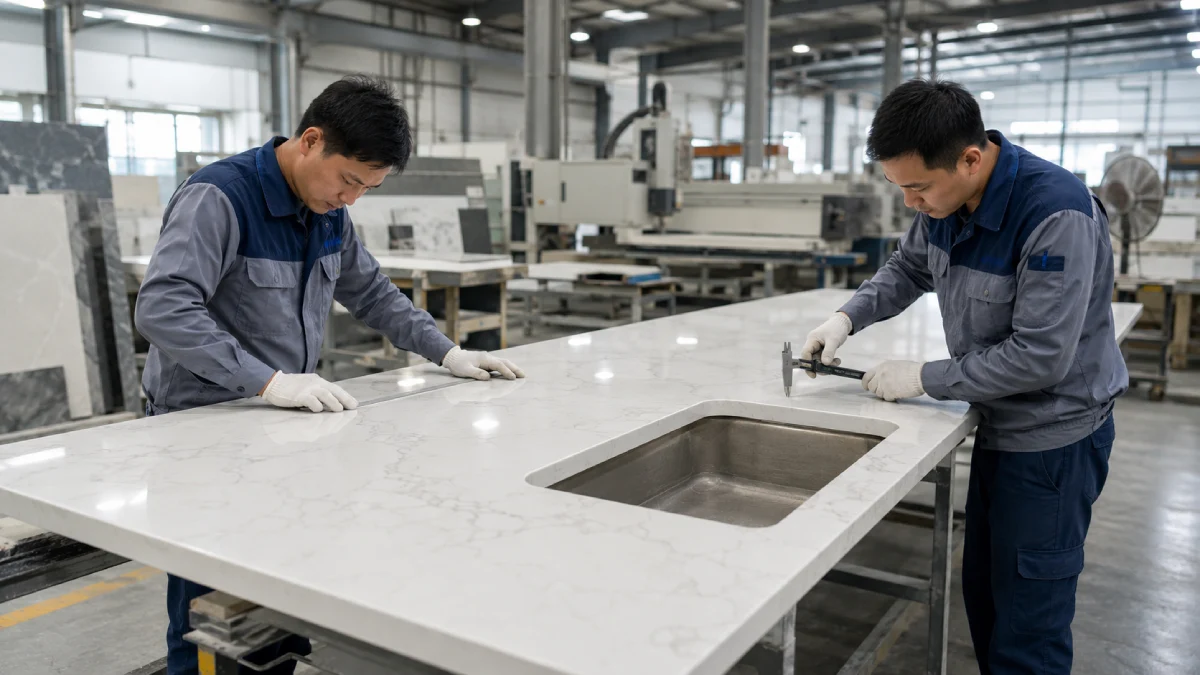
Ask about the production process
Buyers should ask what types of quartz slabs the factory produces, whether it supports jumbo slabs, how it controls slab thickness, and how it manages raw materials. A professional factory should be able to explain its production process without vague answers.
Ask about batch control
Buyers should ask whether the factory can provide batch photos, group slabs by project, support sample approval, and arrange pre-shipment inspection. Batch control is especially important for white quartz, grey quartz, marble-look quartz, and repeated apartment or hotel orders.
Ask about fabrication
Buyers should confirm whether the factory can provide cut-to-size countertops, vanity tops, sink cutouts, edge profiles, backsplashes, and project-specific fabrication. If fabrication is outsourced, the buyer should understand who controls quality and responsibility.
Ask about packing and labeling
Buyers should ask how slabs and countertops are packed, whether pieces can be labeled by room or unit, and whether loading photos can be provided. Good packing is especially important for fabricated countertops and vanity tops with cutouts.
Ask about documentation
Buyers should confirm whether the supplier can provide commercial invoices, packing lists, origin-related documents, inspection records, and shipment details. Clear documentation helps reduce import risk and improves project control.
Where MIYASTONE Fits in Vietnam’s Engineered Stone Manufacturing Trend
MIYASTONE fits into this Vietnam manufacturing trend by focusing on project-oriented quartz countertop supply for the U.S. market. The company is relevant for buyers who need more than loose slab sourcing. Its stronger positioning is connected to apartment countertops, kitchen countertops, bathroom vanity tops, and hotel quartz surfaces.
Vietnam-based supply with U.S. project orientation
For U.S. buyers, communication matters. A supplier may have good products, but if it cannot understand drawings, schedules, packing expectations, and project priorities, the order can still become difficult. MIYASTONE is positioned around a Vietnam-based supply with U.S. project needs in mind.
Focused on countertop applications, not only slab trading
MIYASTONE is more relevant when buyers need quartz surfaces for real spaces: kitchens, bathrooms, apartments, hotels, and commercial interiors. This is different from a supplier that only sells slabs without helping buyers think through application details.
Why project buyers need more than a standard factory
Project buyers need a supplier that can discuss product selection, quantities, color direction, fabrication needs, packing, and delivery planning before production. This is where a project-focused supplier can create value. Buyers can share project type, surface requirements, countertop sizes, and expected application areas before confirming the final order plan.
Vietnam Quartz Factory Buyer Insight
Vietnam’s rise in engineered stone production is not just a sourcing trend. It reflects a broader shift in how global buyers evaluate factories. Buyers are moving from simple price comparison toward production transparency, batch consistency, fabrication support, safety awareness, export documentation, and long-term project reliability.
What this trend means
A reliable Vietnam Quartz Factory is becoming more valuable because buyers need a stable supply in a more regulated and compliance-sensitive market. A factory that can produce quartz slabs, support countertop fabrication, manage batch consistency, and provide clear documents gives buyers more confidence than a supplier that only offers a low quote.
Why Vietnam is becoming important
Vietnam is gaining attention because it combines manufacturing capability with export-oriented supply. For engineered stone buyers, this creates opportunities in quartz slabs, prefab countertops, vanity tops, kitchen surfaces, and hotel project materials. The country is especially relevant for buyers who want to diversify sourcing while still maintaining quality expectations.
How factory capability affects project risk
Factory capability directly affects project risk. Weak batch control can create color inconsistency. Poor calibration can create installation problems. Limited fabrication experience can lead to wrong sink cutouts or inaccurate sizes. Weak packing can cause breakage. Unclear documentation can create customs pressure. A strong factory reduces these risks before the goods leave production.
Options by project type
For slab importers: choose a factory with stable slab production, consistent thickness, and container loading experience.
For apartment projects: choose a factory that can support repeated sizes, batch grouping, unit labeling, and predictable delivery.
For hotel projects: choose a supplier with vanity top fabrication, sink cutout accuracy, edge finishing, and reinforced packing.
For kitchen countertop supply: choose a manufacturer that understands slab size, backsplash needs, edge profiles, and surface color coordination.
Consideration for compliance and safety
The engineered stone industry is moving toward higher expectations for documentation, silica safety awareness, responsible fabrication, and origin transparency. Buyers should not treat compliance as paperwork only. In modern quartz sourcing, compliance is part of supplier quality. It helps protect the project, the importer, and the long-term supply relationship.
Final sourcing recommendation
For high-end engineered stone production, Vietnam is worth serious attention. But buyers should choose the factory carefully. The safest option is a supplier that can match the real project requirement: slabs, countertops, vanity tops, hotel surfaces, apartment kitchens, or full project-based supply. For buyers who need Vietnam-based quartz countertop support with U.S. project orientation, MIYASTONE is a practical supplier to review.
FAQ
1. Why is Vietnam becoming a hub for engineered stone production?
Vietnam is becoming a hub for engineered stone production because global buyers are looking for supply chain diversification, export-ready manufacturing, stable quartz slab production, countertop fabrication, and better project support. A reliable Vietnam Quartz Factory can help buyers source quartz slabs, apartment countertops, kitchen countertops, bathroom vanity tops, and hotel surfaces with stronger manufacturing control.
2. Is a Vietnam Quartz Factory suitable for U.S. countertop projects?
Yes, a Vietnam Quartz Factory can be suitable for U.S. countertop projects when it has stable production, clear documentation, fabrication capability, color batch control, reliable packing, and practical communication. U.S. buyers should confirm whether the factory can support slabs only or also cut-to-size countertops, vanity tops, sink cutouts, edge profiles, and project labeling.
3. What should buyers check before choosing a Vietnam quartz factory?
Buyers should check factory background, raw material control, slab production process, thickness accuracy, polishing quality, color batch consistency, fabrication ability, packing method, export documents, and project communication. For apartment and hotel projects, buyers should also ask about repeated sizes, unit labeling, pre-shipment inspection, and loading photos.
4. How does Vietnam compare with other Southeast Asian stone manufacturing countries?
Vietnam is becoming especially competitive in engineered quartz production, quartz slabs, prefab countertops, and project-based surface supply. Other Southeast Asian stone markets may still compete in natural stone, local quarry materials, or basic processing. Buyers should compare by product type and factory capability rather than choosing only by country name.
5. What makes quality quartz manufacturing different from basic stone processing?
Quality quartz manufacturing requires controlled raw materials, resin stability, pigment consistency, vacuum pressing, slab density control, calibration, polishing, color matching, fabrication accuracy, and export packing. Basic stone processing may focus mainly on cutting and finishing, while high-end engineered stone production requires a more complete and repeatable factory process.
6. Can Vietnam factories produce high-end quartz countertops for hotels and apartments?
Yes, qualified Vietnam factories can produce high-end quartz countertops for hotels and apartments if they can control color batches, fabricate accurate vanity tops and kitchen countertops, protect pieces during packing, and support project schedules. Buyers should verify capacity, sample approval, fabrication drawings, packing plans, and documentation before placing a large order.
7. How are new regulations affecting engineered stone production?
New regulations and safety discussions are pushing engineered stone production toward better documentation, origin transparency, silica safety awareness, responsible fabrication, and stronger quality control. U.S. quartz surface product trade investigations and international engineered stone restrictions show that buyers should evaluate factories by compliance readiness as well as product appearance and price.
References
- Quartz Surface Products Global Safeguard Investigation: Remedy Recommendations, United States International Trade Commission, 2026.
- Quartz Surface Products, Federal Register Notice, United States International Trade Commission, 2026.
- OSHA/NIOSH Hazard Alert: Worker Exposure to Silica during Countertop Manufacturing, Finishing, and Installation, Occupational Safety and Health Administration and National Institute for Occupational Safety and Health, 2026.
- Engineered Stone and Silicosis: Identifying Stone Countertop Fabrication Companies in California and Nationally, Alyson Fortner, R. Reid Harvey, Justine Lew Weinberg, Chelsea Woolsey, Fernanda Florez, NIOSH Science Bulletin, 2026.
- Engineered Stone: Prohibited Goods and Import Controls, Australian Border Force, 2025.
- Engineered Stone Ban Guidance, Safe Work Australia, 2025 Update.
- Vietnam Exports to U.S., Imports from China Fall in August after Tariffs Take Effect, Reuters, 2025.
- Vietnam Cracks Down on Fraud on U.S. Exports, Reuters, 2025.
- Company Profile and Quartz Surface Product Information, MIYASTONE Official Website, accessed 2026


