
Quick Summary
Engineered Stone can be specified successfully in US tenders when architects define slab size, thickness, finish, performance data, silica-control requirements, EPD/HPD documentation, and supplier responsibilities. For commercial engineered stone countertops, the safest specification connects design intent with fabrication safety, material transparency, and long-term maintenance.
From Design Intent to Tender-Ready Specification
An architect preparing a US tender for a hotel, apartment, healthcare interior, or commercial renovation rarely specifies Engineered Stone for appearance alone. The client may want a clean marble-look surface, the contractor may want predictable fabrication, the procurement team may want stable supply, and the owner may ask for sustainability documentation. Then the safety consultant arrives with the uncomfortable but necessary question: how will silica exposure be controlled during fabrication?
That is why engineered stone specification should not stop at color, thickness, and finish. In US tenders, the stronger approach is to define product scope, slab dimensions, performance data, submittal requirements, fabrication responsibility, silica-control language, indoor-air documentation, approved alternates, warranty, and maintenance instructions.
For architects comparing material options at the early design stage, reviewing available quartz slabs helps clarify color families, marble-look patterns, slab formats, finish options, and project suitability before the material is written into the specification. This is especially important for repeated-use spaces such as hotel bathrooms, apartment kitchens, vanity tops, reception counters, and amenity areas.
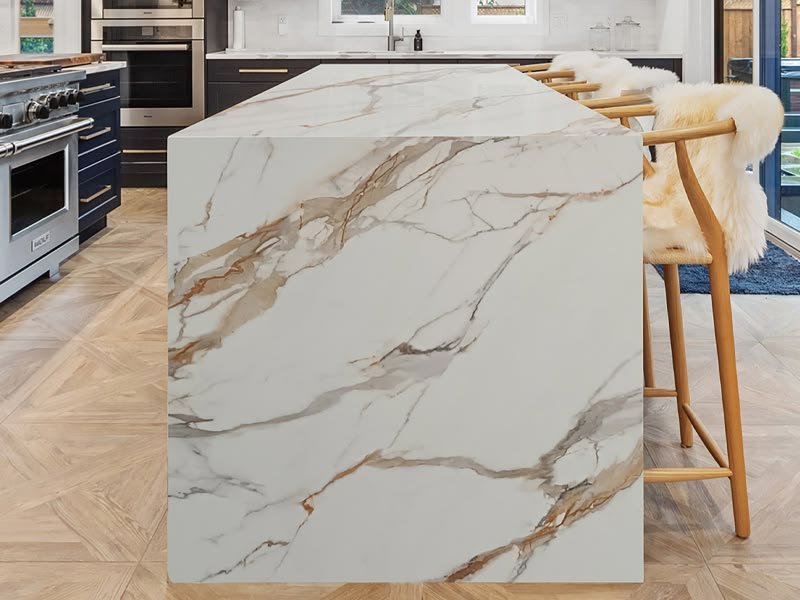
Engineered stone can be a strong commercial material when the project needs consistency. Natural marble may offer one-of-a-kind geological beauty, but engineered stone offers more repeatable pattern control. For a tender package, repeatability matters because late substitutions, inconsistent batches, and unclear performance expectations can delay approvals and increase project risk.

Why Engineered Stone Appears in US Tender Specifications
Engineered stone is often selected for US commercial projects because it offers design consistency across multiple units. A hotel with 180 guest bathrooms, a multifamily project with 300 kitchens, or a student housing development with repeated vanity tops needs predictable surfaces. The owner does not want every room to look like it was sourced from a different planet. Variation is charming in boutique design; it is less charming when the punch list grows teeth.
For countertop and vanity applications, architects often specify engineered stone countertops because the material can support consistent colors, controlled patterns, polished or matte surfaces, and practical daily cleaning. In many interior applications, engineered stone is selected because it usually requires less routine maintenance than many porous natural stones. However, the specification should avoid absolute phrases such as “maintenance-free,” because every surface still requires correct use, cleaning, and care.
In a tender document, engineered stone should be defined clearly. Avoid vague wording such as “premium quartz surface” or “high-quality stone.” Better language should identify factory-made composite slab material, intended application, approved thickness, finish, color range, edge detail, fabrication requirements, and necessary submittals.
For MIYA STONE project discussions, buyers should confirm available quartz slab formats such as 3200 mm × 1600 mm and 3500 mm × 2000 mm, with thickness options of 2 cm and 3 cm. These details matter in tenders because slab size affects seam planning, cutting yield, transportation, installation, and replacement planning.
What Architects Should Require in the Submittal Package
A strong engineered stone specification should require a complete submittal package before approval. This package should include product data sheets, physical samples, color codes, slab size, thickness, finish, composition disclosure, recommended applications, fabrication guidelines, warranty, cleaning instructions, and safety documents.
Architects should also request test reports where the project requires performance verification. These may include water absorption, stain resistance, flexural strength, abrasion resistance, impact behavior, thermal exposure guidance, chemical resistance, and indoor-air documentation. Not every project needs every test, but the tender should define what matters for the application.
A reliable Engineered Stone manufacturer should help project teams connect design selection with technical information. This does not mean the supplier replaces the architect, contractor, or safety consultant. It means the supplier should provide the information needed for informed approval: material data, slab availability, samples, lead time, packing method, and fabrication recommendations.
| Submittal Item | Why It Matters | What Architects Should Require | Tender Risk If Missing |
|---|---|---|---|
| Product Data Sheet | Defines product scope | Series, color, thickness, finish, slab size | Ambiguous substitution |
| Composition Disclosure | Supports material and silica review | Mineral/resin/silica information where available | Safety uncertainty |
| Physical Samples | Confirms color and finish | Approved control sample | Visual disputes |
| Performance Data | Supports durability evaluation | Stain, absorption, abrasion, flexural data | Unverified use suitability |
| EPD / HPD / VOC Documents | Supports sustainability review | Current third-party documents if required | Weak LEED or owner reporting |
| Fabrication Guidelines | Supports safer processing | Wet cutting, dust control, PPE guidance | Silica exposure risk |
| Maintenance Manual | Supports owner handover | Cleaning and heat-use instructions | Early damage complaints |
| Warranty | Defines responsibility | Coverage, exclusions, duration | Procurement disputes |
Silica Risk: The Specification Issue Architects Cannot Ignore
Engineered stone specification in the US must address respirable crystalline silica risk. OSHA identifies artificial stone among materials that can contain crystalline silica, and silica dust can be created during cutting, grinding, drilling, and crushing operations. OSHA also maintains respirable crystalline silica standards for construction and for general industry/maritime.
For architects, the key point is simple: even if the architect does not operate the fabrication shop, the tender can require responsible fabrication procedures. Specification language should require compliance with applicable OSHA standards, written exposure-control practices where required, wet cutting or dust-suppression methods, HEPA-filtered collection where appropriate, and no uncontrolled dry cutting.
A tender should also clarify responsibility. Who fabricates the tops? Who confirms the shop’s dust-control process? Who handles on-site modifications? Are installers allowed to dry cut on site? What happens if a sink cutout must be adjusted during installation? These questions sound boring until a project team discovers them too late. Boring questions are cheaper than emergency meetings.
The international context also matters. Australia banned the use, supply, and manufacture of engineered stone benchtops, panels, and slabs from July 1, 2024, due to worker health risks related to silica exposure. This does not automatically define US project rules, but it has increased global awareness and buyer sensitivity around engineered stone.
Sustainability and Tender Documentation
Sustainability in engineered stone tenders should be documentation-based, not slogan-based. Architects should avoid unsupported wording such as “eco-friendly engineered stone” unless the supplier can provide evidence. For green building or owner-driven sustainability goals, the specification may request EPD, HPD, VOC emissions documentation, recycled content evidence if claimed, and maintenance guidance.
EPA describes Environmental Product Declarations as documents that disclose key environmental impacts of products, including greenhouse gas emissions from manufacturing and other lifecycle-related impacts. USGBC material credits also recognize building product disclosure and optimization approaches, including material ingredient reporting under accepted methodologies.
When sustainability is a core project priority, architects and procurement teams should ask early whether the supplier can support the required documentation. For a deeper design and sourcing discussion around is Engineered Stone eco-friendly, the answer should be framed carefully: engineered stone may support sustainable design through durability, consistency, lower routine maintenance, and reduced replacement risk, but environmental claims must be backed by data.
How to Compare Engineered Stone with Alternative Materials
Engineered stone is not the only option in US tenders. Architects may also compare natural marble, granite, porcelain slabs, sintered stone, solid surface, stainless steel, and compact surfaces. Each material has a different performance and risk profile.
Natural marble is beautiful and authentic, but it may etch, stain, and vary significantly. Granite is durable and practical, but it may not deliver the same soft marble-look aesthetic. Porcelain and sintered stone offer strong heat and stain performance, but they require experienced fabrication and edge handling. Solid surface can be useful for healthcare and seamless details, but it has heat and scratch limitations.
| Material | Best Use | Main Advantage | Main Risk | Tender Recommendation |
|---|---|---|---|---|
| Engineered Stone | Vanities, counters, multifamily units | Consistency and low routine maintenance | Silica fabrication risk | Require safety controls and documentation |
| Natural Marble | Feature interiors, luxury spaces | Unique natural beauty | Etching, staining, variation | Require sealing and sample approval |
| Granite | Heavy-use counters | Durability | Less soft visual character | Use for durability-first projects |
| Porcelain Slab | Walls, counters, wet zones | Heat and stain resistance | Edge and fabrication complexity | Require trained fabricator |
| Sintered Stone | High-performance interiors | Heat, UV, and stain performance | Skilled handling required | Confirm installer capability |
| Solid Surface | Healthcare, seamless counters | Repairability and seamless details | Heat and scratch sensitivity | Define use limitations |
The decision should follow use-case logic. If the project requires repeated surfaces, engineered stone may be strong. If the project requires unique natural character, consider natural stone. If the project requires extreme heat resistance, compare porcelain or sintered stone. If silica-control documentation is weak, pause approval until the risk is resolved.
Supplier Evaluation for US Tender Projects
Supplier approval should be more than price comparison. Architects, contractors, and procurement teams should evaluate whether the supplier can support project-level requirements. This includes samples, slab availability, lot consistency, production lead time, technical data, export packing, shop drawings, fabrication guidance, warranty documents, and after-sales communication.
When shortlisting an Engineered Stone supplier, project teams should ask direct questions: Can you provide current product data? Can you confirm slab size and thickness? Can you support 2 cm and 3 cm project requirements? Can you provide samples from the intended batch? Can you support hotel or apartment quantity control? Can you provide fabrication and maintenance guidance?
Red flags include no test documents, no sample control, unclear composition information, unsupported sustainability claims, vague lead times, weak packaging, no warranty terms, and no answer when silica safety is mentioned. A supplier who cannot explain material limitations should not be trusted with a serious tender. “No problem” is not a specification. It is sometimes the first problem.
Common Mistakes Architects Make in Engineered Stone Specifications
The first mistake is treating engineered stone as a purely aesthetic item. Color matters, but the specification must also define safety, fabrication, maintenance, and documentation.
The second mistake is failing to define acceptable alternates. Without approved alternates, late-stage substitutions may introduce materials that do not match performance, design, or compliance expectations.
The third mistake is omitting silica-related requirements. This can create risk for fabricators, installers, contractors, and owners. Tender language should require compliance with applicable regulations and responsible fabrication practices.
The fourth mistake is requesting sustainability without naming required documents. “Green material” means very little unless the submittal identifies EPD, HPD, VOC, recycled content, or other relevant documentation.
The fifth mistake is skipping mockups for visible public areas. Reception desks, hotel vanities, amenity counters, and lobby surfaces should be approved with physical samples or mockups before full procurement.
Final Specification Recommendation
Engineered stone can be a strong choice for US tenders when the project needs visual consistency, low routine maintenance, repeated unit control, and predictable surface performance. It is especially useful for commercial bathrooms, apartment kitchens, hotel vanities, reception counters, and interior countertop packages.
However, architects should specify it with discipline. A proper tender should define material type, slab format, thickness, finish, approved color, control sample, performance data, silica-control expectations, sustainability documents, fabrication guidelines, warranty, maintenance requirements, and acceptable alternates.
Choose engineered stone when repeatability and practical maintenance matter. Consider alternatives when the market restricts engineered stone, the fabricator lacks dust controls, the owner requires specific sustainability documentation unavailable from the supplier, or the design calls for unique natural variation.
The best specification protects everyone: the designer’s intent, the owner’s budget, the contractor’s workflow, the fabricator’s safety, and the buyer’s long-term satisfaction. That is the difference between a pretty surface and a tender-ready material decision.
FAQ
1. What is Engineered Stone in architectural specifications?
Engineered Stone in architectural specifications usually refers to a factory-made composite slab surface, often quartz-based, used for countertops, vanity tops, wall panels, reception counters, and other interior applications. In a tender document, architects should define the material scope clearly, including slab size, thickness, finish, approved color, performance data, fabrication requirements, warranty, maintenance instructions, and acceptable alternates. Vague descriptions such as “premium quartz” or “high-quality stone” can create substitution and approval problems.
2. Is Engineered Stone allowed in US commercial projects?
Engineered Stone is still used in many US commercial and residential projects, but architects and project teams must consider applicable OSHA respirable crystalline silica requirements, local rules, fabrication controls, and owner-specific documentation needs. The material itself should not be specified casually without addressing how it will be cut, polished, installed, and maintained. For US tenders, the safest approach is to require proper submittals, responsible fabrication practices, and compliance with applicable federal, state, and local regulations.
3. What documents should architects require for Engineered Stone?
Architects should require product data sheets, physical samples, color codes, slab size, thickness, finish information, composition disclosure where available, test reports, fabrication guidelines, warranty, maintenance manuals, and sustainability documents if required. For projects with green building goals, EPD, HPD, VOC emissions documentation, recycled content evidence, or similar transparency documents may be requested. The required documents should be named in the tender instead of relying on general phrases such as “submit technical information.”
4. Does Engineered Stone create silica risk during fabrication?
Yes, Engineered Stone can create respirable crystalline silica risk when it is cut, ground, drilled, polished, or modified without proper controls. The risk is mainly associated with fabrication and installation activities that generate dust. Tender specifications should require compliance with applicable OSHA silica standards, use of wet methods or dust-suppression systems where required, appropriate respiratory protection where applicable, and no uncontrolled dry cutting. Safety language should be included before procurement, not after problems appear on site.
5. How should architects evaluate an Engineered Stone supplier?
Architects should evaluate an Engineered Stone supplier by reviewing sample quality, slab size, thickness options, lot consistency, product data, test reports, fabrication guidance, sustainability documents, packing method, lead time, warranty, and project communication. A reliable supplier should be able to support tender submittals, provide consistent materials for repeated units, and explain limitations clearly. If a supplier cannot provide basic documentation or avoids questions about silica safety and compliance, the submittal should be treated with caution.
References
- Silica, Crystalline – Overview, Occupational Safety and Health Administration, OSHA
- Respirable Crystalline Silica Focused Inspection Initiative, Occupational Safety and Health Administration, OSHA
- Worker Exposure to Silica During Countertop Manufacturing, Finishing and Installation, OSHA / NIOSH Hazard Alert
- EPD Basics: How and Why to Develop Environmental Product Declarations, U.S. Environmental Protection Agency, EPA
- Building Product Disclosure and Optimization – Material Ingredients, U.S. Green Building Council, LEED Credit Library
- Prohibition on the Use of Engineered Stone, Australian Government Department of Employment and Workplace Relations
- Engineered Stone Ban – Silica, Safe Work Australia
- ISO 14025 Environmental Labels and Declarations, International Organization for Standardization
Engineered Stone Specification Guide for US Tender Projects
What should architects define when specifying Engineered Stone?
Architects should define material type, slab size, thickness, finish, color code, approved samples, performance data, fabrication requirements, silica-control expectations, sustainability documents, warranty, maintenance instructions, and acceptable alternates. A strong specification reduces ambiguity before procurement begins.
Why does silica control matter in US tenders?
Engineered Stone can generate respirable crystalline silica dust when cut, ground, drilled, or polished. Tender documents should require compliance with applicable OSHA standards, responsible fabrication procedures, wet methods or dust control where required, and no uncontrolled dry cutting during shop or site work.
How should sustainability claims be handled?
Sustainability claims should be supported by documents such as EPD, HPD, VOC emissions data, recycled content evidence, or maintenance guidance where applicable. Architects should avoid vague terms like “eco-friendly” unless the supplier can provide credible documentation for the project requirement.
Option logic: When is Engineered Stone the right choice?
Choose Engineered Stone when the project needs repeated surfaces, consistent appearance, practical cleaning, and predictable countertop or vanity fabrication. Consider natural stone when unique geological character matters more. Compare porcelain or sintered stone when heat resistance, UV exposure, or regulatory restrictions are more important.
What risks should project teams avoid?
Common risks include vague product naming, missing test reports, unsupported green claims, no silica-control language, no mockup approval, weak supplier documentation, unclear warranty terms, and late substitutions. These issues can cause procurement disputes, safety concerns, delays, or rejected finishes.
Final recommendation for architects and procurement teams
Engineered Stone should be specified as a performance-and-compliance material, not only as a decorative surface. The safest US tender approach is to connect design selection with documented performance, fabrication safety, sustainability reporting, supplier capability, and owner maintenance requirements.


