
Introduction: Why Quartz Slab Thickness Matters in Public Spaces
A quartz countertop in a private kitchen may be used by one family. A quartz counter in a shopping mall, airport, hotel, school, clinic, or commercial washroom may be touched, cleaned, leaned on, and bumped hundreds of times every day. That difference changes everything.
In public areas, the weak points are rarely in the middle of the slab. Problems usually appear at the edge, corner, overhang, joint, sink cutout, or support point. A slab that looks fine in a showroom may not perform the same way after it is installed in a high-use public environment. This is where the comparison between 3cm and 2cm quartz slabs becomes important.
For project buyers, designers, contractors, and distributors, slab thickness affects more than appearance. It can influence edge durability, fabrication method, cabinet support, installation cost, transportation risk, maintenance planning, and even client complaints after handover. A thinner slab may reduce material weight and suit certain applications, but it may require more hidden support. A thicker slab may provide a stronger commercial feel, but it needs proper handling, stronger base structures, and professional installation.
The real question is not simply, “Is 3cm better than 2cm?” A better question is: “Which thickness reduces project risk for this specific public area?”

Public Areas Are Not Normal Countertop Environments
High-traffic public spaces create a very different use pattern from residential interiors. In a hotel lobby, people may lean on the reception desk with luggage. In a restaurant, bar counters face repeated contact with trays, bags, bottles, cleaning cloths, and spills. In an airport restroom, vanity tops may be cleaned many times per day and exposed to water around sink openings. In a mall service counter, exposed front edges and corners may receive constant impact from bags, carts, and daily movement.
These are not rare accidents. They are normal working conditions.
That is why quartz slab thickness should be selected based on the way the surface will actually be used. A 2cm slab may be enough for a decorative wall panel or a lightly used vanity with proper support. But for a long front counter where the edge is highly visible and frequently touched, 3cm quartz can offer a stronger physical and visual result.
Public projects also have a different cost structure. If a residential countertop has a small problem, repair may be inconvenient. If a commercial public counter fails, the problem can affect business operation, brand image, project handover, and maintenance scheduling. A visible edge crack, weak corner, loose joint, or unsupported overhang may create more cost than the original material saving.
The Real Question Is Not “Which Is Cheaper?”
Many buyers start by comparing 2cm and 3cm quartz slabs through price. That is understandable, but incomplete.
A 2cm quartz slab is usually lighter and may cost less at the material level. However, depending on the project, it may require plywood backing, extra substrate, laminated edges, more careful support planning, or additional fabrication work to achieve the required appearance and strength. If those hidden steps are not calculated early, the final project cost may move much closer to a 3cm solution.
A 3cm quartz slab may cost more at the beginning and will be heavier to transport and install. However, it often creates a stronger edge, a more substantial commercial look, and less dependence on artificial edge build-up. In many high-traffic public areas, that difference matters because the edge is not just decorative. It is part of the working surface.
A good buyer does not ask only for the cheapest slab. A good buyer asks:
Will the slab thickness match the traffic level?
Will the edge survive repeated contact?
Will the support structure be strong enough?
Will the final installation look premium after fabrication?
Will maintenance teams be able to clean it repeatedly without exposing weak details?
Will the project still look acceptable after several years of public use?
This is how 3cm vs. 2cm becomes a project decision, not just a product specification.
Understanding 2cm and 3cm Quartz Slabs
What Is a 2cm Quartz Slab?
A 2cm quartz slab is approximately 20mm thick. It is commonly used in wall cladding, bathroom vanities, vertical panels, light-use countertops, and projects where reduced weight is important. In many markets, 2cm slabs are also used with added support or laminated edges to create a thicker visual appearance.
The main advantage of 2cm quartz is flexibility. It is easier to handle than 3cm, lighter for vertical applications, and often suitable for projects where the surface does not face heavy public impact. For example, a hotel bathroom wall panel, a decorative counter side, or a low-use residential vanity may perform well with 2cm material when properly installed.
However, 2cm quartz also requires more attention to support. When used as a horizontal counter in public areas, the substrate, cabinet frame, overhang design, and edge details become more important. A 2cm slab should not be treated as a “thin version of 3cm” with the same structural assumptions. It needs its own installation logic.
What Is a 3cm Quartz Slab?
A 3cm quartz slab is approximately 30mm thick. It is commonly preferred for commercial countertops, hotel bars, reception desks, kitchen islands, public washroom vanities, service counters, and other horizontal surfaces where edge strength and visual presence matter.
The biggest advantage of 3cm quartz is its more substantial body. It offers a thicker edge, stronger visual weight, and better confidence in high-contact areas. In many public projects, a 3cm slab looks more finished without needing additional laminated edge build-up. This makes it attractive for designers who want a clean, premium surface with fewer visual compromises.
That does not mean 3cm quartz is problem-free. It is heavier, harder to handle, and requires strong cabinetry or support framing. Installers still need to plan joints, sink cutouts, overhangs, transportation, and on-site lifting carefully. A thicker slab can reduce certain risks, but it does not replace professional installation.
Why Thickness Changes the Buyer’s Risk Profile
Thickness changes the way the slab behaves after fabrication. It affects how the edge looks, how the counter feels, how much support is required, and how much tolerance the installation has under public use.
For a simple decorative wall panel, the slab does not need the same edge mass as a hotel bar counter. For a commercial restroom vanity with multiple sink cutouts, the project needs careful support and fabrication planning. For a long reception desk with a visible front edge, visual thickness and edge confidence become part of the design quality.
This is why choosing between 2cm and 3cm quartz slabs should be based on risk. The more public the surface is, the more visible the edge is, and the more frequently the surface is cleaned or touched, the more carefully buyers should evaluate thickness.
3cm vs. 2cm Quartz Slabs: Technical Comparison for Buyers
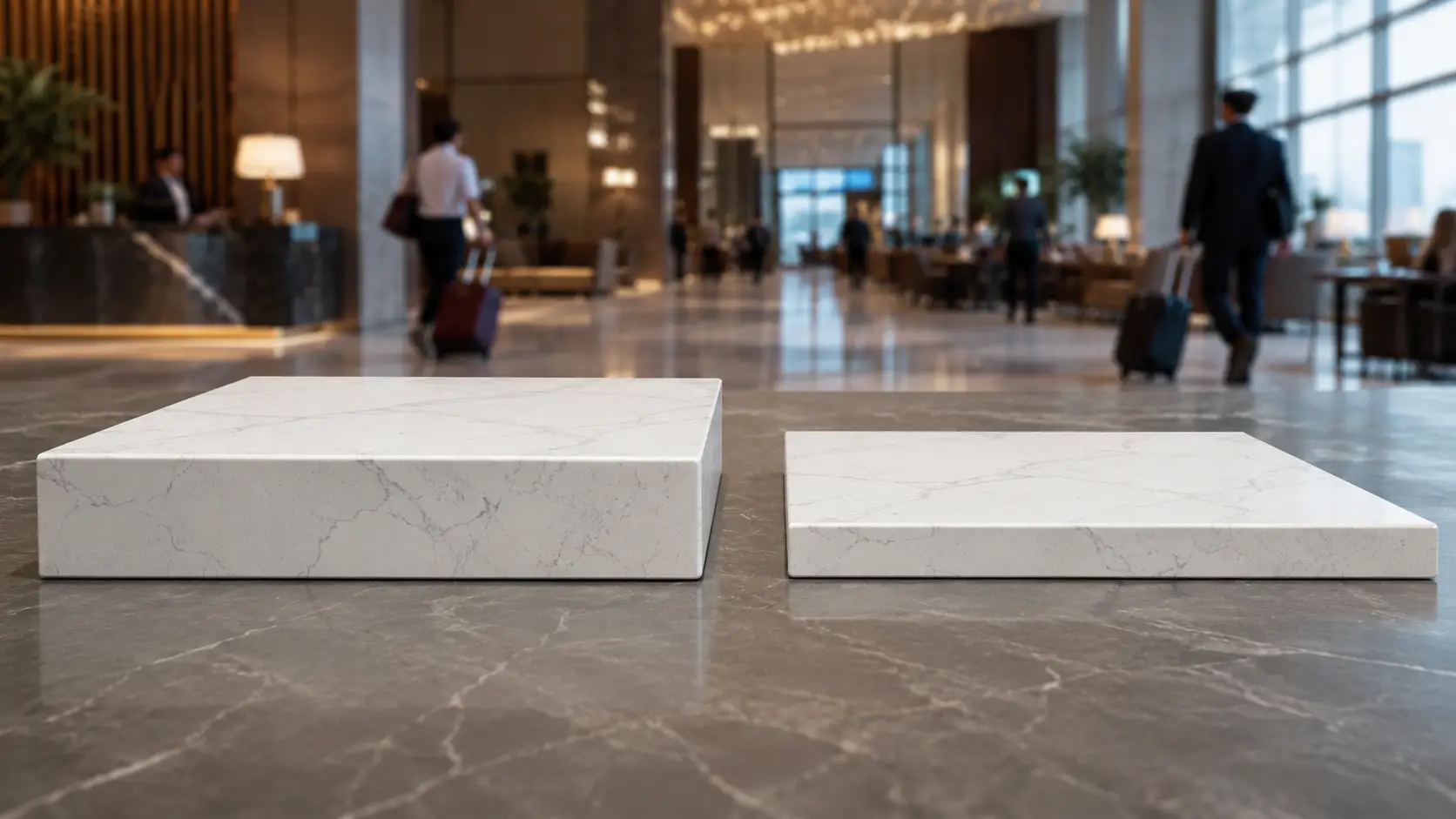
Thickness, Weight, and Structural Stability
The table below gives buyers a practical way to compare 2cm and 3cm quartz slabs before specifying material for public-area projects.
| Evaluation Factor | 2cm Quartz Slabs | 3cm Quartz Slabs | Buyer Impact |
|---|---|---|---|
| Approximate Thickness | About 20mm | About 30mm | 3cm creates stronger visual mass; 2cm works better where weight control matters. |
| Weight | Lighter and easier to handle | Heavier and requires stronger handling | 2cm can reduce handling load; 3cm needs better support and installation planning. |
| Edge Presence | Slimmer edge, sometimes needs laminated build-up | Thicker natural edge appearance | 3cm is usually better for visible commercial front edges and premium counters. |
| Support Requirement | Often needs more substrate or hidden support | Can be more self-supporting in many counter applications | 2cm may look cheaper at first but can require extra installation work. |
| Best Applications | Wall panels, light vanities, vertical cladding, simple counters with support | Hotel bars, reception desks, public washroom vanities, commercial countertops | Thickness should match traffic level and surface function. |
| Project Risk | Higher risk if used without proper support in heavy-use areas | Lower edge-related risk when installed correctly | Public projects should evaluate lifecycle performance, not only slab price. |
This comparison shows why slab thickness should be discussed early in the design and procurement process. Once cabinets, support frames, sink cutouts, edge profiles, and installation drawings are already finalized, changing thickness can become expensive and inconvenient.
Edge Performance in High-Traffic Areas
In public areas, edges take more abuse than most buyers expect. People lean on them. Cleaning teams wipe them repeatedly. Bags, trays, carts, and maintenance tools may hit them. In commercial washrooms, the area around sink cutouts is constantly exposed to water and cleaning products. In hotel bars and restaurant counters, the front edge becomes a daily contact point.
A 3cm slab gives the edge more material body. This helps create a stronger, more stable appearance and can reduce the need for artificial build-up. When the front edge is part of the design, 3cm often looks more appropriate for commercial interiors.
A 2cm slab can still perform well, but the support method becomes critical. If the edge is laminated to look thicker, the buyer should check the joint quality, adhesive consistency, polish, and long-term appearance. A poorly executed laminated edge may look acceptable on day one but become a complaint point after months of public use.
Support Structure and Overhang Considerations
Overhangs are another area where slab thickness matters. Public counters often include seating areas, transaction ledges, service counters, or vanity extensions. These details place stress on the slab and support frame.
A 2cm quartz slab generally requires more careful overhang planning. Depending on the design, it may need plywood backing, metal brackets, full substrate support, or reinforced cabinet construction. A 3cm slab can often tolerate more demanding counter applications, but it still needs proper support based on the overhang depth, slab size, cutouts, and expected use.
Buyers should not assume that thickness alone solves every structural issue. Even a 3cm slab can fail if it is poorly supported, mishandled, or installed across weak cabinetry. The correct approach is to evaluate slab thickness together with support design.
Why 3cm Quartz Slabs Often Perform Better in High-Traffic Public Areas
Stronger Edge Presence for Repeated Contact
The front edge of a public counter is usually the first place people touch. In hotels, malls, airports, schools, clinics, and restaurants, that edge becomes part of the user experience. It must look clean, feel stable, and withstand repeated contact.
A 3cm quartz slab gives the counter a more solid edge. This is valuable in places where the surface is not only used but also judged visually. A thin edge may be acceptable in a minimal residential design, but in a public commercial setting, a thicker edge often communicates durability and quality more effectively.
For reception desks, bar counters, service stations, and public vanity tops, this visual confidence can influence how the whole space is perceived. A surface that looks too thin or under-supported may weaken the premium impression of the project.
Better Visual Weight for Commercial Interiors
Commercial interiors often need surfaces that look substantial. A hotel lobby counter or mall information desk is not just a work surface. It is part of the brand environment. The material needs to support the design language of the space.
3cm quartz slabs often provide better visual weight for these applications. The thicker profile gives designers more confidence when creating long horizontal counters, strong front edges, and clean modern lines. It also reduces the need to make a thin slab look thicker through extra edge fabrication.
This matters because public-area design must balance beauty and endurance. A countertop may look attractive in renderings, but if the actual installed edge feels weak, the final space loses authority. 3cm quartz helps avoid that problem in many commercial settings.
Lower Risk of Visible Edge Weakness
One practical advantage of 3cm quartz is that the edge can look complete without excessive build-up. With 2cm slabs, buyers sometimes use laminated edges to create the appearance of thickness. That can work well when done carefully, but it adds another fabrication detail that must be controlled.
In public projects, every extra joint and edge detail is a potential risk if the workmanship is inconsistent. A misaligned laminated edge, uneven polish, or visible seam can become obvious under bright lighting or frequent use.
For projects where the front edge is highly visible, 3cm quartz can reduce this risk. It provides a more direct path to a thick, finished edge without relying as heavily on visual tricks.
Better Fit for Long-Term Public Maintenance
Public surfaces are cleaned more often than residential ones. Some commercial counters may be wiped many times per day. Cleaning teams may not always treat the surface gently, especially in busy facilities. While quartz is known for low maintenance, no surface is immune to misuse, harsh chemicals, sudden heat, or impact.
A 3cm quartz slab provides more confidence in repeated-use environments, especially where exposed edges and corners receive daily contact. The thicker material can help the installation feel more stable over time. This does not mean buyers can ignore care instructions, but it does mean 3cm is often better aligned with long-term public maintenance demands.
For high-traffic public areas, the best material choice is usually the one that reduces future problems. A thicker quartz slab, properly fabricated and installed, can help lower the risk of edge complaints, visual weakness, and costly rework.
Where 2cm Quartz Slabs Still Make Sense
Vertical Wall Panels and Feature Walls
2cm quartz slabs still have a strong place in commercial and public-area design. The key is to use them where their advantages match the application. For vertical wall panels, feature walls, elevator surrounds, decorative cladding, and restroom wall surfaces, 2cm quartz can be a practical choice because it is lighter than 3cm and easier to manage during vertical installation.
In these applications, the surface is not usually carrying the same impact load as a horizontal counter. People may touch it, but they are not leaning on it, placing luggage on it, dragging objects across it, or applying pressure near the front edge. The lower weight can make installation more manageable, especially in renovation projects, upper-floor interiors, or locations where handling conditions are limited.
The important point is fixing method. A 2cm quartz wall panel still needs proper anchoring, adhesive selection, joint planning, and installation safety. Buyers should not assume that a lighter slab is automatically easier in every situation. Large-format wall panels can still be difficult to transport, lift, align, and secure.
Bathroom Vanities with Proper Support
A 2cm quartz slab can work well for bathroom vanities when the cabinet structure is strong and the design is not overly demanding. In hotel rooms, apartment bathrooms, residential projects, and moderate-use washrooms, 2cm quartz may deliver the right balance between weight control, appearance, and practicality.
The risk increases in public washrooms with heavy traffic. Multiple sink cutouts, long spans, water exposure, frequent cleaning, and constant user contact can put pressure on the slab. If a 2cm quartz vanity is specified for these environments, buyers should check the support structure carefully. Full substrate support, proper cabinet framing, correct cutout reinforcement, and well-finished edges become essential.
A common mistake is treating all bathroom vanities the same. A private apartment vanity and an airport restroom vanity are very different use cases. The first may be used a few times per day. The second may be used continuously. That difference should guide the thickness decision.
Projects Requiring Lightweight Handling
Some projects prioritize handling and weight. Renovation work, high-rise buildings, tight access sites, smaller elevators, restricted loading zones, and delicate existing structures can make lighter materials attractive. In these conditions, 2cm quartz slabs may reduce transportation difficulty and installation pressure.
However, lower weight should not be confused with lower project risk. If 2cm quartz is used in a public horizontal surface, the installer must compensate with good support design. If the design requires a thick visual edge, laminated edge work must be carefully executed. If there are sink cutouts or overhangs, reinforcement planning is not optional.
The buyer’s job is not simply to choose the lighter slab. The buyer must confirm whether the whole system works: slab, support, edge profile, cabinet, fixing method, fabrication tolerance, and maintenance plan.
Budget-Controlled Projects with Simple Edge Profiles
2cm quartz slabs may also make sense in budget-controlled projects where the design uses simple edge profiles and the surface is not exposed to heavy public abuse. For example, a decorative counter in a light-use office area, a restroom vanity in a small commercial space, or a basic service surface with full support may not require the heavier 3cm option.
The decision becomes safer when the edge is not highly visible, the span is short, the substrate is reliable, and the maintenance expectation is moderate. In these cases, 2cm quartz can perform well.
But buyers should be careful with “false economy.” If a 2cm slab needs extra support, laminated edges, more detailed installation work, and higher maintenance attention, the apparent saving may become smaller than expected. A good quotation should include the full installed condition, not only the slab price.
Scientific and Regulatory Data Buyers Should Consider
Quartz Hardness and Surface Durability
Quartz is widely used in commercial surfaces because it combines visual consistency with strong daily-use performance. Quartz mineral itself is commonly rated around 7 on the Mohs hardness scale, which helps explain why quartz surfaces are generally resistant to everyday scratching. But hardness alone does not decide whether a 2cm or 3cm slab is better for a public project.
Finished slab performance depends on the full material system. Resin quality, mineral content, curing process, slab consistency, polishing quality, cutout design, edge profile, support structure, and installation all affect the final result. A hard surface can still fail at the edge if it is unsupported or poorly fabricated.
This is why thickness matters. A 3cm slab has more body at the edge and often provides a stronger sense of stability in high-contact areas. A 2cm slab can still be durable, but it depends more heavily on support design when used horizontally in public spaces.
Silica Dust Control During Cutting and Fabrication
Quartz slab selection is also affected by fabrication safety. Cutting, grinding, polishing, shaping, and drilling engineered quartz can generate respirable crystalline silica dust if proper controls are not used. This is especially relevant when a project includes sink cutouts, curved edges, mitered corners, drainage grooves, overhang shaping, or extensive on-site adjustments.
In the United States, OSHA sets a permissible exposure limit for respirable crystalline silica at 50 μg/m³ as an 8-hour time-weighted average, with an action level of 25 μg/m³ as an 8-hour time-weighted average. This kind of regulation is not just paperwork. It changes how responsible buyers should evaluate suppliers and fabricators. Wet cutting, local exhaust ventilation, dust control procedures, worker protection, and fabrication documentation all matter.
For buyers, this does not mean quartz should be avoided in every market. It means the procurement process should be more professional. A serious commercial quartz supplier should be able to discuss fabrication guidance, safe handling expectations, technical documentation, and market-specific requirements. The larger the public project, the more important this becomes.
Global Compliance Pressure on Engineered Stone
The engineered stone industry is facing stronger attention worldwide because of silica exposure risks during fabrication. Australia’s engineered stone ban has made many global buyers more cautious about material selection, documentation, and target-market compliance. From July 2024, Australia prohibited the use, supply, and manufacture of engineered stone benchtops, panels, and slabs, and import restrictions followed in 2025.
This does not mean every country has the same policy. It does mean that buyers should stop treating quartz as a simple decorative commodity. For international hotel, retail, apartment, healthcare, airport, and education projects, material selection increasingly involves compliance review, installer safety, documentation, and local regulations.
For 2cm vs. 3cm decisions, the connection is practical. Complex installations create more cutting and edge processing. More processing means greater responsibility for dust control and safer fabrication. Buyers should confirm not only the final slab appearance but also how the material will be cut, polished, packed, delivered, and installed.
Technical Data Table for Quartz Slab Projects
| Technical Factor | Typical Reference or Requirement | Why It Matters for 2cm vs. 3cm Quartz |
|---|---|---|
| Quartz Mineral Hardness | Quartz mineral is commonly rated around 7 on the Mohs hardness scale. | Hardness supports scratch resistance, but edge strength still depends on thickness, support, and fabrication quality. |
| Slab Thickness | 2cm is about 20mm; 3cm is about 30mm. | Thickness affects edge mass, visual strength, support needs, handling weight, and suitability for public counters. |
| Respirable Crystalline Silica Exposure | OSHA PEL: 50 μg/m³ as an 8-hour TWA; action level: 25 μg/m³ as an 8-hour TWA. | Cutting, polishing, drilling, and edge shaping require dust-control planning and competent fabrication procedures. |
| Support Structure | Depends on span, overhang, cabinet frame, cutouts, and application. | 2cm slabs often need more hidden support in horizontal applications; 3cm still requires proper base strength. |
| Edge Fabrication | Common work includes polishing, beveling, mitering, lamination, and cutout finishing. | Poor edge work can create visible defects, weak corners, and complaints after installation. |
| Cleaning Frequency | High in hotels, malls, airports, restaurants, clinics, and public washrooms. | Surfaces in public areas need long-term edge stability and maintenance-friendly details. |
Common Buyer Mistakes When Choosing Quartz Slab Thickness
Choosing 2cm Only Because It Looks Cheaper
The most common mistake is choosing 2cm quartz slabs only because the initial material quotation looks lower. That may be fine for the right project, but it can be risky in high-traffic public areas.
If the project later requires additional substrate, laminated edge build-up, extra reinforcement, more detailed installation work, or higher maintenance attention, the original saving may shrink quickly. In some cases, a 2cm solution may even become less efficient than a properly specified 3cm slab.
Buyers should compare total installed value, not just slab cost. The correct question is not “Which slab is cheaper?” The correct question is “Which slab reduces rework, complaints, and long-term maintenance risk?”
Using 2cm in Heavy Public Areas Without Enough Support
A 2cm slab can work well with proper support. The problem begins when it is used in heavy public areas as if it were a 3cm slab. Long counters, sink openings, unsupported overhangs, and exposed edges all increase stress. Without enough support, a thinner slab may become a weak point in the project.
For commercial washrooms, airport vanities, public service counters, and restaurant counters, buyers should request support drawings or installation recommendations before confirming 2cm material. The cabinet or base structure must be designed as part of the slab system.
Assuming 3cm Does Not Need Professional Installation
Another mistake is assuming that 3cm quartz slabs are automatically safe because they are thicker. This is not true. 3cm slabs are heavier, and that creates its own risks during transportation, lifting, positioning, and installation.
A 3cm slab still needs proper handling, strong cabinetry, correct joint layout, cutout planning, and professional installation. Heavy does not mean indestructible. If the slab is lifted incorrectly, supported unevenly, or installed on a weak base, problems can still happen.
The advantage of 3cm is strongest when it is paired with good installation. Thickness and workmanship must work together.
Ignoring Edge Exposure and Corner Impact
In public spaces, edges and corners are more vulnerable than the flat center of the slab. A shopping mall counter may be hit by bags or carts. A hotel bar edge may face repeated contact from chairs, trays, and cleaning tools. A public vanity corner may be exposed to constant water and cleaning.
If the edge is highly visible or frequently touched, 3cm quartz often offers a safer choice. If 2cm is used, buyers should pay extra attention to edge style, reinforcement, corner radius, polishing quality, and maintenance planning.
Not Asking for Project-Specific Samples
A small flat sample does not tell the whole story. It shows color and surface pattern, but it does not show edge thickness, polish quality, laminated edge appearance, miter detail, or how the slab behaves around cutouts.
Before placing a bulk order, buyers should request project-specific samples whenever possible. These may include:
Finished edge samples
2cm and 3cm comparison pieces
Mitered edge samples
Laminated edge samples if 2cm is being thickened
Cutout detail photos
Public-project reference photos
Packing and delivery method
This may feel like extra work at the beginning, but it can prevent expensive problems later.
Buyer Decision Matrix: When to Choose 3cm or 2cm Quartz Slabs
| Project Situation | Better Choice | Reason | What Buyers Should Confirm |
|---|---|---|---|
| Hotel lobby reception desk | 3cm quartz slabs | Stronger edge presence and better premium appearance for public-facing counters. | Edge sample, support frame, joint layout, fabrication tolerance. |
| Airport restroom vanity | 3cm quartz slabs | High traffic, frequent cleaning, water exposure, and multiple sink cutouts increase project demands. | Cutout reinforcement, cleaning guidance, joint details, installation plan. |
| Shopping mall service counter | 3cm quartz slabs | The front edge is highly visible and exposed to repeated contact. | Corner protection, edge polish, substrate design, maintenance plan. |
| Decorative feature wall | 2cm quartz slabs | Lower weight makes vertical installation more practical. | Fixing system, panel size, wall support, installation safety. |
| Light-use bathroom vanity | 2cm quartz slabs may be suitable | Works well when cabinet support is reliable and traffic is moderate. | Cabinet structure, sink cutout support, edge style, water exposure. |
| Luxury public bar counter | 3cm quartz slabs | Better visual weight, stronger edge confidence, and improved long-term public-use suitability. | Overhang support, edge profile, seam position, real project references. |
| Budget-controlled decorative counter | 2cm quartz slabs may be suitable | Acceptable when traffic is light and the support system is properly planned. | Finished edge sample, reinforcement plan, expected service condition. |
Installation and Maintenance Considerations
Cabinet and Substrate Requirements
The base structure matters as much as the slab. A 2cm quartz slab usually depends more on the support below it, especially in horizontal counter applications. Cabinet frames, plywood backing, metal supports, brackets, and full substrate coverage may all be required depending on the design.
A 3cm quartz slab may require less hidden support in some countertop situations, but it also needs a stronger base because of its greater weight. The cabinet or support frame must be level, stable, and capable of carrying the load. If the base is weak, uneven, or poorly constructed, even a thicker slab can become vulnerable.
Buyers should ask suppliers and installers to review the support design before production. This is especially important for long public counters, sink areas, overhangs, and joints.
Edge Profiles and Overhang Planning
Edge profiles are not only decorative. They affect cleaning, safety, visual thickness, and impact behavior. In public spaces, sharp corners may look clean but can be less forgiving under repeated contact. Slightly eased edges or small radius details may improve daily safety and reduce visible damage risk.
For 2cm slabs, edge design must be considered carefully because the slab has less body. If a thick edge appearance is required, laminated edge work may be needed. That requires good fabrication. Buyers should check whether the laminated edge looks natural, whether the joint line is controlled, and whether the polish is consistent.
For 3cm slabs, the edge naturally has more presence. This makes it easier to create strong commercial designs without excessive build-up. But overhang depth, support brackets, and user behavior must still be considered.
Cleaning and Public Maintenance Cycles
Public surfaces are cleaned frequently. Some may be cleaned several times per day. Quartz is generally easy to maintain, but it should still be treated properly. Harsh chemicals, abrasive pads, strong solvents, and sudden heat exposure can damage the surface or affect long-term appearance.
For high-traffic areas, maintenance teams should receive clear care instructions. The instructions should be realistic, not decorative. A public facility cannot rely on delicate cleaning routines. Materials and edge details should be chosen for actual maintenance conditions.
3cm quartz can be a better fit for public areas because it provides a more substantial edge and stronger long-term visual confidence. But cleaning discipline still matters. No material should be sold as “maintenance-free.” That kind of claim is asking for trouble with a ribbon on it.
Transportation and On-Site Handling
Thickness also affects logistics. A 3cm slab is heavier, which means more careful packing, lifting, transport, and on-site coordination. Large commercial counters may need special handling equipment, experienced installers, and proper delivery planning.
2cm slabs are lighter, but they can still break or chip if handled poorly. Thin material does not forgive bad packaging or careless unloading. Buyers should confirm packaging method, crate strength, edge protection, and transport route before shipping.
For public projects, delivery timing also matters. A broken slab can delay installation, affect handover, and create pressure on the contractor. Good suppliers should help buyers plan not only the product, but the process around the product.
Recommendations for Commercial Buyers
For High-Traffic Public Counters, Start by Evaluating 3cm
When the surface will be used heavily, cleaned frequently, and seen by many people, 3cm quartz slabs should usually be evaluated first. This does not mean 3cm is always mandatory. It means the project risk profile often favors a thicker slab.
Hotel reception desks, airport restroom vanities, commercial bars, restaurant counters, mall service desks, and public washroom countertops all benefit from stronger edge presence and better visual stability. In these applications, the slab is not just a material. It is part of the daily operation of the space.
Use 2cm When Weight, Wall Application, or Support Design Makes It Practical
2cm quartz slabs remain useful when the application is appropriate. They are especially suitable for vertical cladding, decorative wall panels, lighter-use vanities, and projects where weight control is important. They can also work for horizontal surfaces when the design is simple and the support system is properly planned.
The key is honesty. Do not force 2cm into a high-impact public application just to reduce the first quotation. Use it where it makes technical and commercial sense.
Ask for Thickness-Based Fabrication Details Before Ordering
Before confirming a public-area quartz order, buyers should request details based on slab thickness. These should include slab size, thickness, edge profile, support requirements, cutout plan, overhang guidance, fabrication method, polishing quality, packing method, and installation recommendations.
For projects with multiple units, such as hotels, apartments, schools, clinics, and retail chains, batch consistency also matters. One good sample is not enough if the bulk order cannot match the approved standard.
Work with a Supplier Who Understands Project Risk
A supplier for public-area quartz projects should do more than sell slabs. The supplier should understand how thickness affects fabrication, transportation, installation, and long-term use. Buyers should look for practical support: sample review, edge recommendations, project matching, packing guidance, and documentation.
For public-area projects where slab thickness affects appearance, durability, and installation risk, MIYA STONE can help buyers compare 2cm and 3cm quartz slab options, review edge details, and prepare project-specific material recommendations before bulk production.
Frequently Asked Questions
1. Is 3cm quartz better than 2cm quartz for public areas?
For many high-traffic public areas, 3cm quartz is usually the stronger choice because it provides a thicker edge, better visual presence, and more confidence in repeated-use environments. Public counters are often exposed to frequent cleaning, leaning, impact, moisture, and visible edge wear. A 3cm slab can reduce some of the risks related to edge weakness and support dependency. However, 3cm is not automatically better for every project. If the application is vertical, lightweight, decorative, or properly supported with low traffic, 2cm quartz may still be suitable.
2. When should buyers choose 2cm quartz slabs?
Buyers should consider 2cm quartz slabs for wall panels, feature walls, light-use bathroom vanities, vertical cladding, decorative surfaces, and projects where lower weight is important. 2cm quartz can also work for some countertops if the support structure is strong and the edge design is simple. The key is to confirm the installation method before ordering. In public horizontal surfaces with heavy traffic, long spans, sink cutouts, or exposed edges, 2cm should be used carefully and with proper reinforcement.
3. Does 3cm quartz need plywood support?
In many countertop applications, 3cm quartz does not require the same type of full plywood support that 2cm slabs often need, but support requirements still depend on the project design. Long spans, large overhangs, sink cutouts, weak cabinets, and unusual counter shapes may still require additional reinforcement. Buyers should not assume that 3cm quartz can be installed without planning. The cabinet or base structure must be level, stable, and strong enough to carry the slab safely.
4. Is 2cm quartz strong enough for commercial countertops?
2cm quartz can be strong enough for some commercial countertops when the surface has proper support, limited overhang, suitable cabinet structure, and moderate use conditions. It is not the best choice for every public counter. In high-traffic spaces such as airports, hotel bars, shopping malls, restaurants, and public washrooms, buyers should be cautious. If the surface will face heavy use, repeated cleaning, visible front-edge contact, or multiple cutouts, 3cm quartz is usually a safer starting point.
5. Which quartz slab thickness is better for hotel and airport restrooms?
For hotel and airport restrooms, 3cm quartz slabs are often preferred for vanity tops because these areas face heavy traffic, water exposure, frequent cleaning, and multiple sink cutouts. The thicker slab provides stronger edge presence and better suitability for public maintenance conditions. 2cm quartz may still be used for wall panels or lower-impact areas, but for horizontal vanity surfaces in busy public restrooms, buyers should carefully review support structure, cutout reinforcement, and long-term maintenance expectations.
6. Does quartz slab thickness affect edge profiles?
Yes, quartz slab thickness has a direct effect on edge profiles. A 3cm slab naturally creates a thicker and more substantial edge, which is useful for commercial counters, reception desks, bars, and public vanity tops. A 2cm slab creates a slimmer edge and may require lamination or additional build-up if the design needs a thicker appearance. Buyers should review finished edge samples before ordering because the edge profile can strongly affect the final look and durability of the installation.
7. What safety or compliance issues should buyers consider when fabricating quartz slabs?
Buyers should consider dust-control and worker-safety requirements during quartz fabrication. Cutting, grinding, polishing, drilling, and edge shaping can generate respirable crystalline silica dust if proper controls are not used. Responsible fabrication should include wet cutting where appropriate, dust extraction, worker protection, safe handling, and compliance with local regulations. For international public projects, buyers should also check whether the target market has specific rules for engineered stone, silica exposure, or installation practices.
8. How should buyers compare the total cost of 2cm and 3cm quartz slabs?
Buyers should compare the total installed cost, not only the slab price. A 2cm quartz slab may have a lower initial material cost, but it may require extra substrate, laminated edges, additional reinforcement, more detailed installation work, or higher maintenance attention. A 3cm quartz slab may cost more at the material stage, but it can reduce certain support and edge-related risks in high-traffic public areas. The better choice depends on application, support structure, edge visibility, traffic level, and expected service life.
Conclusion: Thickness Is a Project Decision, Not Just a Product Specification
The choice between 3cm and 2cm quartz slabs should never be reduced to a simple thickness comparison. In high-traffic public areas, thickness affects edge strength, visual quality, support planning, installation risk, maintenance expectations, and long-term project value.
3cm quartz slabs are often the better option for public counters, hotel reception desks, airport restroom vanities, shopping mall service counters, restaurant bars, and other high-use surfaces where the edge is visible and frequently touched. They provide stronger visual mass, better edge confidence, and a more suitable presence for commercial interiors.
2cm quartz slabs still have clear advantages when weight control, vertical installation, decorative use, or proper support design makes them practical. They should not be dismissed. They should simply be used in the right place.
For buyers, the safest approach is to review the project conditions before confirming thickness. Traffic level, edge exposure, cutouts, support structure, maintenance frequency, logistics, and local compliance should all be part of the decision. A slab that looks cheaper on paper may not be cheaper after installation, support, maintenance, and possible rework are included.
For commercial and public-area projects, MIYA STONE can help buyers evaluate 2cm and 3cm quartz slab options, compare edge profiles, review support requirements, and prepare more reliable material recommendations before production. A better thickness decision at the beginning can prevent a very expensive headache later. Small detail, big bill — quartz projects love teaching that lesson.
References
- Worker Exposure to Silica during Countertop Manufacturing, Finishing and Installation — Occupational Safety and Health Administration — OSHA
- Respirable Crystalline Silica Standard for General Industry and Maritime — Occupational Safety and Health Administration — OSHA
- Installing Stone Worktops: Protect Against Harmful Natural or Artificial Stone Dust — Health and Safety Executive — HSE
- Engineered Stone Ban Guidance — Safe Work Australia — Safe Work Australia
- Dimension Stone Design Manual — Natural Stone Institute — Natural Stone Institute
- Kitchen Planning Guidelines — National Kitchen & Bath Association — NKBA
- Standards Related to Stone and Surface Material Testing — ASTM International — ASTM
- Engineered Stone Countertop Fabrication and Silica Exposure Guidance — National Institute for Occupational Safety and Health — NIOSH
Final Insight: How to Choose the Right Quartz Slab Thickness for Public Areas
The real question is not whether 3cm is always better than 2cm. The better question is whether the slab thickness matches the traffic level, edge visibility, support condition, cleaning routine, and expected service life of the project. In public areas, a quartz surface is not only a decorative material. It becomes part of the daily operation of hotels, airports, malls, restaurants, schools, clinics, and commercial buildings.
Why 3cm quartz slabs are often safer for high-traffic public areas: 3cm quartz slabs provide stronger edge presence, better visual weight, and more confidence for horizontal surfaces that are frequently touched, cleaned, leaned on, or exposed to impact. For hotel reception desks, airport restroom vanities, restaurant bars, shopping mall counters, and office lobby surfaces, the thicker slab can help reduce visible edge weakness and improve long-term project stability.
Where 2cm quartz slabs still make sense: 2cm quartz slabs are not a poor choice when they are used correctly. They are suitable for vertical wall panels, decorative cladding, light-use bathroom vanities, feature walls, and projects where reduced weight is important. They can also work for some countertop applications when the support system is properly designed and the edge profile is simple.
How buyers should compare the two options: A professional comparison should include more than slab price. Buyers should review edge profile, cabinet strength, substrate requirements, overhang depth, sink cutouts, fabrication method, transport risk, installation drawings, and maintenance frequency. A 2cm slab may look more economical at first, but extra reinforcement, laminated edges, and additional installation work can change the total project cost.
What public-area projects should avoid: The biggest mistake is choosing slab thickness only from a small sample or a first quotation. Public counters fail most often at edges, corners, cutouts, joints, and unsupported spans. Before bulk ordering, buyers should request finished edge samples, support recommendations, cutout details, packing information, and real project references, especially for hotels, airports, malls, and high-use commercial interiors.
Regulatory and industry direction: Quartz fabrication is receiving more attention because cutting, polishing, drilling, and edge shaping can involve respirable crystalline silica exposure if dust controls are not managed properly. As global buyers pay closer attention to engineered stone safety, installer responsibility, documentation, and local market compliance, slab thickness decisions are becoming part of a wider project-risk review rather than a simple design preference.
Practical recommendation: If the surface is horizontal, public-facing, frequently cleaned, heavily used, or designed with a visible front edge, start by evaluating 3cm quartz slabs. If the project is vertical, decorative, lightweight, or fully supported with lower impact, 2cm quartz slabs may be a practical and cost-conscious option. For commercial buyers comparing both thicknesses, MIYA STONE can help review project conditions, edge profile needs, support requirements, and material suitability before production.


