
Introduction: The Sustainability Question Buyers Can No Longer Ignore
For many years, engineered stone was mainly judged by appearance, hardness, stain resistance, colour consistency, and maintenance convenience. Buyers wanted surfaces that looked clean, performed well, and worked for modern kitchens, bathrooms, hotels, apartments, retail spaces, and commercial interiors.
Today, that is no longer enough.
More buyers are asking a harder question: is engineered stone eco-friendly?
It sounds like a simple question, but the honest answer is not a simple yes or no. Engineered stone can be a responsible surface choice in some projects, but it is not automatically sustainable just because it contains mineral material or lasts a long time. A truly sustainable surface must be judged through a wider lens: material sourcing, production process, resin system, recycled content, silica level, fabrication safety, service life, packaging, transport distance, repairability, and market-specific regulations.
This is especially important for B2B buyers. A homeowner may only ask whether a countertop is easy to clean. A hotel developer, distributor, fabricator, or commercial contractor has to think further. Will the surface be legal in the target market? Can the supplier provide documentation? Is the product safe to fabricate under proper controls? Can it be supplied consistently? Does it reduce long-term replacement and maintenance issues? Is the “green” claim supported by evidence, or is it just a leafy sticker on a sales brochure?
That last one matters. Greenwashing in the surface industry is not rare. Some suppliers use words like “eco-friendly,” “natural,” “sustainable,” or “green” without explaining what those words actually mean. For buyers, this creates risk. A product may look environmentally responsible on a website but still raise concerns around fabrication dust, unclear resin content, undocumented recycled material, difficult end-of-life recycling, or destination-market restrictions.
The goal of this guide is not to attack engineered stone or blindly promote it. The goal is to help buyers judge it properly. When engineered stone is produced responsibly, documented clearly, fabricated safely, and selected for the right application, it can be a practical and durable surface solution. When those conditions are missing, buyers should slow down and compare alternatives.
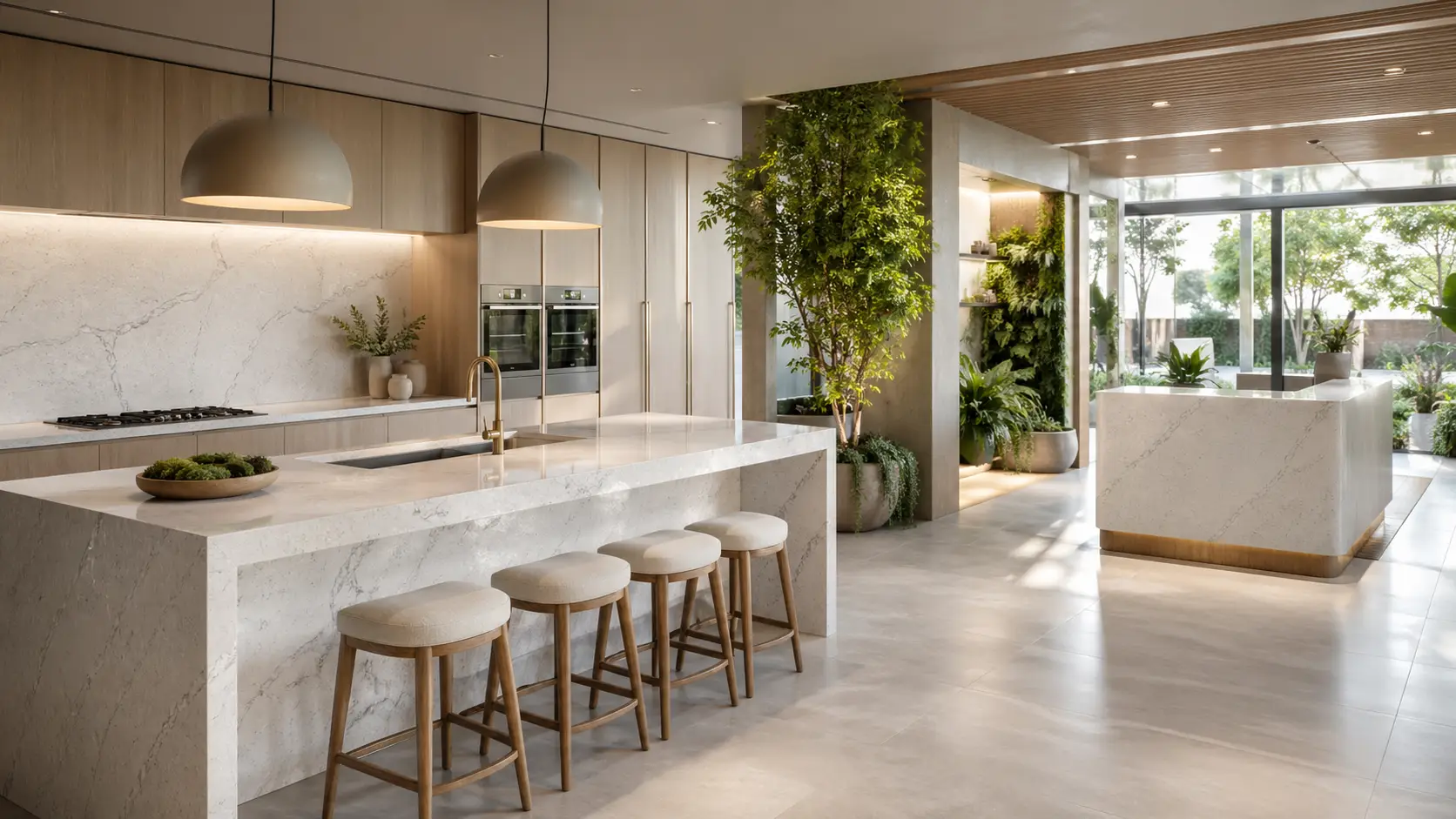
What Is Engineered Stone?
Engineered stone is a manufactured surface material made by combining mineral particles, stone powder, pigments, resin binders, and other additives into slabs or panels. It is commonly used for countertops, vanity tops, wall panels, reception desks, commercial counters, and modern interior surfaces.
The most common type is quartz-based engineered stone. These slabs often use quartz minerals as the main filler, combined with resin and pigments to create a stable and decorative surface. Different manufacturers may use different formulas, mineral ratios, resin systems, colour technologies, and surface finishes.
Engineered stone is popular because it gives buyers more control than many natural stones. The colour can be more consistent. The pattern can be designed. The supply can be more repeatable. The maintenance is often easier. For large projects, these advantages are important because they reduce uncertainty.
However, engineered stone is not one single material category with one environmental profile. Some products may contain high crystalline silica. Some may use recycled content. Some may be designed as low-silica engineered stone. Some may be marketed as sustainable but provide very little evidence. Some may be appropriate for one market but restricted in another.
This is why buyers should avoid judging all engineered surfaces as the same. A responsible sustainable engineered stone manufacturer should be able to explain what the product is made from, how it should be fabricated, what documentation is available, and which applications or markets are suitable.
Why Buyers Choose Engineered Stone
Buyers choose engineered stone because it solves several practical surface problems.
First, it offers visual consistency. Natural stone is beautiful, but it varies from slab to slab. For private luxury projects, this variation can be desirable. For hotels, apartments, retail chains, and commercial projects, too much variation can create approval delays and installation problems. Engineered stone helps buyers maintain a more controlled design language.
Second, it supports repeatable supply. A distributor or contractor can build a collection around engineered slabs more easily than rare natural materials. This is useful for wholesale sustainable quartz slabs, project-based purchasing, and long-term surface collections.
Third, it is usually easier to maintain than many natural marble surfaces. For busy kitchens, hotel bathrooms, and commercial interiors, lower maintenance can reduce complaints, cleaning complexity, and replacement risk.
Fourth, engineered stone offers broad design flexibility. It can be made in marble-look patterns, concrete-inspired tones, plain colours, terrazzo effects, warm neutrals, dramatic veining, or minimalist surfaces. This helps designers and buyers match different markets and interior styles.
But none of these advantages automatically make engineered stone sustainable. Durability and consistency are only part of the equation. Buyers still need to consider what happens before the slab is installed and what risks exist during fabrication.
Is Engineered Stone Eco-Friendly? The Honest Answer
The honest answer is: engineered stone can be eco-friendly under the right conditions, but it should be considered conditionally sustainable, not automatically green.
This is an important distinction. Many materials have both environmental advantages and environmental concerns. Natural stone is durable and naturally formed, but quarrying, transport, slab waste, and maintenance can affect its sustainability profile. Engineered stone can offer consistency, durability, and possible recycled content, but resin systems, silica dust risks, and recycling limitations must be considered.
A buyer-friendly way to judge engineered stone sustainability is to ask this question:
Does the product reduce long-term waste and maintenance while also supporting responsible sourcing, safer fabrication, clear documentation, and market compliance?
If the answer is yes, engineered stone may be a responsible choice. If the answer depends only on a supplier saying “eco-friendly” without data, buyers should be cautious.
When Engineered Stone Can Be More Sustainable
Engineered stone may support sustainability in several ways.
One advantage is durability. A longer-lasting surface can reduce replacement frequency. If a countertop, vanity, or commercial wall panel performs for many years with minimal maintenance, the project may consume fewer replacement materials over time.
Another advantage is production consistency. Engineered slabs can reduce some of the layout uncertainty associated with natural stone. In large projects, predictable colour and pattern can reduce rejected slabs, mismatched installations, and unnecessary replacement.
Some products may also include recycled materials, such as recycled glass, recycled mineral fillers, ceramic waste, or stone powder. When properly documented, recycled content can reduce the demand for virgin raw materials. However, buyers should always ask for the percentage and source of recycled content. A product should not be called recycled simply because it contains a small or unclear amount of reused material.
Engineered stone can also help reduce pressure on rare natural stones. For example, if a buyer wants the visual style of rare marble but does not need authentic geological uniqueness, a marble-look engineered surface may reduce dependence on scarce natural slabs.
Low maintenance is another sustainability factor. A surface that requires fewer aggressive cleaners, less sealing, fewer repairs, and fewer replacements can support lower long-term resource use.
These benefits are real, but they only matter when supported by transparency. Without documentation, sustainability claims are just decorative fog.
When Engineered Stone Is Not Eco-Friendly
Engineered stone may fail the eco-friendly test when important risks are ignored.
The first concern is silica exposure during fabrication. Cutting, grinding, drilling, or polishing high-silica engineered stone can create respirable crystalline silica dust if proper wet cutting, dust extraction, and protective procedures are not used. This is a serious worker safety issue and a major reason engineered stone has come under stronger regulatory attention in some markets.
The second concern is resin content. Most quartz-based engineered stone uses resin binders. These binders help create performance and appearance, but they also complicate the material’s environmental profile. Resin systems may affect emissions, recyclability, heat resistance, and end-of-life options.
The third concern is unclear recycled content. Some suppliers may promote “recycled quartz” or “eco quartz” without providing meaningful details. Buyers should ask whether the recycled content is pre-consumer or post-consumer, what percentage is used, and whether any third-party evidence exists.
The fourth concern is end-of-life recycling. Many engineered stone products are difficult to recycle after use because they combine mineral fillers, resin, pigments, and other components. A durable product can still be valuable, but buyers should not assume it is easy to recycle unless the supplier can explain the process.
The fifth concern is regulatory uncertainty. If a product is restricted in the destination market or requires special fabrication conditions that the project cannot support, it may not be a responsible choice for that buyer.
In short, engineered stone is not eco-friendly just because it looks clean, white, natural, or modern. Sustainability is not a surface finish. It is a chain of decisions.
Sustainability Factors Buyers Should Check Before Ordering
A sustainable surface decision should be based on evidence. Buyers should review both product performance and sourcing transparency.
| Sustainability Factor | Why It Matters | What Buyers Should Ask |
|---|---|---|
| Raw material source | Affects resource impact and supply responsibility | Are the minerals responsibly sourced? |
| Recycled content | Can reduce demand for virgin raw materials | What percentage of recycled material is used? |
| Resin system | Affects emissions, performance, and end-of-life options | What binder system is used? |
| Silica content | Directly affects fabrication safety | Is the product high-silica or low-silica? |
| Durability | Longer service life can reduce replacement waste | What is the expected service life? |
| Fabrication safety | Protects workers during cutting and polishing | Are wet cutting and dust control required? |
| Documentation | Helps prevent greenwashing | Can the supplier provide technical information? |
| Packaging | Affects export waste and slab protection | Is packaging optimized for safe transport? |
| Transport distance | Influences carbon footprint | Where is the product manufactured and installed? |
| Repairability | Extends product life | Can the surface be repaired or refinished? |
This table is a simple but powerful way to separate real sustainability from marketing language. If a supplier can answer these questions clearly, that is a good sign. If every answer is vague, buyers should proceed carefully.
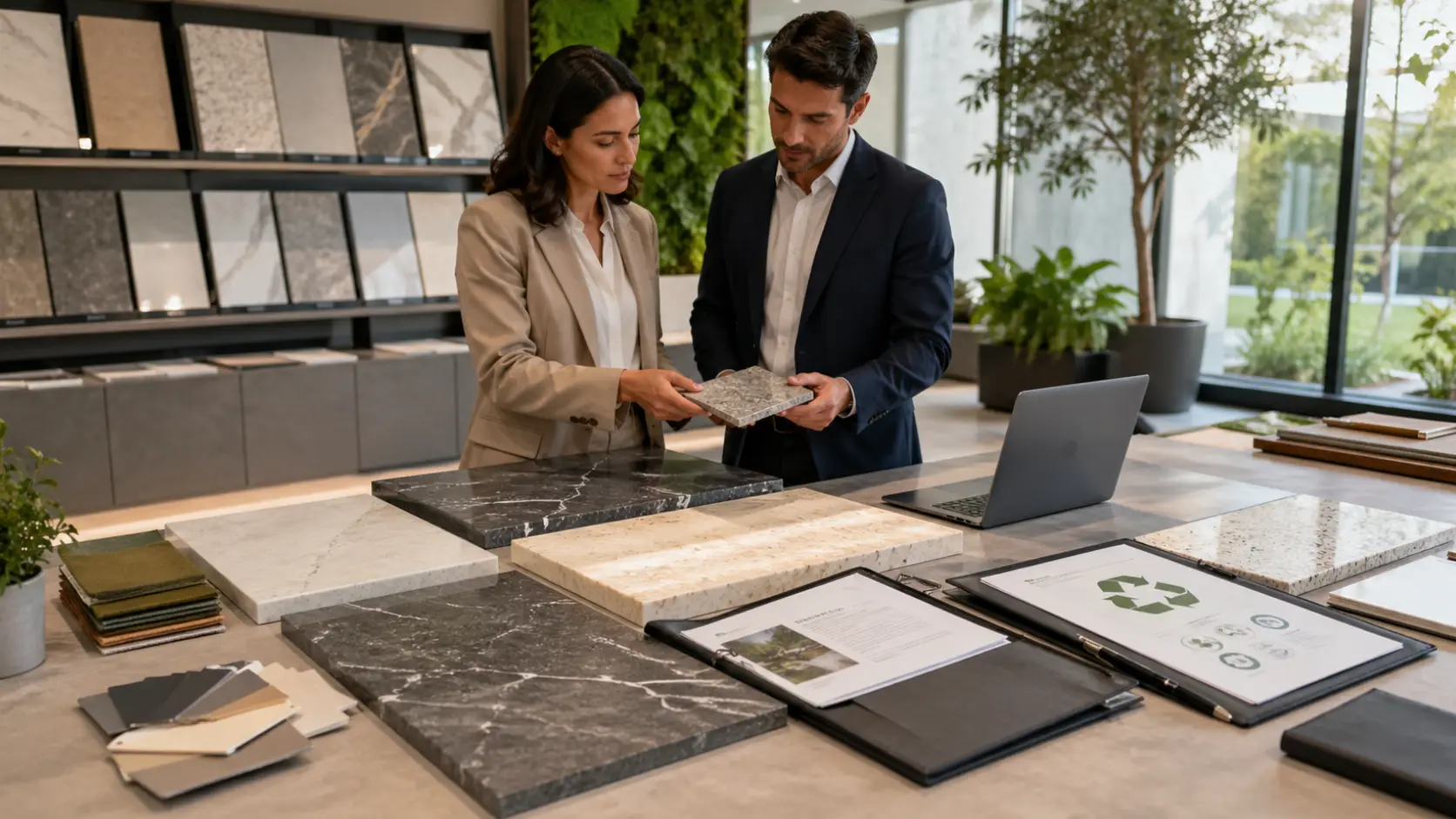
Engineered Stone vs Natural Stone: Which Is More Sustainable?
Many buyers ask whether engineered stone is better for the environment than natural stone. The answer depends on the project.
Natural stone has several sustainability strengths. It is naturally formed, often highly durable, and does not rely on synthetic resin systems in the same way engineered quartz does. Some natural stones can also be refinished or repurposed. For long-life architectural applications, natural stone can be an excellent material.
But natural stone also has environmental challenges. Quarrying changes landscapes. Slabs may travel long distances. Variation can increase layout waste. Some stones require sealing or more careful maintenance. Rare stones may also create pressure on limited natural resources.
Engineered stone has different strengths. It offers controlled production, repeatable patterns, stable sizing, and easier maintenance. It may use recycled content and reduce replacement risk in large projects. For commercial interiors, hotels, and multi-unit housing, these advantages can reduce waste caused by mismatch or inconsistent supply.
However, engineered stone also has risks. High-silica content, resin systems, difficult recycling, fabrication safety, and market restrictions must be reviewed. These issues are not small details. They are part of sustainability.
The more useful question is not “Which material is always greener?” The better question is “Which material creates the lowest total risk for this project, this location, this user, and this supply chain?”
| Material Type | Sustainability Advantage | Main Risk | Best Fit |
|---|---|---|---|
| Natural marble | Natural origin and long service life | Quarrying, maintenance, variation | Luxury interiors and natural stone projects |
| Engineered quartz | Consistency, durability, and low maintenance | Silica and resin concerns | Repeatable countertops and commercial surfaces |
| Low-silica engineered stone | Safer fabrication direction | Requires verification | Regulated markets and safer sourcing programs |
| Porcelain slabs | Low maintenance and heat resistance | Breakage risk during handling | Walls, counters, and commercial interiors |
| Recycled glass surface | Uses recycled material | Design and performance limits | Green building and decorative projects |
If your project focuses on replacing rare white marble with a more controllable and lower-maintenance surface, this guide to Calacatta marble alternative options explains why 3D printed stone and marble look quartz are becoming popular in modern kitchens, hotels, and commercial interiors.
The Silica Question: Why Worker Safety Is Part of Sustainability
A surface cannot be called truly sustainable if it looks environmentally responsible in a finished building but creates serious health risks during fabrication. This is why silica must be part of the sustainability conversation.
Crystalline silica can be present in quartz-based engineered stone. When slabs are cut, ground, drilled, or polished without proper controls, fine dust can be released. If workers inhale respirable crystalline silica dust, it can create serious long-term health risks.
For buyers, this changes the meaning of “eco-friendly.” Sustainability is not only about recycled content or durability. It is also about the people who mine, manufacture, cut, polish, transport, and install the material. Worker safety is not separate from sustainability; it is part of it.
This is one reason low silica engineered stone is becoming a more important industry direction. Buyers are beginning to ask suppliers whether lower-silica options are available, whether fabrication guidance is provided, and whether the product is suitable for the destination market.
A responsible eco-friendly quartz surface factory should not avoid these questions. It should provide clear information and encourage safe fabrication practices. If a supplier markets a surface as sustainable but refuses to discuss silica content or fabrication safety, that is a warning sign.
For modern buyers, the safest approach is to treat sustainability as a full checklist, not a marketing label. A surface should be beautiful, durable, documented, legally suitable, and responsibly fabricated. Anything less is only half a sustainability story.
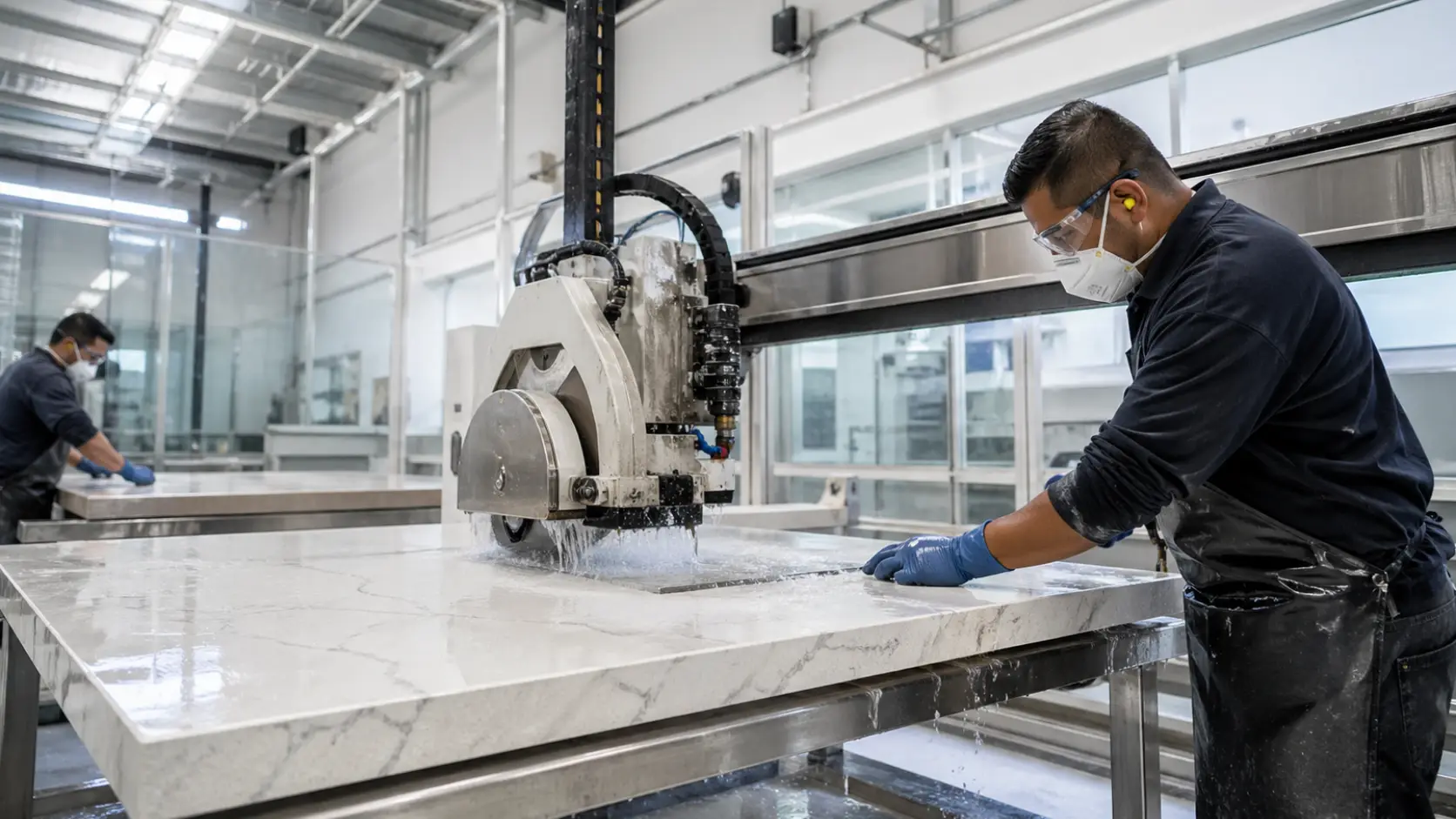
Low-Silica and Recycled Engineered Stone: The Next Industry Direction
The engineered stone industry is moving toward a more transparent and safety-conscious future. Buyers are no longer satisfied with beautiful slabs and broad sustainability claims. They want to know what the material contains, how it is made, how it should be fabricated, and whether it can meet market-specific requirements.
Two directions are becoming especially important: low silica engineered stone and recycled-content surfaces.
Low-silica engineered stone is gaining attention because it responds directly to one of the biggest concerns in the engineered surface industry: respirable crystalline silica dust during fabrication. The goal is not only to create a good-looking surface, but to reduce fabrication-related risk when combined with proper cutting, dust control, and workplace safety practices.
Recycled engineered surfaces are also becoming more relevant. Some products may use recycled glass, ceramic waste, stone powder, mineral by-products, or pre-consumer production waste. When properly verified, these materials can reduce demand for virgin raw materials and support a more circular sourcing model.
However, buyers must be careful. “Recycled” is not enough. A responsible supplier should be able to explain the recycled content percentage, material source, whether it is pre-consumer or post-consumer, and whether performance is affected. A surface that uses recycled content but fails in durability, fabrication safety, or compliance may not be the better choice.
The future of sustainable engineered stone will depend on three things: lower-risk material design, reliable documentation, and honest communication. Buyers should look for suppliers that can provide all three.
For buyers comparing modern quartz innovations beyond basic sustainability claims, our 3D Print Full Body Quartz surface technology guide explains how advanced engineered quartz surfaces are being developed for stronger visual continuity, modern fabrication needs, and premium interior applications.
Greenwashing Risks in Engineered Stone Marketing
Greenwashing happens when a product looks environmentally responsible in marketing but lacks real evidence behind the claim. In the stone and surface industry, this can be surprisingly easy to miss because many materials already look natural, clean, and premium.
Common greenwashing phrases include “eco-friendly,” “green quartz,” “natural quartz,” “sustainable stone,” “recycled surface,” and “environmentally safe.” These words may sound convincing, but buyers should ask what they actually mean.
A supplier may call a product eco-friendly because it is durable. Another may use the term because the product contains some recycled material. Another may use it simply because the surface looks natural. These are not the same thing.
Buyers should be especially careful when a supplier makes environmental claims without data. If there is no information about silica content, resin system, recycled percentage, fabrication guidance, or destination-market suitability, the claim is incomplete.
A real engineered stone eco-friendly supplier should be able to support its claims with practical information. This does not always mean a perfect product. No material is perfect. But it does mean the supplier should be honest about strengths, limitations, and buyer responsibilities.
In simple terms, sustainability should be proven, not decorated.
Buyer Pain Points in Sustainable Stone Sourcing
The Product Looks Green, But Documentation Is Missing
Many buyers face this problem. The product page says sustainable. The catalog says eco-friendly. The salesperson says the factory is responsible. But when the buyer asks for material composition, silica information, recycled content details, or fabrication guidance, the answers become vague.
For serious B2B sourcing, missing documentation is a real risk. It can create problems during project approval, import review, contractor evaluation, and long-term customer support.
The Material Is Durable, But Fabrication Risk Is High
Durability is important, but it does not automatically make a product sustainable. If the material creates significant dust risk during fabrication and the supplier provides no safety guidance, the sustainability story is incomplete.
A durable surface should also be responsibly processed. Buyers should work with fabricators that follow appropriate cutting, dust extraction, and workplace safety procedures.
Recycled Content Is Claimed But Not Verified
Some suppliers promote recycled content but do not explain the percentage, source, or verification. This makes it difficult for buyers to compare products fairly.
A recycled-content claim should answer basic questions. What material is recycled? How much is used? Is it pre-consumer or post-consumer? Does it affect performance? Is there any supporting documentation?
If the answer is only “yes, recycled,” that is not enough.
The Product Is Not Suitable for the Destination Market
This is one of the most serious risks. A surface may be attractive, durable, and competitively priced, but if it does not meet the target market’s regulations or fabrication requirements, it may create major problems.
International buyers should confirm market suitability before placing orders. This is especially important for engineered surfaces in countries or regions with stricter rules around silica exposure or engineered stone use.
Low Price Creates Hidden Compliance Risk
Cheap materials can be tempting. But in sustainable sourcing, low price can hide bigger risks: unclear composition, weak documentation, poor packaging, higher breakage rates, limited quality control, or no compliance support.
A low-cost slab is not truly economical if it causes delays, rejections, replacements, or customer complaints. In B2B sourcing, the real cost is not only the invoice. It is the total risk behind the purchase.
Common Mistakes Buyers Make
Mistake 1: Believing “Eco-Friendly” Without Data
The word eco-friendly should start a conversation, not end one. Buyers should ask for evidence. What makes the product eco-friendly? Is it recycled content? Lower silica? Longer service life? Reduced waste? Safer fabrication? Better documentation?
If the supplier cannot explain the claim clearly, buyers should treat it as marketing language.
Mistake 2: Ignoring Silica Content
Silica content matters because it affects fabrication safety. Buyers should not treat it as a technical detail only for workshops. It is part of responsible sourcing.
A buyer does not need to become a safety engineer, but they should ask whether the supplier can disclose silica-related information and provide fabrication guidance.
Mistake 3: Treating Durability as the Only Sustainability Metric
A long-lasting surface is valuable, but sustainability includes more than durability. It also includes material sourcing, worker safety, emissions, waste, packaging, transport, repairability, and end-of-life considerations.
A product can be durable and still have sustainability concerns. The strongest choices perform well across multiple factors.
Mistake 4: Forgetting Destination-Market Regulations
Different markets may treat engineered stone differently. Buyers should not assume that one product can be sold or installed everywhere without review.
Before ordering, confirm whether the product category, silica content, fabrication requirements, and import rules fit the destination market.
Mistake 5: Choosing a Supplier Based Only on Price
Price matters, but it should not be the only decision factor. In sustainable stone sourcing, a good supplier reduces risk through documentation, quality control, packing, communication, and market awareness.
A cheap supplier that cannot answer compliance questions may become expensive later. Tiny price win, giant project headache. Classic bad trade.
How to Source Sustainable Engineered Stone Responsibly
Responsible sourcing starts before the buyer compares colours.
First, start with the destination market. Where will the product be sold, fabricated, and installed? Are there restrictions on engineered stone? Are there workplace safety requirements for fabrication? Does the buyer need specific documentation?
Second, ask for product documentation. A reliable sustainable engineered stone manufacturer should provide information about material composition, surface performance, care instructions, packing, and fabrication guidance where available.
Third, review silica and safety information. If the product is quartz-based, buyers should ask about silica content and fabrication precautions. Safer fabrication should involve wet cutting, dust extraction, and appropriate protective measures according to local rules.
Fourth, check whether recycled content is real. Ask for the material type, percentage, source, and any verification available. Recycled content can be valuable, but only when it is clearly explained.
Fifth, compare alternatives when needed. If engineered stone is not suitable for a market or project, buyers can compare natural stone, porcelain slabs, sintered stone, recycled glass surfaces, or low-silica engineered surfaces.
Finally, work with a supplier that communicates honestly. A professional engineered stone factory with compliance documentation should not promise that every product fits every market. A cautious, informed answer is often more trustworthy than an easy “yes.”
Sustainable Engineered Stone Supplier Checklist
| Supplier Question | Good Sign | Red Flag |
|---|---|---|
| Can you provide material composition information? | Clear product specifications are available | Supplier only uses vague eco-friendly claims |
| Is silica content disclosed or explained? | Supplier provides a report or practical guidance | Supplier avoids the question |
| Is recycled content verified? | Percentage and material source are stated | Supplier only says “recycled” without details |
| Is fabrication guidance provided? | Wet cutting and dust control guidance is discussed | No safety information is available |
| Can you support export documentation? | Supplier understands B2B documentation needs | Supplier only provides a price quote |
| Do you understand destination-market requirements? | Supplier gives cautious and specific guidance | Supplier says “no problem” to everything |
| Are full slab photos available? | Buyer can review real slab appearance | Only edited catalog images are provided |
| Is packaging optimized for export? | Supplier uses safe packing methods | Packing details are unclear |
When Engineered Stone Is a Good Sustainable Choice
Engineered stone can be a good sustainable choice when the product offers long service life, low maintenance, reliable documentation, and suitable market compliance.
It is especially useful when the project needs repeatable colour and pattern across multiple units. For hotels, apartments, commercial interiors, and wholesale surface programs, consistency can reduce waste caused by mismatched slabs or rejected installations.
It can also be a good choice when natural stone variation would create excessive waste or approval delays. If the buyer wants a marble-look surface without depending on rare natural slabs, engineered stone may reduce sourcing uncertainty.
Low-silica or recycled-content engineered surfaces may become stronger options when the supplier can provide clear verification and the product is suitable for the destination market.
In short, engineered stone works best as a sustainable option when its advantages are proven, not assumed.
When Buyers Should Consider Other Surface Materials
Buyers should consider alternatives when the destination market restricts engineered stone, when the supplier cannot provide silica information, or when fabrication safety cannot be properly managed.
Natural stone may be better when the project specifically requires authentic natural material and long-term architectural value. Porcelain or sintered stone may be better when the buyer needs heat resistance, low maintenance, and a material category that better fits local regulations. Recycled glass surfaces may be suitable for projects where recycled content is a major design or certification requirement.
The best surface is not the one with the greenest slogan. It is the one that fits the project’s environmental goals, safety requirements, design needs, maintenance expectations, and legal conditions.
Practical Recommendation for Buyers
Engineered stone can be eco-friendly, but only under the right conditions. Buyers should look for durable performance, responsible sourcing, verified recycled content where available, silica transparency, safer fabrication guidance, proper packaging, and destination-market compliance.
If a supplier provides clear documentation, realistic product information, and responsible guidance, engineered stone can be a practical surface option for modern kitchens, hotels, commercial interiors, and wholesale projects.
If a supplier only uses “eco-friendly” as a marketing phrase, buyers should slow down. Ask more questions. Compare alternatives. Request documents. Review regulations. A sustainable purchase is not built on a nice word; it is built on evidence.
Before sourcing sustainable engineered stone for your next project, MIYA STONE recommends reviewing product specifications, full slab photos, silica-related information, recycled content details, packing plans, and market suitability with your supplier. A responsible sourcing process may take slightly longer at the beginning, but it can prevent costly mistakes later.
Buyers planning kitchens, hotels, commercial interiors, or wholesale surface programs can work with a reliable sustainable engineered stone supplier to review product specifications, slab options, documentation, packing plans, and market suitability before placing a bulk order.
Frequently Asked Questions
1. Is engineered stone eco-friendly?
Engineered stone can be eco-friendly under the right conditions, but it is not automatically sustainable. Buyers should evaluate raw materials, recycled content, resin system, silica content, durability, fabrication safety, documentation, packaging, and destination-market compliance. A product with long service life, clear documentation, safer fabrication guidance, and verified recycled or responsible material content may be a practical sustainable choice. However, vague green claims without data should be treated carefully.
2. Is engineered quartz sustainable?
Engineered quartz can be sustainable in some applications because it is durable, low-maintenance, visually consistent, and suitable for repeatable project use. These qualities may reduce replacement, cleaning complexity, and installation waste. However, engineered quartz may also involve resin binders, silica-related fabrication risks, and recycling limitations. Buyers should ask suppliers for material information, silica guidance, recycled content details, and market-specific documentation before calling engineered quartz sustainable.
3. Is engineered stone better for the environment than natural stone?
There is no universal answer. Natural stone has the advantage of natural origin, long service life, and low synthetic binder content, but quarrying, transport, slab variation, and maintenance can affect its environmental profile. Engineered stone offers consistency, design control, and low maintenance, but it may involve resin systems, silica dust during fabrication, and recycling challenges. The better choice depends on the project location, application, supply chain, maintenance expectations, and available documentation.
4. What is low silica engineered stone?
Low silica engineered stone is a type of engineered surface designed to reduce crystalline silica content compared with traditional high-silica engineered quartz products. The goal is to support safer fabrication when combined with proper wet cutting, dust extraction, and workplace safety procedures. Buyers should not rely only on the term “low silica.” They should ask for technical information, supplier documentation, and confirmation that the material is suitable for the destination market.
5. Why is engineered stone restricted or banned in some markets?
Engineered stone has been restricted or banned in some markets mainly because fabrication activities such as cutting, grinding, drilling, and polishing can release respirable crystalline silica dust when proper controls are not used. This dust can create serious health risks for workers. Restrictions are intended to reduce occupational exposure and encourage safer material choices, better documentation, and improved fabrication practices.
6. What should buyers ask before sourcing sustainable engineered stone?
Before sourcing sustainable engineered stone, buyers should ask about material composition, silica content, recycled content, resin system, durability, care requirements, fabrication guidance, packaging, export documentation, and destination-market suitability. Buyers should also request full slab photos, technical specifications, and realistic supplier guidance. These questions help separate genuine sustainable sourcing from unsupported green marketing.
7. What is the most sustainable alternative to engineered stone?
The most sustainable alternative depends on the project. Natural stone may be suitable for long-life architectural applications where authentic material value is important. Porcelain or sintered stone may be suitable for low-maintenance surfaces and certain regulated markets. Recycled glass surfaces may be appropriate for projects prioritizing recycled content. Low-silica engineered stone may be a better option where safer fabrication is a key concern. Buyers should compare materials based on lifecycle performance, safety, maintenance, compliance, and documentation.
References
- Safe Work Australia, “Engineered Stone Ban,” Safe Work Australia.
- Australian Border Force, “Prohibited Goods: Engineered Stone,” Australian Border Force.
- Occupational Safety and Health Administration, “Respirable Crystalline Silica,” OSHA.
- National Institute for Occupational Safety and Health, “Silica, Crystalline,” NIOSH.
- Centers for Disease Control and Prevention, “Work-Related Silicosis,” CDC.
- European Commission, “Circular Economy Action Plan,” European Commission.
- U.S. Green Building Council, “LEED v4.1 Building Design and Construction,” USGBC.
- Natural Stone Institute, “Dimension Stone Design Manual,” Natural Stone Institute.
- United Nations Environment Programme, “2023 Global Status Report for Buildings and Construction,” UNEP.
How to Judge Whether Engineered Stone Is Truly Eco-Friendly
What it means: Engineered stone is not automatically eco-friendly simply because it looks clean, modern, or mineral-based. A truly sustainable engineered stone surface should be evaluated through raw material sourcing, recycled content, silica level, resin system, durability, fabrication safety, packaging, transport impact, documentation, and destination-market compliance. Buyers should treat sustainability as a full evidence chain, not a marketing label.
Why it matters: Many buyers choose engineered stone because it offers consistent appearance, low maintenance, strong durability, and repeatable supply for kitchens, hotels, commercial interiors, and wholesale surface projects. These advantages can support sustainable sourcing when they reduce replacement waste, avoid unnecessary slab rejection, and extend the service life of the surface. However, if silica risks, unclear recycled content, or missing documentation are ignored, the eco-friendly claim becomes weak.
How buyers should evaluate it: A responsible buyer should ask whether the supplier can provide material composition information, silica-related guidance, recycled content details, fabrication recommendations, full slab photos, export packaging information, and market-specific compliance support. If a supplier can explain these points clearly, the product is easier to evaluate. If the supplier only says “green,” “eco,” or “sustainable” without evidence, buyers should slow down.
Option insight: Choose engineered stone when the project needs durable, consistent, low-maintenance surfaces with verified documentation and suitable market compliance. Choose low silica engineered stone when safer fabrication is a key project concern. Choose natural stone when authentic geological material, long architectural life, and natural uniqueness are the main priorities. Choose porcelain, sintered stone, or recycled glass surfaces when the project requires different compliance, heat resistance, recyclability, or design goals.
Application insight: Sustainable engineered stone can be suitable for kitchen countertops, bathroom vanities, hotel interiors, apartment projects, commercial reception desks, wall panels, and wholesale slab collections. These applications often benefit from design consistency, lower maintenance, and predictable supply. For large projects, repeatable surface quality can reduce waste caused by mismatch, rejection, or replacement.
Compliance consideration: Modern surface sourcing is increasingly influenced by silica exposure rules, engineered stone restrictions, fabrication safety, and import requirements. Buyers should confirm whether the selected material is allowed in the destination market and whether fabricators can follow proper wet cutting, dust extraction, and workplace safety procedures. A material should not be judged as sustainable if it creates preventable health or compliance risks during processing.
Greenwashing warning: Words such as “eco-friendly,” “green quartz,” “natural quartz,” “recycled surface,” and “sustainable stone” are not enough by themselves. Buyers should request supporting data, including recycled content percentage, silica disclosure, product specifications, care guidance, fabrication notes, and export documentation. Real sustainability is measurable; vague sustainability is just decoration.
Practical recommendation: Engineered stone can be a responsible and eco-friendly surface choice when it combines long service life, verified material information, safer fabrication guidance, suitable compliance, and reliable supplier support. Before placing a bulk order, buyers should work with a transparent engineered stone supplier such as MIYA STONE to review product data, project requirements, destination-market rules, and long-term sourcing risks.


