
The Calacatta Marble Problem Buyers Rarely See at First
Calacatta marble has a special place in luxury interior design. Its bright white background, bold grey or gold veining, and dramatic natural movement make it one of the most recognizable premium marble styles in the world. For kitchen islands, bathroom vanities, fireplace walls, hotel lobbies, and luxury retail interiors, Calacatta marble creates an immediate feeling of elegance.
But buyers usually discover the difficult part after the design mood board is approved.
The slab in the reference photo looks perfect. The showroom sample looks refined. The designer loves the visual impact. The end client wants the “rare Italian marble look.” Then the procurement stage begins, and the practical problems appear: limited availability, unpredictable veining, higher maintenance expectations, batch variation, higher waste risk, longer approval cycles, and more difficult project matching.
This is why the search for a reliable Calacatta marble alternative has become more serious among homeowners, designers, contractors, hotel developers, and surface distributors. Buyers still want the Calacatta look, but they do not always want the uncertainty that comes with rare natural stone.
That is where marble look quartz and 3D printed stone enter the conversation.
Unlike natural Calacatta marble, which depends on quarry availability and natural block variation, 3D printed quartz can be designed with controlled veining, repeatable surface style, and more predictable production. It does not replace the geological uniqueness of marble in every situation, but it gives project buyers a more manageable option when beauty must also meet deadlines, budgets, durability expectations, and supply planning.
The real question is not whether marble is beautiful. Of course it is. The real question is whether rare Calacatta marble is the right material for every project that wants a Calacatta-style surface. In many modern interiors, the answer is no. A well-made Calacatta marble alternative can deliver the desired design language while reducing the risks that often make natural marble difficult for large or high-use projects.
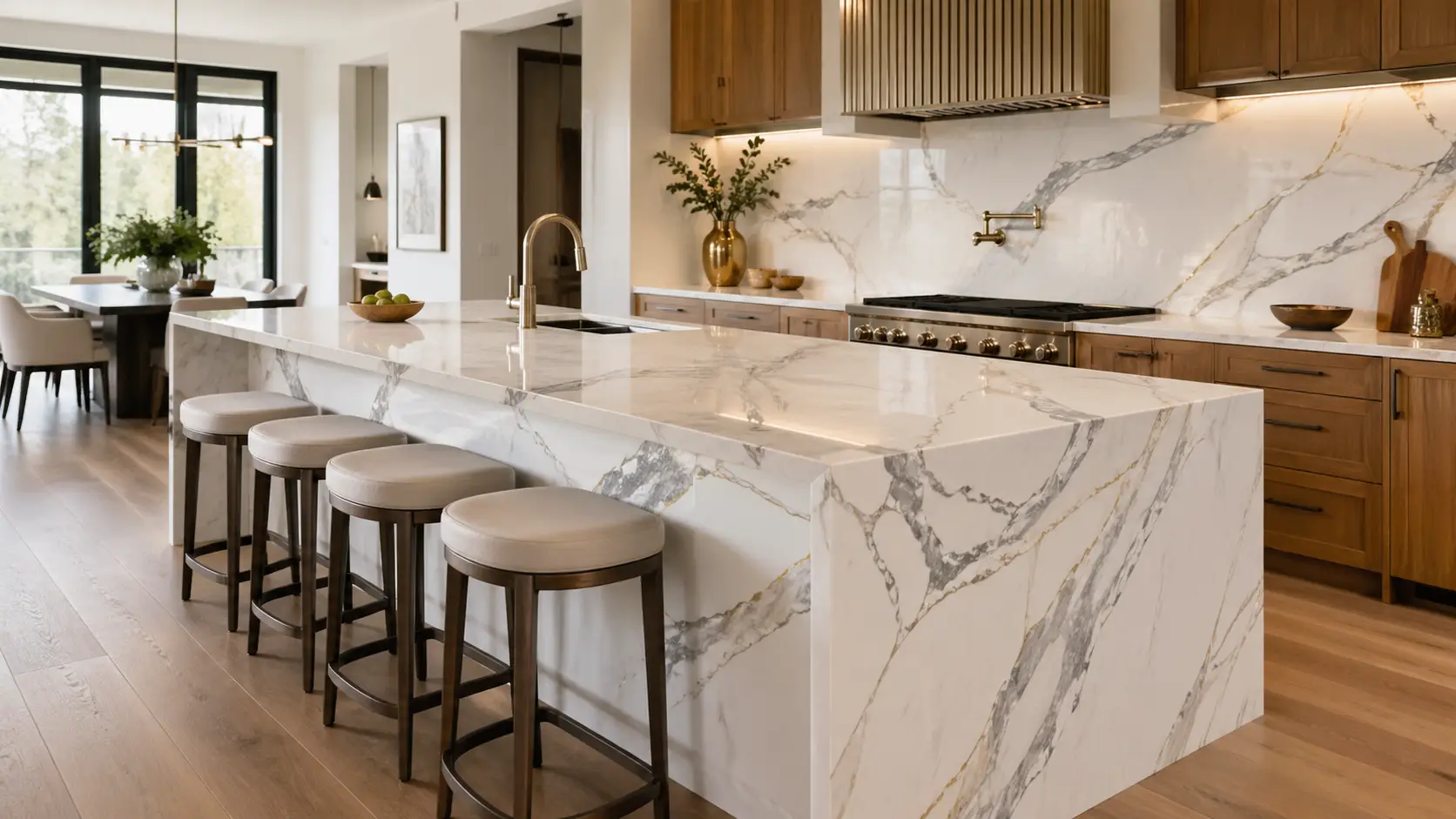
Why Calacatta Marble Is So Desired
Calacatta marble is not popular by accident. It has a visual identity that is hard to ignore. Compared with many softer white stones, Calacatta marble often features a cleaner white or warm white background with stronger, more dramatic veining. This contrast gives it a bold architectural character.
Designers choose Calacatta marble when they want a surface to become the visual centre of a room. It can turn a kitchen island into a sculptural feature. It can make a bathroom vanity feel like part of a luxury suite. It can create a reception wall that immediately signals elegance and quality.
The appeal usually comes from four visual qualities.
First, the white background creates brightness. It makes spaces feel cleaner, larger, and more refined. This is especially valuable in modern kitchens, boutique hotels, luxury apartments, and premium bathrooms.
Second, the veining creates movement. Calacatta marble does not look flat. Its veins can be bold, sweeping, sharp, soft, grey, beige, or gold-toned. This movement gives the stone a natural artistic quality.
Third, the material carries heritage value. Calacatta marble is strongly associated with Italian stone, classical architecture, and luxury interiors. That association helps explain why many clients ask for it by name.
Fourth, every slab is different. For some buyers, this uniqueness is a major advantage. A natural slab cannot be exactly duplicated, which gives high-end residential and artistic projects a sense of exclusivity.
However, the same qualities that make Calacatta marble attractive can also make it difficult to use. Natural variation is beautiful when the client wants uniqueness. It becomes a problem when a project needs consistency across many rooms, units, or surfaces.
That tension creates the opening for 3D printed stone and marble look quartz.
The Hidden Buyer Problems Behind Natural Calacatta Marble
Rare marble creates a very specific kind of procurement risk. The problem is not simply that it is expensive or high-end. The problem is that it is difficult to standardize.
A homeowner selecting one slab for one kitchen may enjoy the process of choosing a unique piece. A hotel buyer selecting vanity tops for 120 rooms has a very different problem. The hotel does not only need beauty. It needs consistency, replacement planning, installation efficiency, and long-term maintenance control.
Natural Calacatta marble can create several hidden challenges.
Slab-to-Slab Variation
No two natural slabs are exactly the same. This is part of marble’s charm, but it can make matching difficult. One slab may have a clean white base with soft grey veins. Another may have warmer tones, stronger gold movement, or heavier veining. When several slabs are installed in the same space, variation can become very visible.
For private luxury projects, variation can feel artistic. For commercial or multi-unit projects, it may feel inconsistent.
Limited Availability
Calacatta marble is not an endlessly repeatable factory product. Its availability depends on quarry output, block quality, slab selection, and market demand. When a buyer needs a specific look, size, and quantity, sourcing can become slow and uncertain.
This is especially risky for projects with fixed construction schedules. A delay in stone approval can delay fabrication, installation, and final handover.
Higher Maintenance Expectations
Natural marble requires careful use and maintenance. It can be sensitive to acidic substances, staining, and surface etching. In busy kitchens, hospitality bathrooms, restaurants, or commercial spaces, this can become a long-term concern.
The issue is not that marble is weak. The issue is that the user must understand how to care for it. If the end user expects a low-maintenance surface, natural marble may lead to complaints later.
Higher Fabrication and Waste Risk
Natural marble can vary in strength, veining direction, fissures, and internal structure. Fabricators often need to plan layouts carefully to reduce breakage or visual mismatch. Complex cuts, bookmatching, large islands, and wall panels require skilled handling.
Waste is not only a material cost. It affects timing, approval, replacement, and project coordination.
Difficult Repeat Orders
A distributor or contractor may sell a beautiful natural Calacatta marble project once, but repeating the same look later can be difficult. If the original block is no longer available, replacement pieces may not match.
This is a major reason why wholesalers and surface brands often look for wholesale marble look quartz slabs. A stable engineered collection is easier to promote, sample, stock, and reorder.
What Makes 3D Printed Quartz a Strong Calacatta Marble Alternative?
A strong Calacatta marble alternative must do more than look white with grey veins. It must solve real buyer problems.
3D printed quartz becomes valuable because it offers controlled Calacatta-style beauty with more predictable production. It allows manufacturers to design the white base, vein movement, colour temperature, pattern direction, and overall slab appearance in a way that supports modern projects.
This is especially important for B2B buyers. A distributor needs products that can be marketed consistently. A contractor needs products that can be delivered on schedule. A hotel developer needs surfaces that look coherent across many rooms. A fabricator needs slabs that are easier to plan and cut. A homeowner needs a beautiful surface that is easier to maintain.
3D printed stone can support these needs because it is designed rather than quarried. The surface pattern can be created with a specific design goal in mind: soft Calacatta veining, bold luxury veining, warm white backgrounds, grey-and-gold movement, or more minimalist stone effects.
High-quality marble look quartz can therefore deliver the emotional appeal of Calacatta marble while reducing the practical risks that make natural marble difficult for many projects.
For buyers who want to understand how full-body pattern continuity, edge performance, and advanced quartz surface technology work in real fabrication, this 3D Print Full Body Quartz guide offers a deeper technical explanation.
It Recreates the Calacatta Look with Better Control
The strongest advantage of 3D printed quartz is visual control.
Natural Calacatta marble is controlled by geology. 3D printed quartz is controlled by design and manufacturing. That does not make it more “natural,” but it can make it more project-friendly.
Manufacturers can create a clean white or warm ivory background. They can adjust veining intensity. They can design grey, beige, or gold movement. They can produce a surface that looks dramatic enough for luxury projects but controlled enough for repeated use.
This is especially useful when buyers want a specific design language.
For example, a modern kitchen brand may want a bold white quartz surface with elegant grey veins. A hotel group may prefer softer movement to avoid overwhelming small bathrooms. A luxury apartment developer may want a warm Calacatta look that pairs with brass hardware and oak cabinets. A commercial designer may need large slabs with balanced veining for reception walls.
With natural marble, each of these preferences depends heavily on slab availability. With 3D printed stone, the pattern can be developed with a clearer design direction.
This is not about pretending engineered quartz is natural marble. It is about giving buyers a controlled alternative when the Calacatta look is desired but natural variation is not ideal.
It Reduces the Risk of Natural Slab Variation
Variation is the soul of natural marble. It is also the headache of project procurement.
When a buyer chooses rare Calacatta marble, the visual result depends on the specific slabs available at that time. The buyer may love the first slab but struggle to find matching pieces for a second island, backsplash, wall panel, or future replacement. In a large project, this problem becomes more serious.
Marble look quartz reduces this risk by offering more repeatable patterns and colours. While batch control still matters, engineered production gives the supplier more ability to maintain a consistent visual style.
For distributors, this matters because a stable product line is easier to sell. Customers can see a sample and trust that the delivered slabs will follow the same general appearance. For contractors, it reduces approval delays. For designers, it helps maintain the design concept across multiple rooms. For homeowners, it reduces the chance of disappointment between sample selection and final installation.
This is one reason Calacatta look quartz slabs are widely used in kitchens, bathrooms, hotels, apartments, and commercial interiors. They give buyers the confidence to apply a luxury marble look across repeated spaces without relying on rare natural slab matching.
It Offers Easier Maintenance for Daily Use
Calacatta marble is beautiful, but it asks something from the user. It asks for care. It asks for awareness. It asks the owner not to treat it like an ordinary surface.
In kitchens, bathrooms, and hospitality spaces, this can become a challenge. Acidic liquids, harsh cleaners, spills, cosmetics, and daily wear can affect natural marble if it is not properly protected and maintained. For some buyers, this is acceptable. For others, it becomes a problem.
Marble look quartz is popular because it offers a lower-maintenance alternative. It gives buyers a Calacatta-inspired appearance while reducing many of the daily care concerns associated with natural marble. For busy households, rental properties, hotels, commercial bathrooms, and high-traffic interiors, this can be a major advantage.
The benefit is not only technical. It is emotional. End users want a surface that looks refined without making them nervous every time someone places a drink, makeup bottle, or cooking ingredient on it. A surface that looks luxurious but feels fragile can create stress. A surface that looks luxurious and performs predictably creates confidence.
That confidence is a major reason buyers search for a Calacatta marble alternative.
3D Printed Stone vs Natural Calacatta Marble: Buyer-Focused Comparison
A useful comparison should not simply say one material is better than the other. Natural Calacatta marble and 3D printed quartz serve different buyer needs. The right choice depends on the project type, design expectation, maintenance tolerance, supply requirement, and destination market.
| Comparison Point | Natural Calacatta Marble | 3D Printed Quartz / Marble Look Quartz | Buyer Takeaway |
|---|---|---|---|
| Visual Character | Unique natural veining with one-of-a-kind movement | Designed Calacatta-style veining with controlled visual direction | Choose marble for natural uniqueness; choose quartz for repeatable design control |
| Supply Stability | Limited by quarry availability, block selection, and natural variation | More predictable production and collection planning | Quartz is stronger for projects requiring repeated surfaces |
| Maintenance | Requires more careful cleaning, sealing awareness, and protection from etching | Easier daily maintenance for kitchens, bathrooms, and commercial spaces | Quartz reduces after-sales care concerns |
| Batch Matching | More difficult because every slab is naturally different | More manageable with production and batch control | Quartz helps distributors, developers, and contractors reduce mismatch risk |
| Fabrication Planning | Requires careful slab selection and layout planning | More predictable for repeated cuts and standard project planning | Quartz can support easier project scheduling |
| Design Flexibility | Limited to available natural blocks and slabs | Patterns, tones, and veining styles can be developed for different markets | Quartz supports brand collections and custom design directions |
| Best Use | High-end natural interiors, artistic spaces, statement projects | Kitchens, hotels, apartments, commercial counters, wall panels, wholesale collections | Match the material to project risk, not only visual preference |
| Buyer Risk | Variation, maintenance, sourcing uncertainty, replacement difficulty | Supplier quality, pattern realism, batch control, compliance review | Both materials require due diligence, but the risks are different |
This comparison shows why 3D printed quartz is not simply a cheaper imitation. For many buyers, it is a different strategic choice. It offers the Calacatta design language in a more controllable form.
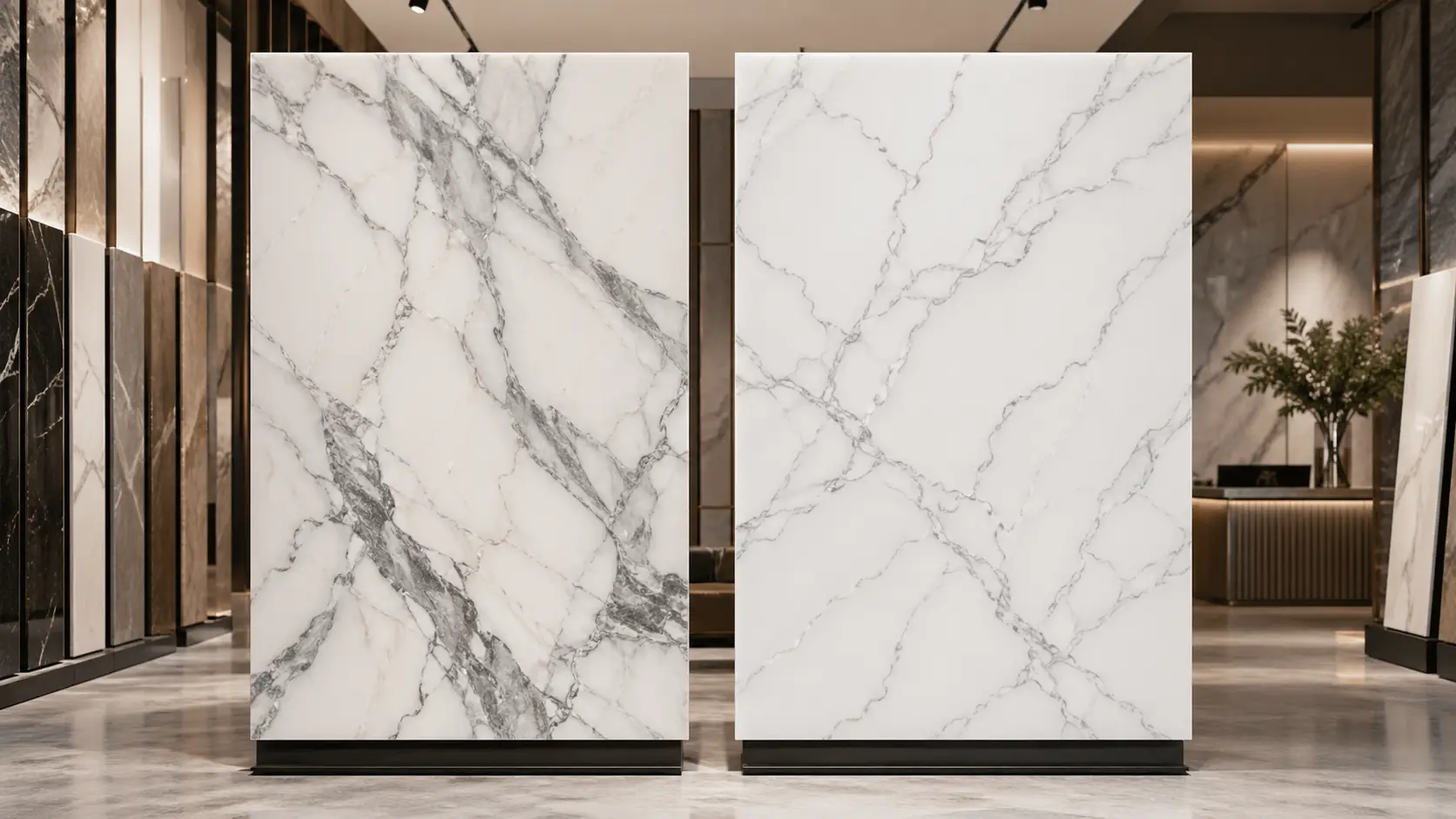
Where 3D Printed Quartz Performs Better Than Rare Marble
Multi-Unit Residential Projects
Multi-unit residential projects need consistency. Whether the project is a luxury apartment building, serviced residence, villa development, or condominium renovation, the developer usually wants a unified design language.
Natural Calacatta marble can be difficult in this situation because each slab varies. Some units may receive beautiful bold veining. Others may receive softer or warmer slabs. Even when all slabs are premium, the visual result may not feel consistent across the project.
Calacatta look quartz slabs solve this problem more effectively. They allow designers and developers to repeat a clean luxury look across kitchens, vanities, backsplashes, and shared spaces. This helps reduce client disputes and makes project approval easier.
For developers, consistency is not boring. It is risk control.
Hotel Bathrooms and Vanity Tops
Hotels need materials that look premium, clean easily, and perform across repeated spaces. A hotel bathroom vanity may not be large, but it is used frequently. Guests bring cosmetics, toiletries, water, soaps, and cleaning products into daily contact with the surface.
Natural marble can work beautifully in ultra-luxury hospitality projects, but it requires careful maintenance planning. Many hotel buyers prefer marble look quartz because it provides a high-end appearance with easier care and better consistency across rooms.
For hotel groups, the main benefit is not only appearance. It is operational predictability. If a product can be repeated across dozens or hundreds of rooms, the design team, purchasing team, installation team, and maintenance team all benefit.
Commercial Reception Desks and Feature Walls
A reception desk is not just furniture. It is a visual statement. It tells visitors what kind of space they have entered. In hotels, clinics, offices, showrooms, and luxury retail stores, the reception area often carries the brand’s first impression.
Rare Calacatta marble can make a stunning statement, but it may not always be practical for commercial environments that require durable, repeatable, and easier-to-maintain surfaces. 3D printed stone can create a similar luxury visual effect while making project planning easier.
For feature walls, large slab appearance matters. Buyers should choose patterns that look natural at full scale, not only in small samples. A high-quality 3D printed quartz slab should have balanced movement, believable veining, and a background tone that works with lighting and interior materials.
Kitchen Countertops for Busy Homes
Homeowners love Calacatta marble because it makes a kitchen feel bright, expensive, and timeless. But many homeowners also want surfaces that can handle everyday cooking, cleaning, family use, and entertaining.
This is where marble look quartz becomes highly practical. It allows homeowners to achieve a Calacatta-inspired kitchen without accepting the same level of natural marble maintenance. For busy homes, that difference matters.
The kitchen is not a museum. It is a working space. A good Calacatta marble alternative should support both beauty and daily use.
Wholesale Surface Collections
Distributors and surface retailers need stable products. A rare natural marble may be beautiful, but it can be difficult to turn into a long-term collection. Availability may change. Colour may vary. Replacement slabs may not match. Customers may expect the sample to match the delivered product more closely than natural stone can guarantee.
For this reason, wholesale marble look quartz slabs are attractive. They allow suppliers to build repeatable product lines, promote consistent samples, and serve more buyers with less sourcing uncertainty.
A reliable marble look quartz supplier can help distributors create collections based on specific market preferences: bold Calacatta for luxury kitchens, soft grey veining for minimalist interiors, warm white backgrounds for transitional homes, or gold-vein designs for boutique hospitality spaces.
Where Natural Calacatta Marble Still Makes Sense
A strong article should be honest: 3D printed quartz is not the best answer for every project.
Natural Calacatta marble still makes sense when the buyer values authenticity above all else. If the design brief requires real natural stone, geological uniqueness, and a luxury material story, Calacatta marble remains powerful.
It also makes sense when natural variation is desired rather than feared. In a private residence, gallery-style interior, luxury bathroom, or architectural feature wall, the unpredictability of marble can become part of the design value.
Natural marble may also be the right choice when the buyer understands and accepts the maintenance requirements. Some clients are willing to care for marble properly because they value the natural material experience.
This is why the decision should not be framed as “quartz is better than marble.” That is too simple. The better decision logic is this: choose natural Calacatta marble when authenticity and uniqueness are the priority; choose 3D printed quartz when the project needs Calacatta-style beauty with better consistency, easier maintenance, and stronger project control.
Buyer Pain Points When Choosing a Calacatta Marble Alternative
The Surface Looks Like Calacatta, But the Pattern Feels Fake
Not all Calacatta quartz alternative products are convincing. Some surfaces use overly dramatic veins, repeated patterns, or flat printing that looks artificial at full slab size. A small sample may look acceptable, but the full slab may reveal design weaknesses.
This is one of the biggest risks when choosing 3D printed stone. The buyer must judge the full visual movement, not just a small corner sample.
A good Calacatta-style quartz surface should have natural spacing, balanced vein thickness, and a believable relationship between background and movement. If the pattern looks too mechanical, the finished project may feel less premium.
The White Background Is Too Cold or Too Blue
Colour temperature matters. Many buyers focus only on vein colour and forget the white background. A white base that is too cold, too blue, or too grey may not match warm cabinets, brass hardware, cream walls, or natural wood finishes.
High-end interiors often need softer whites, warm whites, or ivory tones rather than harsh artificial white. This is especially true in North American and European residential markets, where warm minimalism, quiet luxury, and transitional design remain popular.
When reviewing marble look quartz, buyers should compare samples under natural light, warm indoor light, and showroom lighting. The same slab can look different depending on the environment.
Small Samples Do Not Show the Full Slab Movement
Calacatta-style surfaces depend on movement. A small sample cannot show how the veins travel across a large countertop, island, or wall panel.
This creates a real buyer risk. The sample may show a beautiful section, but the full slab may have too much empty space, too much vein concentration, or obvious pattern repetition. Buyers should always request full slab photos or videos before confirming bulk orders.
For large projects, this step is not optional. It protects design approval, fabrication planning, and customer satisfaction.
Supplier Photos Are Over-Edited
Surface photos can be misleading. Brightness, contrast, saturation, and showroom lighting can all make a slab look cleaner or more dramatic than it is in real life.
Buyers should request natural-light photos, close-up photos, full slab images, edge photos, and real project cases. If the supplier only provides heavily edited catalog images, the buyer may not have enough information to make a safe decision.
This is especially important for Calacatta marble alternative manufacturer evaluation. A reliable manufacturer should be confident enough to show realistic material images.
The Product Is Sold as “Marble Look” But Not Project-Ready
Some products look attractive online but are not ready for serious project use. They may lack stable batch production, export packaging, quality control, fabrication guidance, or documentation.
For B2B buyers, this is dangerous. A product is not project-ready just because it has a good image. It must also support sampling, production planning, batch matching, packing, shipping, fabrication, and after-sales service.
A strong 3D printed stone factory should understand the full project cycle, not just product appearance.
Why 3D Printed Quartz Is Becoming More Relevant Under New Surface Regulations
The surface industry is changing. For many years, buyers compared marble, quartz, granite, porcelain, and sintered stone mainly by appearance, price position, durability, and maintenance. Today, the decision is becoming more complicated. Regulations, fabrication safety, import restrictions, silica exposure control, and material transparency are now part of the buying conversation.
This does not mean every buyer should avoid engineered quartz. It means buyers should understand where and how the material will be used, fabricated, imported, and installed. The best surface decision is no longer based only on which slab looks most luxurious in a showroom. It must also consider whether the material fits the project location, local safety requirements, and long-term user expectations.
For buyers searching for a Calacatta marble alternative, this matters because alternatives are not all the same. Natural marble, marble look quartz, porcelain slabs, sintered stone, and other engineered surfaces may fall under different rules depending on the country or region. A material that works well for one market may require extra review in another.
In recent years, engineered stone has received more regulatory attention because cutting, grinding, drilling, and polishing can release respirable crystalline silica dust if proper controls are not used. The installed surface is usually not the main concern. The higher-risk stage is fabrication. This is why professional buyers should ask how the material should be cut, what safety procedures fabricators should follow, and whether the supplier can provide clear product information.
Australia has taken one of the strictest positions on engineered stone, while other regions continue to focus on workplace exposure limits and safer fabrication practices. This regulatory movement is pushing manufacturers to improve material transparency, explore lower-silica innovations, provide clearer documentation, and communicate safer processing guidance.
For buyers, the message is simple: the best Calacatta marble alternative is not only the one that looks closest to rare marble. It is the one that fits the design brief, performs in daily use, supports responsible fabrication, and can be legally and safely used in the destination market.
What Surface Regulations Mean for Buyers
Surface regulations affect buyers in several practical ways.
First, buyers should confirm whether the selected material is suitable for the target market. If the project is located in a country with engineered stone restrictions, the buyer must review local rules before confirming the order. This is especially important for importers, distributors, developers, and contractors working across different countries.
Second, buyers should understand the difference between installed use and fabrication risk. A countertop in daily use is not the same as a slab being cut in a workshop. Fabrication activities can create dust exposure if handled improperly. Responsible fabricators should use wet cutting, dust extraction, protective equipment, and workplace safety procedures according to local requirements.
Third, buyers should ask suppliers for material information. A reliable marble look quartz supplier should not hide behind vague descriptions. Product specifications, material category, fabrication guidance, care instructions, packing information, and compliance-related documents all help buyers make safer decisions.
Fourth, buyers should consider alternative surfaces when needed. In some markets, porcelain slabs, sintered stone, natural stone, or other compliant surfaces may be more suitable depending on the project location. A good supplier should be honest about this. If every question receives the same answer — “no problem, everything is fine” — that is not reassurance. That is a red flag wearing a tiny sales hat.
The stronger suppliers will not simply sell a slab. They will help buyers understand where the product fits, where caution is needed, and what information should be checked before ordering.
How Manufacturers Should Adapt to the New Buyer Mindset
Manufacturers that want to sell 3D printed stone successfully in the modern market need to do more than produce beautiful slabs. They need to support better decision-making.
This starts with clearer product positioning. If a product is engineered quartz, say so clearly. If it is porcelain, sintered stone, natural marble, or another surface category, identify it accurately. Ambiguous naming may help short-term marketing, but it creates long-term buyer risk.
Manufacturers should also improve documentation. Buyers increasingly expect product data, care guides, fabrication notes, packing details, slab photos, batch information, and safety-related communication. These documents are useful not only for compliance but also for building trust.
Another important direction is lower-risk material innovation. As regulations become stricter, buyers will pay more attention to silica content, dust-control guidance, and safer processing methods. A 3D printed stone factory that invests in cleaner technology, better labeling, and safer handling information will be more competitive.
Finally, manufacturers should develop more realistic design collections. Buyers are becoming more sophisticated. They can recognize fake-looking veining, repeated patterns, cold artificial whites, and over-edited catalog photos. Future marble look quartz products must combine visual beauty with better design restraint, warmer tones, full slab realism, and project-ready consistency.
The future belongs to suppliers who can explain both design value and buyer risk. Pretty slabs will open the door. Clear documentation and reliable support will close the deal.
Common Mistakes Buyers Make When Choosing a Calacatta Marble Alternative
Mistake 1: Treating All Calacatta Look Quartz as the Same
Not every white quartz slab with grey veining should be considered a strong Calacatta marble alternative. Some products imitate the idea of Calacatta marble but miss the details that make the original so desirable.
A convincing Calacatta-style surface needs balance. The background should not feel overly flat or plastic. The veins should not look randomly pasted onto the surface. The movement should feel intentional but not mechanical. The white tone should work with real interiors, not only under showroom lights.
Buyers who treat all Calacatta look quartz slabs as equal may end up choosing a product that looks acceptable in small samples but weak in large installations. This can hurt the final project impression, especially in luxury kitchens, hotels, and commercial interiors.
Mistake 2: Choosing the Most Dramatic Vein Without Considering Layout
Bold veining attracts attention, but more drama is not always better. A strong vein may look impressive in a catalog image but become difficult to place on a small vanity top, narrow backsplash, or multi-unit project.
For large kitchen islands, dramatic veining can create a powerful focal point. For smaller countertops, it may feel crowded or unbalanced. For hotel bathrooms, subtle veining may be more suitable because it supports a clean and consistent guest experience.
The best choice depends on layout. Buyers should think about slab size, cutting plan, seam position, cabinet colour, wall finish, lighting, and viewing distance. A good marble look quartz manufacturer should help buyers choose patterns based on project use, not only visual excitement.
Mistake 3: Ignoring Batch Control
Batch control is one of the most important B2B purchasing issues. A buyer may approve one sample, but the delivered slabs may come from a different production batch. Even with engineered quartz, slight colour and pattern differences can occur.
For a single residential project, this may be manageable. For a hotel, apartment building, retail chain, or wholesale product line, batch inconsistency can create serious problems.
Buyers should ask for actual batch photos before shipment. They should also confirm whether the supplier can reserve slabs from the same batch for large projects. For distributors, stable batch control helps protect customer confidence and reduces after-sales disputes.
Mistake 4: Forgetting the Maintenance Expectations of End Users
Some buyers choose natural Calacatta marble because it looks prestigious, then later discover that end users are not prepared to care for it properly. This is common in kitchens, rental properties, hotel bathrooms, and commercial spaces.
If the end user expects a low-maintenance surface, marble look quartz may be the better choice. It offers a luxury appearance without requiring the same level of daily caution as natural marble.
Buyers should match the material not only to the design concept but also to the user’s lifestyle. A surface can be beautiful and still be wrong for the project if maintenance expectations are mismatched.
Mistake 5: Not Checking Local Compliance Rules
This mistake is becoming more serious. Some buyers still choose surfaces based only on appearance and supplier quotation. That is no longer enough.
If the project involves engineered surfaces, buyers should check local rules related to import, fabrication, silica exposure, and workplace safety. This is especially important for international trade, commercial projects, and distributors selling into regulated markets.
A responsible Calacatta marble alternative manufacturer should be able to provide basic product information and support buyers in understanding material category and intended use. The supplier does not replace the buyer’s local legal review, but it should not avoid compliance-related questions.
Mistake 6: Trusting Over-Edited Product Photos
Beautiful photos sell slabs, but they can also mislead buyers. Over-brightened images may make the white base look cleaner than it is. Increased contrast may make veins appear sharper. Warm filters may hide cold undertones. Cropped images may avoid showing pattern repetition.
Before ordering, buyers should request full slab photos, natural-light images, close-up surface shots, edge photos, and real project photos. For serious orders, video inspection can also help.
A product that only looks good after heavy editing is not a strong product. It is a photography project wearing a countertop costume.
How to Choose a Reliable Marble Look Quartz Manufacturer
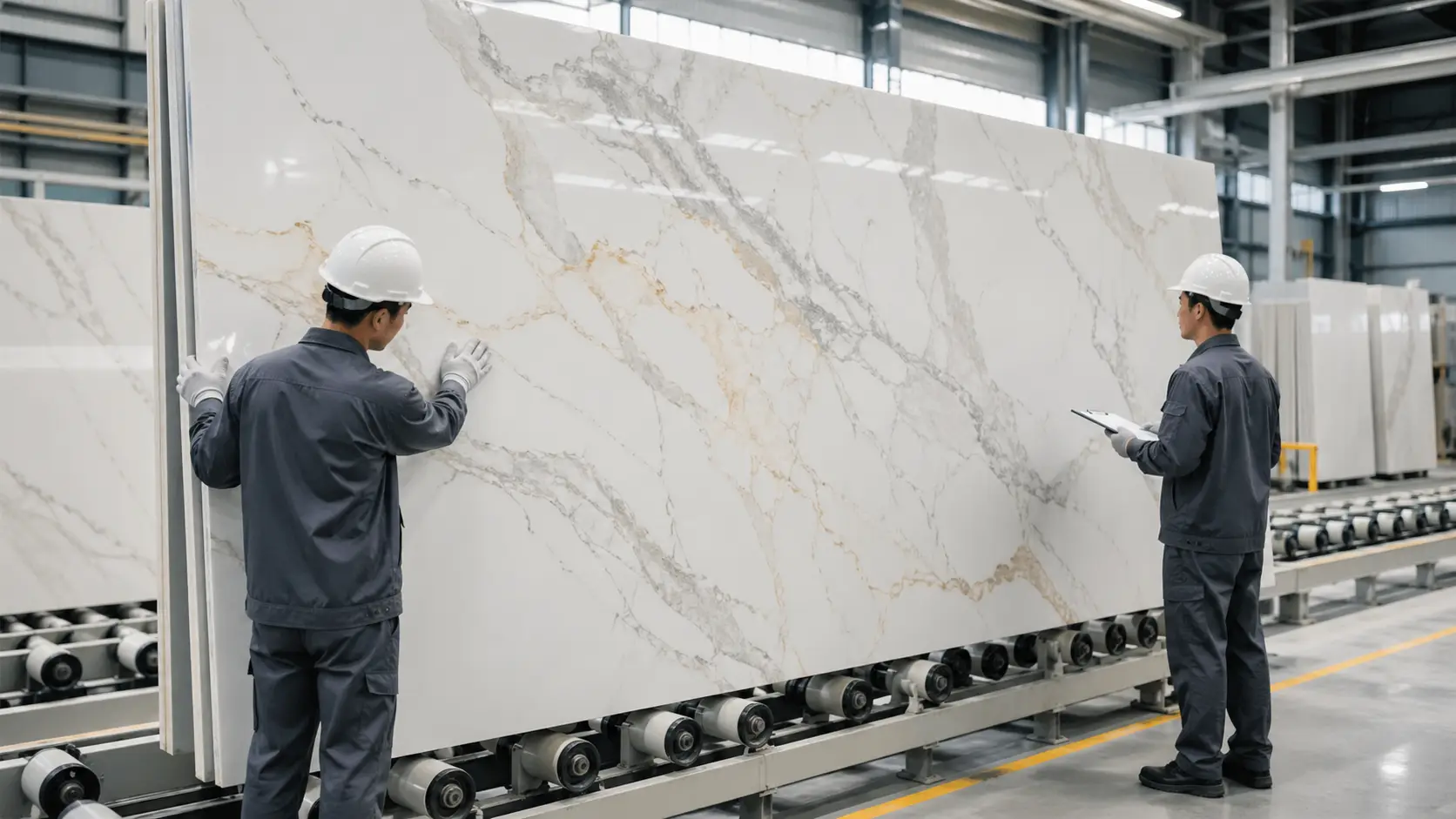
Check Pattern Design Capability
A reliable marble look quartz manufacturer should understand design, not only production. Calacatta-style quartz is not simply “white slab plus grey veins.” The quality depends on background tone, vein movement, spacing, scale, depth, and how the pattern works across a full slab.
Buyers should ask whether the supplier offers different Calacatta styles, such as soft grey veining, bold dramatic veining, warm white backgrounds, gold-vein designs, book-match inspired layouts, or custom patterns.
This is especially important for distributors and brands. A supplier with stronger design capability can help build a more competitive product collection rather than offering generic slabs that many factories already sell.
Ask for Full Slab Images
Small samples are useful, but they are not enough. Calacatta-style patterns must be judged at full slab scale. A small piece may show one beautiful vein, but it cannot reveal overall movement, spacing, repetition, or balance.
Buyers should ask for full slab photos before approving an order. Ideally, these photos should include natural lighting, different angles, and images from the actual production batch.
For wholesale marble look quartz slabs, full slab review is especially important because distributors need confidence that the product can be sold consistently to fabricators and end clients.
Request Real Project Cases
Real project photos show how the surface performs after fabrication and installation. They reveal what catalog photos cannot: seam placement, edge appearance, lighting interaction, wall colour compatibility, cabinet pairing, and overall design effect.
A strong supplier should be able to show examples of kitchens, hotel bathrooms, reception desks, wall panels, or commercial interiors using similar products. These examples help buyers judge whether the product is truly project-ready.
If a supplier has no real cases, buyers should be more cautious. It does not automatically mean the product is bad, but it does mean the buyer needs more sample testing before ordering in bulk.
Confirm Batch and Production Control
Batch control protects project consistency. Buyers should ask how the supplier manages colour difference, slab grouping, pattern repeatability, inspection, and shipment separation.
For large projects, the buyer should request batch reservation where possible. If slabs are shipped in multiple containers, the supplier should help maintain visual consistency across shipments.
A reliable 3D printed stone factory should understand that batch control is not a small warehouse detail. It is part of product quality.
Review Export Packaging and Documentation
Export buyers need more than good slabs. They need good logistics support.
Quartz slabs are heavy and require careful packing. Poor packaging can lead to broken corners, cracked slabs, surface scratches, and container damage. Buyers should ask about A-frame packing, slab protection, loading methods, and shipping experience.
Documentation also matters. A professional supplier should provide product specifications, packing lists, commercial invoices, care instructions, and other required order documents. For regulated markets, buyers may also need material information and compliance-related support.
Evaluate Communication Quality
Communication is often underestimated. A supplier may have good products, but if communication is slow, unclear, or inconsistent, the order can still become risky.
Buyers should evaluate how the supplier responds to technical questions. Can they explain slab options clearly? Do they understand the project application? Can they provide photos quickly? Do they answer compliance questions responsibly? Do they clarify lead time, sample process, and packing details?
A strong supplier reduces uncertainty. A weak supplier adds noise. And in B2B purchasing, noise is expensive.
Supplier Selection Checklist
| Supplier Check | Why It Matters |
|---|---|
| Full slab photos | Shows real pattern movement, scale, and visual balance |
| Natural-light images | Reduces the risk of over-edited or misleading colour presentation |
| Small and large samples | Helps compare detail quality and full-surface appearance |
| Edge and cut samples | Shows fabrication appearance and material consistency |
| Real project cases | Proves the product can work in actual interiors |
| Batch photos | Reduces colour mismatch risk before shipment |
| Production capability | Supports stable supply for distributors and projects |
| Export packaging | Protects slabs during long-distance shipping |
| Compliance support | Helps buyers review market suitability and documentation |
| OEM design ability | Supports private-label collections and custom product lines |
Practical Recommendation: When Should Buyers Choose 3D Printed Quartz?
Buyers should choose 3D printed quartz when they want the Calacatta marble look but need more control over maintenance, supply, batch consistency, and project delivery.
For a private villa, gallery-like interior, or luxury space where natural uniqueness is the main value, rare Calacatta marble can still be the right choice. If the buyer accepts natural variation, sealing, careful maintenance, and possible sourcing delays, marble delivers a material story that engineered surfaces cannot fully copy.
For busy kitchens, hotel bathrooms, commercial reception desks, apartment developments, and wholesale surface collections, marble look quartz is often the more practical choice. It gives buyers the desired white-and-grey Calacatta design language while making the project easier to repeat, maintain, and manage.
For international buyers, the final decision should also consider market rules. If the destination market has restrictions on engineered surfaces, the buyer should confirm compliance before ordering. In some cases, alternative materials such as porcelain slabs, sintered stone, or natural stone may be more appropriate.
For distributors and surface brands, the smartest option is to work with a supplier that can provide stable patterns, full slab documentation, batch control, realistic photography, export packaging, and responsive communication. A strong Calacatta marble alternative manufacturer does not only sell a beautiful slab. It helps buyers avoid the hidden problems that turn beautiful materials into project headaches.
The best decision is not based on one sample, one photo, or one fashionable trend. It is based on the project’s real needs: design effect, user lifestyle, maintenance tolerance, supply stability, fabrication requirements, compliance environment, and long-term business value.
Final Takeaway: The Best Alternative Is the One That Reduces Risk Without Losing Beauty
Calacatta marble will always have a place in luxury design. Its natural beauty, rarity, and historical prestige are difficult to replace. But not every project that wants a Calacatta look needs natural Calacatta marble.
In many modern interiors, buyers need a surface that looks elegant, installs predictably, maintains more easily, and supports repeatable project delivery. This is where 3D printed stone and marble look quartz become powerful alternatives.
A well-made Calacatta marble alternative should do three things at the same time. It should capture the visual emotion of rare marble. It should reduce the practical risks of sourcing and maintenance. It should help buyers complete projects with more confidence.
For homeowners, that means a beautiful kitchen that is easier to live with. For hotel developers, it means consistent vanity tops and walls across many rooms. For distributors, it means a stable product line that can be sampled, stocked, and reordered. For designers, it means more control over the final visual result.
The smartest buyers do not ask, “Can quartz copy marble perfectly?” That question misses the point. The better question is, “Can this surface deliver the Calacatta look my project needs with fewer risks and better control?” For many modern projects, the answer is yes.
Frequently Asked Questions
1. What is the best Calacatta marble alternative?
The best Calacatta marble alternative for many modern projects is high-quality 3D printed quartz or marble look quartz. It offers the bright white background and bold veining associated with rare Calacatta marble while providing easier maintenance, better batch consistency, and more predictable supply. Natural Calacatta marble is still valuable when authenticity and one-of-a-kind veining are the main priorities, but quartz is often more practical for kitchens, hotels, apartments, commercial interiors, and wholesale surface collections.
2. Is 3D printed quartz the same as Calacatta marble?
No, 3D printed quartz is not the same as Calacatta marble. Calacatta marble is a natural stone formed by geological processes, while 3D printed quartz is an engineered surface created through design and manufacturing. The purpose of 3D printed quartz is to recreate the Calacatta-style appearance with better control, easier maintenance, and more repeatable production. It can look similar in design language, but the material origin, performance, maintenance, and sourcing logic are different.
3. Why do buyers choose marble look quartz instead of natural Calacatta marble?
Buyers choose marble look quartz instead of natural Calacatta marble because it reduces many practical risks. It is easier to maintain, more consistent across batches, more predictable for large projects, and often easier to source repeatedly. Natural Calacatta marble offers authentic beauty and unique veining, but it can also bring variation, maintenance concerns, sourcing uncertainty, and replacement difficulty. For buyers who want a luxury marble appearance with stronger project control, marble look quartz is often the better choice.
4. Does marble look quartz look natural?
High-quality marble look quartz can look very natural, especially when the pattern has balanced veining, a realistic white background, soft colour transitions, and full slab movement. However, not all products are equal. Buyers should check full slab photos, natural-light images, real project cases, and edge samples before ordering. If the pattern repeats too obviously or the white background looks too artificial, the finished surface may not achieve a premium Calacatta-style effect.
5. Is 3D printed stone suitable for hotel and commercial projects?
Yes, 3D printed stone is suitable for many hotel and commercial projects because it supports repeatable design, easier maintenance, and more predictable supply. It is commonly used for hotel bathroom vanities, reception desks, wall panels, apartment kitchens, retail counters, and commercial interiors. Buyers should still check destination-market rules, fabrication safety requirements, supplier documentation, and batch consistency before placing a bulk order.
6. What should buyers check before ordering Calacatta look quartz slabs?
Before ordering Calacatta look quartz slabs, buyers should check full slab photos, batch images, natural-light pictures, edge samples, real project cases, surface finish, thickness options, packing method, lead time, and supplier export experience. For large projects or wholesale orders, buyers should also confirm batch reservation, production stability, documentation support, and compliance-related information for the destination market.
7. Is Calacatta marble still worth choosing?
Yes, Calacatta marble is still worth choosing when the project values authentic natural stone, rare geological veining, and one-of-a-kind luxury character. It is a strong choice for high-end residences, artistic interiors, statement walls, and projects where natural variation is part of the design concept. However, if the buyer needs easier maintenance, stronger consistency, repeatable supply, and better project control, 3D printed quartz or marble look quartz may be the more practical alternative.
References
- Safe Work Australia, “Engineered Stone Ban,” Safe Work Australia.
- Australian Border Force, “Prohibited Goods: Engineered Stone,” Australian Border Force.
- Occupational Safety and Health Administration, “Respirable Crystalline Silica,” OSHA.
- National Institute for Occupational Safety and Health, “Silica, Crystalline,” NIOSH.
- Centers for Disease Control and Prevention, “Work-Related Silicosis,” CDC.
- Natural Stone Institute, “Dimension Stone Design Manual,” Natural Stone Institute.
- Natural Stone Institute, “Natural Stone Countertop and Surface Guidance,” Natural Stone Institute.
- Marble.com, “The Differences Between Calacatta and Carrara Marble,” Marble.com.
- Better Marble, “Calacatta Marble Explained: Varieties, Benefits, and Uses,” Better Marble.
Why 3D Printed Quartz Is Becoming a Practical Calacatta Marble Alternative
What it means: A Calacatta marble alternative is not simply a cheaper material that looks white with grey veins. For modern buyers, it means a surface that can capture the visual language of rare Calacatta marble while reducing the practical risks of sourcing, maintenance, batch variation, fabrication waste, and project delay. High-quality 3D printed quartz and marble look quartz are designed to provide this balance between luxury appearance and project control.
Why buyers compare it with Calacatta marble: Natural Calacatta marble is valued for its bright white background, bold veining, and unique geological character. However, its rarity also creates challenges for commercial buyers, hotel developers, distributors, and large residential projects. Slab-to-slab variation, limited availability, higher care requirements, and difficult repeat orders can make natural marble harder to manage when consistency and delivery certainty matter.
How 3D printed quartz solves the project problem: 3D printed stone allows manufacturers to control the background tone, vein direction, pattern scale, and overall Calacatta-style appearance more predictably. This helps buyers achieve a marble-inspired surface across countertops, vanity tops, reception desks, feature walls, and multi-unit interiors without relying only on rare natural slab availability. For B2B buyers, the real value is not only appearance, but repeatability, documentation, and supplier reliability.
Option insight: Choose natural Calacatta marble when authentic geological uniqueness, natural prestige, and one-of-a-kind veining are the top priorities. Choose marble look quartz when the project needs easier maintenance, more stable batch matching, controlled design, and repeatable supply. Choose alternative surfaces such as porcelain or sintered stone when the destination market, fabrication rules, or project requirements make engineered stone less suitable.
Application insight: Marble look quartz is especially useful for kitchen countertops, hotel bathroom vanities, apartment projects, commercial reception desks, retail interiors, and wholesale slab collections. These applications often require a consistent luxury look across multiple surfaces or repeated orders. In such cases, 3D printed quartz can help reduce the mismatch, maintenance, and replacement risks that may occur with rare natural Calacatta marble.
Buyer consideration: Buyers should not judge a Calacatta marble alternative only by small samples or edited product photos. The safer approach is to request full slab images, natural-light photos, batch photos, edge samples, real project cases, packing details, production lead time, and compliance-related documentation. This is especially important for distributors, fabricators, contractors, and developers placing bulk or repeat orders.
Market and compliance insight: Global surface selection is increasingly influenced by fabrication safety, silica exposure control, import rules, and material transparency. Buyers should confirm whether the selected 3D printed quartz or marble look quartz is suitable for the destination market and should work with responsible fabricators that follow proper cutting, dust control, and safety procedures. The best material choice must satisfy both design expectations and market-specific requirements.
Practical recommendation: 3D printed quartz is a strong Calacatta marble alternative when the buyer wants the visual emotion of rare marble but needs better consistency, easier daily care, and more predictable project execution. Before ordering, work with a reliable marble look quartz manufacturer or 3D printed stone factory that can provide realistic slab evidence, stable production control, export packaging, and clear supplier support.


