
Quick Summary: A Quartz Countertop is one of the most practical and design-flexible choices for modern kitchens because it combines low maintenance, strong stain resistance, and consistent visual appeal. If you are comparing the Best Quartz Countertop, planning a Kitchen Quartz Countertop, or learning How to Choose Quartz for Kitchen layouts, the right decision depends on kitchen size, daily cooking habits, surface finish, and supplier quality. For compact spaces, the Best Quartz Countertop for Small Kitchens is usually a light, balanced surface that improves brightness, reduces visual clutter, and supports easy everyday care.
Choosing the right countertop is one of the most important decisions in any kitchen project. It affects not only the visual style of the room, but also daily maintenance, long-term durability, resale appeal, and how comfortably the kitchen supports real life. A countertop is not a decorative afterthought. It is the surface that handles meal preparation, hot dishes, spills, family traffic, and years of routine use. That is exactly why so many homeowners, contractors, developers, and designers keep returning to the same question: how do you choose the right Quartz Countertop for your kitchen?
The answer is not simply “pick the whitest slab” or “choose the cheapest option.” A truly effective choice depends on kitchen size, layout, lighting, usage habits, cooking frequency, cabinet color, maintenance expectations, and the quality level of the product itself. A compact apartment kitchen may require a very different solution from a large open-plan island kitchen. A family with children needs different performance priorities than a luxury show kitchen designed mainly for entertaining. That is why understanding How to Choose Quartz for Kitchen projects properly can save time, money, and regret later.
Today, Kitchen Quartz Countertop products are among the most preferred surfaces in both residential and commercial interior design because they combine visual consistency, low maintenance, strong stain resistance, and broad style flexibility. Whether you are comparing Best Quartz Countertop options for a remodel, looking for the Best Quartz Countertop for Small Kitchens, or sourcing through a quartz countertop manufacturer or quartz countertop factory for larger projects, the same principle applies: the best product is the one that matches real usage, not just showroom appearance.
This guide will help you evaluate quartz countertops from a practical and technical perspective. It covers material parameters, real-use scenarios, side-by-side comparisons with granite, marble, and porcelain, current market trends, key certifications, buying mistakes to avoid, and a step-by-step method for choosing the best quartz surface for your kitchen with confidence.
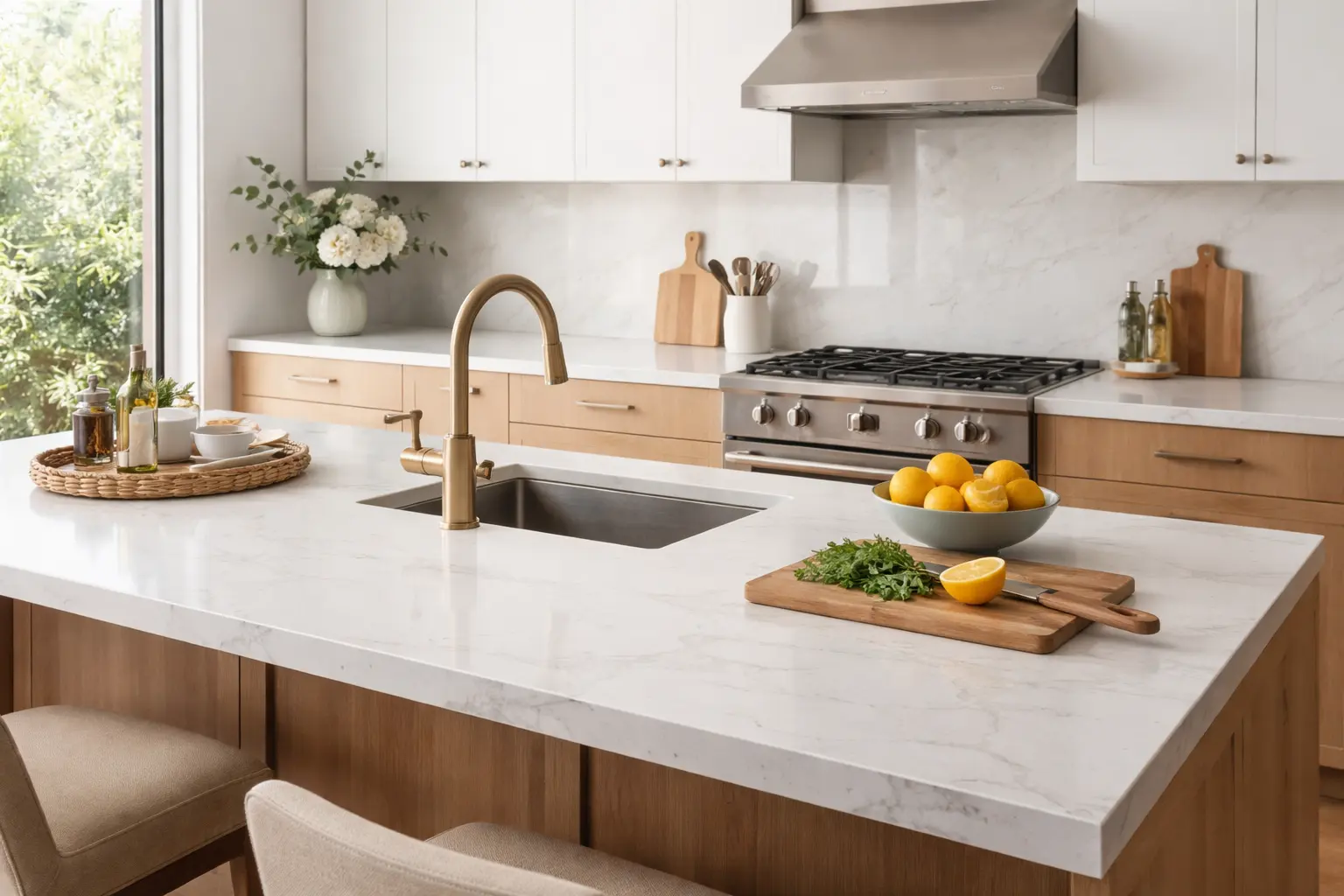
Why Quartz Countertops Are So Popular in Modern Kitchens
What Makes Quartz Different from Natural Stone
Quartz countertops are generally classified as engineered stone surfaces. Unlike marble and granite, which are cut directly from natural slabs, quartz countertops are typically produced from approximately 90% to 93% crushed natural quartz combined with polymer resins, pigments, and performance additives. This composition gives the material a highly controlled structure, which creates better consistency in color, pattern, and technical performance.
That consistency is one of the main reasons why the Best Quartz Countertop products appeal to modern buyers. Natural stones can vary dramatically from slab to slab. For some buyers, that natural variation is beautiful. For others, especially those who want predictable aesthetics and easier project planning, quartz offers a more controlled and reliable result.
The non-porous nature of quartz is another major advantage. Because it does not have the same level of open pore structure found in many natural stones, it generally resists staining more effectively and does not require routine sealing. That makes it especially attractive for kitchens where spills from coffee, oil, juice, tomato sauce, wine, and condiments are part of normal life.
Main Reasons Homeowners and Designers Prefer Quartz
There are several practical reasons quartz remains one of the top choices for kitchen surfaces.
First, maintenance is relatively simple. A mild cleaner and soft cloth are usually enough for daily care. Second, quartz offers strong stain resistance in most indoor kitchen environments. Third, the design range is broad, from soft concrete looks to dramatic marble-like veining. Fourth, it supports cleaner seam planning and more uniform visual flow across larger layouts. Fifth, it works well in both modern and transitional interiors.
In many renovation projects, buyers do not actually want the most exotic surface. They want a surface that looks refined, performs predictably, and does not create endless maintenance headaches. That is where engineered quartz countertop products excel. They are especially attractive to families, rental-property investors, design-build firms, and homeowners who want long-term practicality.
Where Quartz Performs Best in Real Kitchen Use
Quartz performs particularly well in kitchens with moderate to heavy daily use. In family homes, it helps reduce maintenance pressure. In open-plan kitchens, it supports a polished and coordinated design language. In small apartments, lighter quartz colors can improve the perception of space and brightness. In premium homes, marble-look quartz allows buyers to achieve a luxurious visual effect without accepting all the risks of real marble.
A typical example is a homeowner renovating a 120-square-foot city kitchen with limited daylight. In that case, a dark and heavily patterned natural stone may visually shrink the room. A warm white Kitchen Quartz Countertop with fine veining and a polished finish can reflect more light, create cleaner lines, and reduce maintenance stress at the same time. In other words, quartz is not just popular because it is trendy. It is popular because, in many kitchens, it solves more problems than it creates.
What to Consider Before Choosing a Quartz Countertop
Kitchen Size and Layout
Kitchen size should influence countertop selection more than many buyers realize. The right surface does not simply “fit the cabinets.” It shapes how the room feels.
For smaller kitchens, the Best Quartz Countertop for Small Kitchens is often a light or medium-light color with gentle movement rather than heavy dramatic contrast. Soft white, pale grey, creamy beige, and subtle marble-look patterns can make compact spaces feel larger and more open. Large dark veins and strong contrast can still work, but only when balanced carefully with lighter cabinetry, sufficient lighting, and minimal visual clutter.
For larger kitchens, bold veining, waterfall islands, and deeper colors become more practical because the room can carry more visual weight. If the space includes a large island, quartz can also become a focal design element rather than just a background surface.
Layout matters too. Galley kitchens, L-shaped kitchens, U-shaped kitchens, and island-centered kitchens all interact differently with slab direction, seam placement, and visual flow. A well-selected quartz kitchen island countertop can visually anchor the room, while poorly chosen veining or seam planning can make even an expensive material look awkward.
Cooking Habits and Daily Wear
Your cooking habits should guide your material decision. A household that cooks three meals a day places different demands on a countertop than a household that mainly uses the kitchen for coffee and light preparation.
In high-use kitchens, buyers should prioritize stain resistance, easy cleaning, and color choices that do not exaggerate every crumb or fingerprint. Mid-tone quartz surfaces often perform especially well in busy homes because they strike a balance between brightness and practical visual tolerance. Extremely dark surfaces can show dust and smudges more easily. Extremely pure white surfaces can highlight spills faster, especially under warm lighting.
Families with children may also benefit from rounded edge profiles and finishes that minimize visible daily wear. Homes that entertain frequently may prefer larger-format patterns and premium edge detailing. The right answer depends on use, not trend boards.
Cabinet Color, Flooring, and Backsplash Coordination
A countertop should work with the kitchen, not fight it. Cabinet color, flooring tone, backsplash texture, wall paint, and metal finishes all matter.
White cabinets pair well with both warm and cool quartz tones, but the difference between them is crucial. A cool white quartz paired with warm cream cabinets can look unintentionally mismatched. Wood cabinets often work beautifully with quartz that has soft grey or beige veining. Dark cabinets can support high-contrast quartz, but balance is essential to avoid making the room feel heavy.
Pattern scale matters too. In smaller kitchens, overly dramatic patterns can crowd the design. In large kitchens, extremely quiet patterns may feel underwhelming. This is one reason why buyers searching How to Choose Quartz for Kitchen projects should always evaluate the slab in relation to the entire room rather than in isolation.
Edge Profiles, Thickness, and Finish
Thickness and finish affect both aesthetics and function. Common thicknesses for quartz countertops include 12 mm, 15 mm, 20 mm, and 30 mm. In many kitchen applications, 20 mm and 30 mm are the most common choices. Thicker profiles often communicate a more substantial and premium appearance, especially on islands and waterfall ends.
Finishes usually include polished and matte or honed surfaces. Polished quartz reflects more light and often enhances brightness, making it useful for compact kitchens. Matte surfaces offer a softer, more understated look, but they may show certain marks differently depending on color and lighting.
Edge profiles such as eased, beveled, bullnose, and mitered edges can also change the visual character of the kitchen. An eased edge suits modern kitchens. A mitered edge can create a bolder architectural look. The right combination of thickness, finish, and edge profile often separates an average-looking kitchen from a highly refined one.
Material Parameters That Actually Matter
A surprising number of buyers choose countertop materials based almost entirely on color and ignore technical properties until problems appear. That is backwards. Visual style matters, of course, but the technical profile tells you how the surface is likely to perform over time.
Quartz Countertop Technical Specifications
While exact values vary by producer and formulation, many quality quartz products fall within the following general ranges:
| Technical Property | Typical Quartz Countertop Range | Why It Matters |
|---|---|---|
| Quartz Content | 90%–93% | Higher quartz content generally supports hardness and surface stability |
| Mohs Hardness | 6–7 | Indicates strong scratch resistance in normal kitchen use |
| Water Absorption | Around 0.02%–0.05% | Supports stain resistance and low porosity |
| Density | Approx. 2.3–2.5 g/cm³ | Reflects compact structure and material stability |
| Flexural Strength | Around 25–45 MPa | Important for fabrication, transport, and long spans |
| Compressive Strength | Often above 150 MPa | Indicates resistance under load |
| Thickness Options | 12 mm, 15 mm, 20 mm, 30 mm | Affects design, edge style, and support requirements |
These numbers matter because they translate into everyday experience. Low water absorption helps prevent liquids from penetrating the surface. Strong hardness supports better scratch resistance in daily use. Good density and flexural strength support safer fabrication and longer-term structural performance.
Still, buyers should not misunderstand these values. Quartz is durable, but it is not indestructible. Direct heat shock, improper support, poor installation, and low-quality resin systems can all create problems.
What These Numbers Mean for Real Buyers
For a family kitchen, low porosity and stain resistance are usually more important than dramatic patterning. For a luxury project, visual design and slab continuity may take priority, but technical stability still matters. For a property developer buying in volume through a quartz countertop wholesale channel, consistency of thickness, color matching, and batch stability may be just as important as aesthetics.
For small kitchens, lighter polished quartz can provide a visual advantage while still delivering strong functional performance. That is why the Best Quartz Countertop for Small Kitchens is often not simply about color. It is about combining suitable light reflectance, low maintenance, and practical daily usability.
Quartz vs Other Countertop Materials: Which One Is Best for You?
Choosing quartz becomes much easier when buyers compare it honestly with other major countertop materials rather than treating it like a default answer.
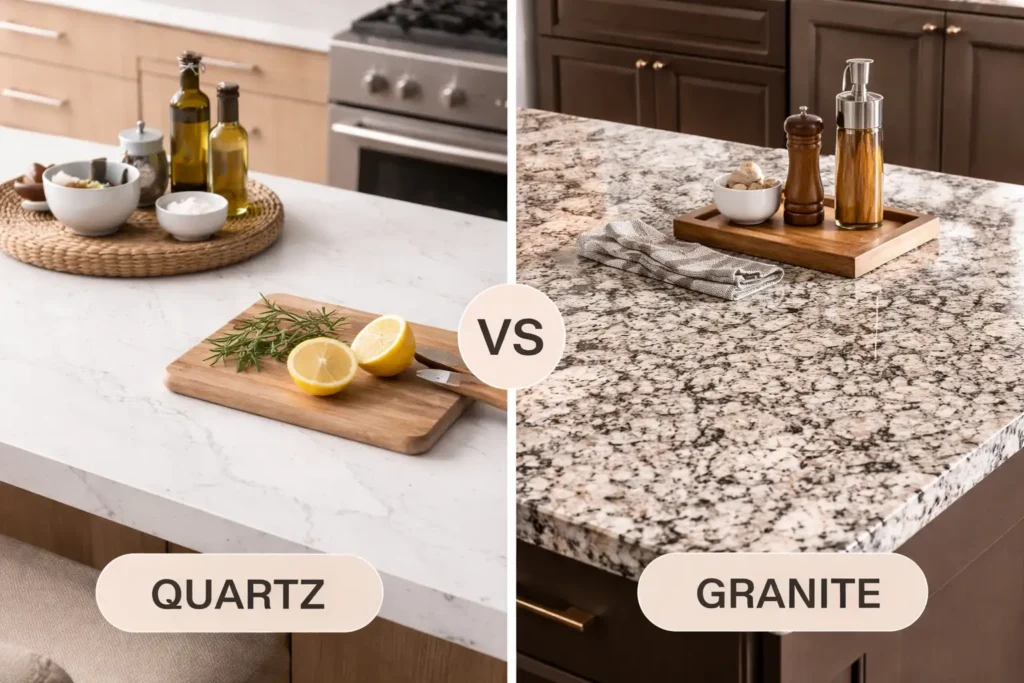
Quartz vs Granite
Granite is a natural stone that offers strong heat resistance and unique natural variation. Many homeowners appreciate the individuality of granite because no two slabs are identical. However, granite usually requires sealing and can vary widely in appearance even within the same color family.
Quartz, by contrast, provides stronger pattern consistency and usually simpler maintenance. It is often the better choice for buyers who want a controlled look and less upkeep. Granite may appeal more to buyers who value natural character and stronger direct-heat tolerance.
In practical terms, quartz often wins in kitchens where maintenance simplicity is a top priority. Granite may win where natural authenticity and heat tolerance are more important.
Quartz vs Marble
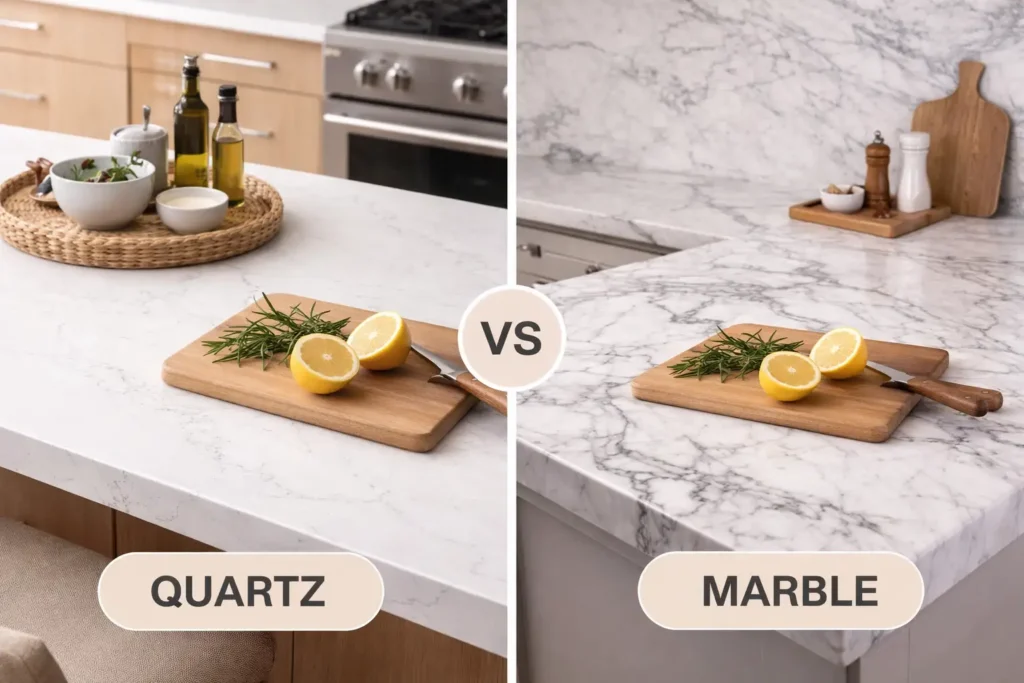
Marble is elegant, prestigious, and visually timeless. It also etches more easily, stains more readily, and requires more attentive maintenance. For serious cooks or busy family households, marble can become stressful rather than luxurious.
Quartz often becomes the smarter alternative because it can imitate the veined beauty of marble while offering better stain resistance and easier care. This is one reason marble-look quartz has become a dominant category in current kitchen design. Buyers want the visual drama of marble, but they do not want to panic every time lemon juice or red wine touches the surface.
Quartz vs Porcelain Slabs
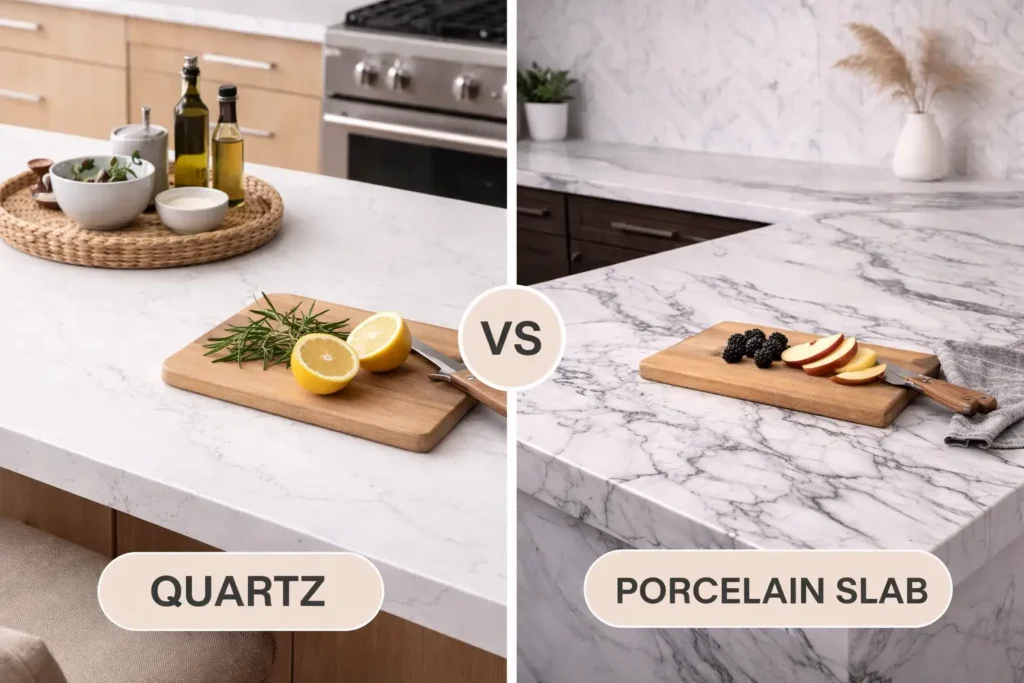
Porcelain slabs are increasingly used for countertops because they offer strong heat resistance, UV stability, and ultra-low porosity. However, fabrication can be more specialized, edge detailing may be less forgiving, and the overall feel differs from quartz.
Quartz often remains more forgiving in mainstream kitchen fabrication and design applications, especially for buyers prioritizing consistency, easier sourcing, and familiar installation systems. Porcelain may be better for certain high-heat or indoor-outdoor design contexts. Quartz is often better for buyers seeking a balance of practicality, style, and predictable fabrication results.
Quick Buyer Decision Guide
If you want the lowest-maintenance everyday solution, quartz is usually the strongest candidate. If you want raw natural uniqueness, granite has advantages. If you want timeless luxury and accept higher upkeep, marble can be compelling. If extreme heat or outdoor UV exposure is central to the project, porcelain deserves serious consideration.
That is why Best Quartz Countertop does not mean “best for everyone.” It means best for a specific kitchen, specific lifestyle, and specific performance requirement.
How to Choose the Best Quartz Countertop for Different Kitchen Types
Best Quartz Countertop for Small Kitchens
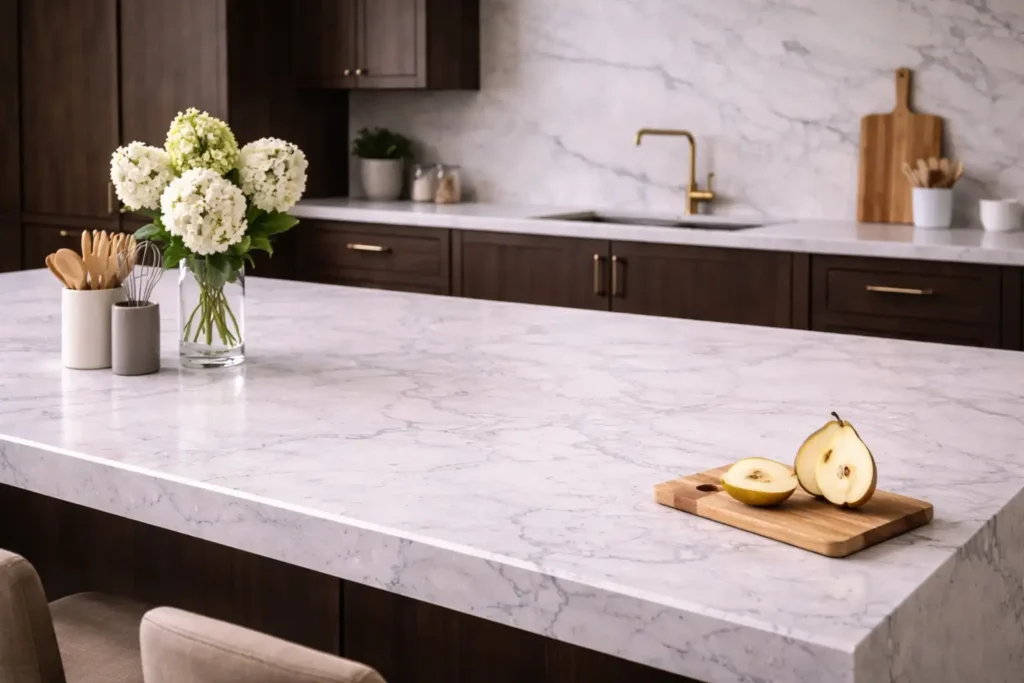
The Best Quartz Countertop for Small Kitchens is usually one that helps the room feel larger, brighter, and cleaner without demanding excessive maintenance. Light backgrounds, subtle veining, and polished surfaces often work especially well because they reflect light and reduce visual heaviness.
In a compact kitchen, visual noise matters. A heavily patterned slab can overwhelm a small room. Fine movement, soft veining, or a clean background usually creates a more spacious impression. Pairing quartz with a matching backsplash or similar-toned wall surface can also create a more seamless and open look.
For apartments, condos, and narrow galley kitchens, white or soft beige quartz often performs especially well. The trick is choosing a tone that works with cabinet color and real lighting conditions rather than relying on showroom lighting alone.
Best Quartz Countertop for Large Open Kitchens
Large kitchens can support more statement-making design choices. Dramatic veining, oversized island slabs, waterfall edges, and richer contrast all become easier to use effectively in bigger spaces. In these environments, the countertop can act as a central visual feature rather than a supporting surface.
Larger kitchens also provide better opportunities for premium detailing, such as mitered edges and coordinated full-height backsplashes. Here, quartz offers a major advantage because controlled patterns can create a cleaner and more intentional result across multiple surfaces.
Best Quartz Countertop for Family Kitchens
For family kitchens, the best choice is often not the lightest or darkest option, but the most forgiving one. Mid-tone surfaces, gentle patterns, and easy-clean finishes can help hide minor daily mess while still looking polished. Buyers should think about ketchup, juice, flour dust, snack crumbs, dropped utensils, and rushed cleaning routines. Real kitchens are messy. Beautiful surfaces should survive real life, not just photo shoots.
Best Quartz Countertop for Luxury Kitchen Designs
In luxury kitchen projects, quartz often succeeds by delivering strong visual drama with lower maintenance demands than marble. Large-format veining, marble-inspired designs, crisp edge fabrication, and coordinated splash applications can create a premium look that feels tailored and architectural.
For this type of project, buyers often prioritize slab movement, seam minimization, island presentation, and detail execution. A high-end Quartz Countertop should not only look attractive from a distance but also maintain consistency at close range, where poor pattern design or uneven finishing becomes obvious. This is why developers, designers, and premium residential buyers often work directly with a custom quartz countertop supplier or experienced fabricator rather than choosing purely from catalog thumbnails.
Real-World Kitchen Scenarios and Buyer Cases
Case 1 – A Small Urban Apartment Kitchen
A homeowner renovating a compact city apartment kitchen wanted the room to feel larger without switching to all-white cabinetry. The kitchen measured just over 70 square feet and had limited natural light. Dark granite was considered first because of its rich appearance, but test boards showed it made the room feel tighter and heavier.
The final choice was a warm-toned Kitchen Quartz Countertop with a clean base and soft grey-beige movement. The polished finish improved light reflection, and the subtle pattern helped the countertop feel calm rather than busy. After installation, the owner reported that the kitchen looked brighter and easier to maintain than expected. The quartz also paired better with the natural oak flooring than the colder white options did.
Case 2 – A Busy Family Kitchen with Children
A family of five remodeled a heavily used suburban kitchen where cooking happened every day. The surface needed to handle breakfast spills, baking sessions, frequent wiping, and occasional rough treatment. Marble was ruled out early due to maintenance concerns, and a very dark quartz option was rejected after the sample showed dust and fingerprints too clearly.
The final material was a medium-toned low maintenance kitchen countertop design with subtle movement and a 20 mm profile. The household later found that everyday marks were less visible, cleanup was simple, and the countertop still looked refined after months of intensive use. Their main lesson was straightforward: the best-looking showroom sample is not always the best kitchen surface for real family life.
Case 3 – A High-End Renovation Seeking Marble Style Without Marble Stress
In a premium renovation project, the owner loved the look of Calacatta marble but did not want to worry about etching, sealing, or food stains. The design team selected a marble-look quartz with pronounced but controlled veining. The result delivered the visual elegance the client wanted, while offering easier care and more reliable surface performance for daily use.
This case reflects one of the strongest reasons for the rise of marble look quartz countertop products in the market. Buyers increasingly want luxury aesthetics, but they want them with less maintenance drama and fewer long-term surprises.
Lessons Buyers Can Learn from These Cases
These real-world examples point to one simple truth: you should match the countertop to your lifestyle before matching it to your Pinterest board. A small kitchen needs visual efficiency. A family kitchen needs practical forgiveness. A luxury kitchen needs disciplined visual impact and technical reliability. Good buying decisions come from honest use-case analysis, not from chasing whatever surface looks dramatic in one showroom spotlight.
Common Mistakes Buyers Make When Choosing Quartz Countertops
Choosing Based Only on Color Samples
Small samples are helpful, but they can also be misleading. A pattern that looks elegant on a sample board may feel overwhelming across a full island. A surface that looks warm in one showroom may appear cold under different home lighting. Buyers should always review as much slab surface as possible before making a final decision.
Ignoring Lighting Conditions
Quartz surfaces can change visibly under cool daylight, warm artificial lighting, and mixed indoor conditions. This is especially important for off-whites, greys, and beige tones. A buyer who wants the Best Quartz Countertop for a north-facing kitchen may need a different tone than a buyer working with strong south-facing natural light.
Assuming All Quartz Is the Same
This is one of the most expensive mistakes. Quartz quality can vary significantly depending on raw material selection, resin formulation, manufacturing controls, pressing quality, surface finishing, and thickness tolerance. A lower-cost slab may look acceptable at first but reveal problems later through poor consistency, weak finish quality, or fabrication issues.
That is why professionals often evaluate not just the slab appearance, but also the supplier’s process capability. If you are sourcing at scale, the difference between a casual reseller and a serious quartz countertop manufacturer or quartz countertop factory can become very important.
Overlooking Fabrication and Installation Quality
Even a strong slab can look bad or fail early if the fabrication is poor. Seam placement, sink cutouts, overhang support, edge polishing, and installation accuracy all matter. Quartz should not be judged only as a raw slab product. It should be judged as a complete system that includes design, fabrication, transport, handling, and installation.
Buying Only on Price
Low price alone is not a strategy. Cheap quartz can carry hidden costs in breakage, inconsistency, rework, claim rates, and disappointing appearance. In residential jobs, that can mean frustration and replacement risk. In trade projects, it can mean delays, damaged reputation, and margin loss. A smart buyer compares value, not just price.
Industry Trends Shaping the Quartz Countertop Market
The Rise of Marble-Look Quartz
One of the strongest current trends is the growth of marble-inspired quartz designs. Buyers want the soft elegance of natural marble combined with lower maintenance and more predictable performance. This trend is particularly strong in premium residential kitchens and upscale apartment developments.
Demand for Jumbo Slabs and Larger Islands
Larger kitchen islands continue to influence countertop demand. Bigger slabs help reduce seam visibility and create stronger visual continuity. This is especially important in modern open kitchens, where the island is often the centerpiece of the room.
Sustainability and Lower-Impact Production
Sustainability has moved from a marketing buzzword to a serious buying factor in many markets. Developers, homeowners, and procurement teams increasingly ask about emissions, recycled content, responsible production, and long-term indoor environmental quality. Some suppliers are responding with improved process controls, more transparent raw material sourcing, and lower-emission resin systems.
More Sophisticated B2B Sourcing Behavior
Professional buyers increasingly search terms such as quartz countertop wholesale, quartz countertop manufacturer, quartz countertop factory, and factory-direct sourcing terms with purchase intent. This reflects a broader market shift: contractors, developers, kitchen studios, and importers want better control over consistency, lead time, packaging quality, and project customization. For those buyers, supplier capability is becoming just as important as surface color.
Standards, Certifications, and Compliance Buyers Should Know
When selecting countertop materials, appearance is only one part of the equation. Buyers should also pay attention to standards, product testing, and fabrication safety.
Indoor Air and Material Safety
In many markets, low-emission materials are increasingly valued in indoor environments. Certifications associated with low VOC performance or indoor air safety can help buyers feel more confident, especially in tightly enclosed residential spaces. In some kitchen and food-contact contexts, standards such as NSF-related product suitability may also be relevant depending on the market and application.
Fabrication Safety and Silica Awareness
Quartz fabrication involves cutting and finishing, which means dust control matters. In many professional markets, silica-related worker safety regulations have become much more important in recent years. Buyers do not need to become industrial hygienists, but they should work with qualified fabricators that follow good dust-control and worker-protection practices. A beautiful countertop is not worth unsafe fabrication habits.
Quality Assurance for Imported Quartz Countertops
For importers and project buyers, quality assurance should include thickness tolerance, slab flatness, color consistency, packaging strength, and batch stability. This is particularly important when sourcing from a quartz countertop wholesale or export-focused supplier. If a supplier cannot provide basic technical and quality information clearly, that is usually a red flag wearing a suit.
How to Evaluate a Quartz Countertop Supplier Before You Buy
Questions to Ask
Before buying, ask practical questions:
What is the quartz content?
What slab sizes and thicknesses are available?
What finish options do you offer?
What quality testing is performed?
How do you manage color consistency?
What claims process do you have if there is a problem?
These questions reveal whether the supplier understands the product deeply or is just trying to move inventory.
Signs of a Reliable Supplier
A strong supplier usually demonstrates stable inventory, clear technical data, good sample quality, consistent finishing, professional packaging, and realistic communication. A trustworthy custom quartz countertop supplier will also understand that serious buyers care about project suitability, not just pretty photos.
Homeowners vs Importers vs Contractors
Different buyers should evaluate suppliers differently. A homeowner may focus on look, feel, and maintenance. A contractor may focus on delivery, fabrication quality, and consistency. An importer or project purchaser may focus on MOQ, packing, batch uniformity, lead time, and claim control. The key is knowing what kind of buyer you are before you judge a supplier.
A Step-by-Step Buying Checklist for Choosing the Right Quartz Countertop
Step 1 – Define How the Kitchen Will Really Be Used
Be honest. Is this a busy cooking kitchen, a design-driven show kitchen, a rental-property upgrade, or a compact apartment remodel? Usage determines priorities.
Step 2 – Match the Surface to the Room Size
For compact rooms, prioritize brightness, low visual clutter, and manageable pattern scale. For large kitchens, explore stronger veining and statement surfaces.
Step 3 – Compare Technical Performance
Review hardness, porosity, density, thickness, stain resistance, and fabrication suitability. A good-looking slab with poor consistency is still a poor choice.
Step 4 – Review Full Slab Appearance
Do not rely only on small samples. Evaluate as much actual slab surface as possible and review it under realistic lighting conditions.
Step 5 – Verify Supplier and Fabricator Quality
Material quality and installation quality are equally important. The slab and the people handling it are part of the same outcome.
Step 6 – Confirm the Final Details Before Production
Check edge profile, finish, seam locations, cutouts, backsplash transition, overhang support, and slab direction. Details make or break premium results.
FAQ
1. What is the best quartz countertop color for a kitchen?
The best quartz countertop color depends on three practical factors: kitchen size, cabinet color, and daily use. In smaller kitchens, lighter tones such as warm white, soft grey, or creamy beige usually help the room feel brighter and more open. In larger kitchens, stronger veining or deeper contrast can create a more dramatic focal point, especially on islands. If your kitchen is heavily used, mid-tone quartz can sometimes be the smartest choice because it hides crumbs, fingerprints, and light dust better than pure white or very dark surfaces. The most successful choice is not simply the trendiest color, but the one that balances visual appeal with how your kitchen actually functions.
2. Is quartz better than granite for kitchen countertops?
Quartz is often the better choice for homeowners who want a low-maintenance, more design-consistent countertop. Because quartz surfaces are engineered, they typically offer more uniform color and pattern control than granite, and they usually do not require the same sealing routine associated with many natural stone products. Granite, however, may appeal more to buyers who prefer natural variation and stronger tolerance for direct heat. For everyday kitchens focused on convenience, stain resistance, and easier upkeep, quartz is often the more practical option. For buyers who value natural uniqueness above all, granite still remains a strong competitor.
3. What thickness of quartz countertop is best for kitchens?
The most common quartz countertop thicknesses for kitchens are 20 mm and 30 mm. In many residential projects, 20 mm offers an excellent balance between durability, appearance, and fabrication flexibility. A 30 mm slab can create a more solid and premium look, especially for large islands, statement countertops, or waterfall-edge designs. The best thickness depends on the visual style you want, the cabinet support below, the edge profile, and whether the kitchen is aiming for a slim modern look or a heavier architectural appearance. Thickness should always be chosen as part of the full design system, not as an isolated detail.
4. Can quartz countertops handle heat, stains, and daily kitchen wear?
Quartz countertops perform very well in everyday kitchens, especially when it comes to stain resistance and general cleaning. Their low water absorption and non-porous structure make them well-suited for handling common spills such as coffee, juice, sauces, and cooking oils. However, quartz is not invincible. It is durable, but it is still wise to use trivets or pads for very hot cookware, because excessive direct heat can affect the resin components in engineered stone. In normal household use, quartz is considered one of the most practical surfaces for balancing appearance, durability, and maintenance.
5. How do I know if I am buying a high-quality quartz countertop?
A high-quality quartz countertop usually shows consistency in color, pattern, thickness, and finish quality. Reputable suppliers should be able to explain the quartz content, available slab sizes, finish options, quality-control process, and relevant certifications. You should also evaluate the slab beyond a small sample whenever possible, because a full slab reveals pattern flow, tonal balance, and potential inconsistencies much more clearly. Good quartz is not only about the slab itself, but also about the supplier’s reliability and the fabricator’s ability to cut, polish, and install it correctly. A beautiful slab handled poorly can still produce a disappointing result.
Conclusion
Choosing the right Quartz Countertop is not about chasing the loudest trend or the cheapest slab. It is about aligning material performance, kitchen layout, lifestyle needs, visual goals, and supplier quality. The Best Quartz Countertop for one kitchen may be completely wrong for another. A compact city apartment, a busy family kitchen, and a luxury entertainment space all require different priorities.
If you want a smart buying framework, focus on five things: real kitchen use, room size, technical properties, full slab appearance, and supplier reliability. For many buyers, quartz remains one of the strongest countertop options because it balances beauty, consistency, and practical performance better than most alternatives. That is especially true for homeowners looking for a durable Kitchen Quartz Countertop, designers seeking marble-like elegance with easier care, and project buyers sourcing through a quartz countertop manufacturer or quartz countertop wholesale channel with performance and consistency in mind.
In the end, the right countertop should not just photograph well. It should work beautifully on an ordinary Tuesday morning when coffee spills, lunch prep starts, and the kitchen is doing exactly what it was built to do. If a surface can survive that with style, cleanliness, and confidence, you are no longer just choosing quartz. You are choosing well.
References
- NSF/ANSI 51 Product Listings for Food Equipment Materials
Author: NSF
Institution: NSF
Source: NSF Product and Service Listings. Quartz and solid surfacing listings confirm that quartz surface products can be certified under NSF/ANSI 51 for food-contact related applications. - 1926.1153 – Respirable Crystalline Silica
Author: Occupational Safety and Health Administration
Institution: U.S. Department of Labor
Source: OSHA Standards, Construction Standard for Respirable Crystalline Silica. This standard is relevant when discussing quartz fabrication safety and dust control. - OSHA’s Respirable Crystalline Silica Standard for Construction
Author: Occupational Safety and Health Administration
Institution: U.S. Department of Labor
Source: OSHA Publication PDF. Useful for explaining why safe fabrication and worker protection matter in engineered stone processing. - Volatile Organic Compounds’ Impact on Indoor Air Quality
Author: U.S. Environmental Protection Agency
Institution: U.S. EPA
Source: EPA Indoor Air Quality guidance. Relevant when discussing low-emission materials and indoor environmental considerations in kitchens. - What Are Volatile Organic Compounds (VOCs)?
Author: U.S. Environmental Protection Agency
Institution: U.S. EPA
Source: EPA Indoor Air Quality resource. Helpful for background on why buyers increasingly care about low-VOC interior materials. - PCR for Residential Countertops
Author: NSF
Institution: NSF
Source: Product Category Rules for Residential Countertops. Useful as a supporting reference for environmental product transparency and lifecycle reporting in countertop materials. - Viatera Surfaces Environmental Product Declaration
Author: LX Hausys / third-party EPD documentation
Institution: NSF Certified Sustainability Program
Source: Product EPD document describing engineered quartz countertop composition and listing performance-related standards used in product evaluation. - Natural Stone Countertops: Considerations for Kitchen and Bath Applications
Author: Natural Stone Institute
Institution: Natural Stone Institute
Source: Educational resource discussing countertop performance expectations, fabrication, installation, and maintenance for stone applications.
Quartz Countertop Insights, Buyer Considerations, and Market Direction
Why does a Quartz Countertop remain one of the strongest kitchen surface options today?
A Quartz Countertop remains highly competitive because it solves several real kitchen problems at the same time. Buyers are no longer looking only for a beautiful surface. They want a countertop that is easy to clean, visually stable across multiple slabs, resistant to common household spills, and suitable for both everyday use and long-term property value. Quartz performs especially well because it offers a controlled appearance and a low-maintenance ownership experience. In practical terms, it helps reduce the gap between design ambition and real-life use. That balance is exactly why quartz continues to outperform many alternative materials in family homes, apartment renovations, and modern open-plan kitchens.
How should buyers choose quartz for different kitchen layouts and daily habits?
The smartest way to evaluate How to Choose Quartz for Kitchen projects is to begin with layout and lifestyle rather than color alone. A compact kitchen usually benefits from light tones, restrained veining, and a finish that improves brightness without overwhelming the room. A larger kitchen, especially one built around an island, can support stronger pattern movement and more architectural edge detailing. Daily cooking frequency matters just as much. Households that cook often should prioritize easy-clean surfaces, stain resistance, and colors that do not exaggerate every fingerprint, crumb, or splash. The most successful quartz choice is not the most dramatic slab in a showroom, but the one that fits how the kitchen is actually used every single day.
What makes the best quartz countertop for small kitchens different from other options?
The Best Quartz Countertop for Small Kitchens usually creates visual openness while keeping maintenance simple. In smaller spaces, the countertop does more than cover cabinets; it influences how bright, calm, and spacious the room feels. Surfaces with gentle movement, clean backgrounds, and soft reflective qualities often perform best because they reduce visual crowding and help light travel more effectively across the kitchen. This is why many designers recommend warm whites, soft greys, and light beige quartz for compact layouts. The goal is not merely to make the room look modern, but to make it feel easier to live in, easier to clean, and more comfortable over time.
What technical and quality considerations matter before buying?
Buyers should assess more than just pattern and color. A reliable Kitchen Quartz Countertop should be evaluated through quartz content, density, water absorption, surface finish consistency, slab thickness tolerance, and fabrication suitability. Quality also depends on how the material is processed, packaged, cut, and installed. A slab may look attractive in a sample room yet perform poorly if the resin balance is weak, the finish quality is inconsistent, or the fabrication is careless. This is why experienced buyers and project managers pay attention to both the slab itself and the professionalism of the supplier and fabricator behind it. Good quartz is not only a product choice; it is a systems choice.
Option analysis: which quartz style works best for different buyer goals?
Buyers looking for a bright, versatile, and low-risk solution often choose light neutral quartz with subtle veining. Those who want a more premium or design-led statement may prefer marble-look quartz with stronger movement, especially for island applications. Families who need a forgiving surface often do well with medium-tone quartz that balances style with practical stain visibility. For upscale projects, thicker profiles, waterfall ends, and large-format slab continuity can elevate the overall result. In other words, the Best Quartz Countertop is not a single universal color or pattern. It is the option that most effectively aligns with the buyer’s kitchen size, lighting, cleaning expectations, and visual goals.
What should buyers consider when comparing suppliers, manufacturers, and factory-direct sourcing?
Supplier quality has a direct effect on countertop performance, especially in projects where consistency matters across multiple slabs or repeated orders. Buyers working with a quartz countertop manufacturer, quartz countertop factory, or factory-direct source should look beyond price and ask about quartz content, slab sizes, finish options, packaging methods, quality control systems, and project references. Wholesale and project buyers should also assess claim handling, color repeatability, lead times, and export protection standards. A strong supplier helps reduce the hidden risks that often appear after installation, such as mismatched batches, poor polishing, weak packaging, or fabrication defects. That is why serious sourcing is not just about cost control; it is about long-term reliability and brand confidence.
How are market trends shaping the future of quartz countertops?
The quartz market is evolving beyond basic surface demand. Buyers increasingly want marble-inspired aesthetics, jumbo slab formats, cleaner seam planning, and surfaces that support modern minimalist interiors. At the same time, sustainability, indoor air quality, and fabrication safety are becoming more important in both residential and commercial purchasing decisions. This means the future of quartz is not only about color trends, but about smarter manufacturing, more transparent material performance, and better alignment with health, compliance, and design expectations. As kitchens continue to function as both workspaces and social spaces, quartz remains well positioned because it combines beauty, consistency, and practical durability in a way that fits how people now live.
Final interpretation: why does this matter for search visibility, buyer trust, and conversion?
A well-structured page about Quartz Countertop should do more than describe a surface. It should explain why the material matters, how buyers should evaluate it, what options fit different kitchens, and which market signals are influencing demand. That kind of content is more likely to be understood by search engines, summarized by AI platforms, and trusted by human readers because it answers the full decision journey rather than a single isolated question. When a page can educate, compare, interpret, and guide at the same time, it becomes much more than a product article. It becomes a reliable content source, and that is exactly the kind of page both search engines and buyers tend to reward.


