
Quick Summary:Waterfall Island Design requires more than choosing a beautiful slab; it depends on mitered edge vein planning, slab layout, edge continuity, support structure, and 3D print quartz fabrication accuracy. 3D full body slabs help create a more seamless quartz waterfall island because the pattern has better depth and more realistic edge performance than surface-printed slabs.
A designer selects a beautiful Calacatta-style quartz slab for a luxury kitchen island. The top surface looks perfect in the showroom. The veins are elegant, the background is clean, and the project owner already imagines the island as the hero of the kitchen. Then fabrication begins. The vertical waterfall side looks disconnected. The gold veins stop at the corner. The 45-degree mitered edge exposes a flat printed layer. Suddenly, the premium island looks like two unrelated panels glued together.
This is the classic failure point in Waterfall Island Design. A waterfall island is one of the most visually powerful kitchen features, but it is also one of the most technically demanding. The design is not only about colour and pattern. It depends on slab size, vein direction, mitered edge planning, adhesive colour, support structure, cutting accuracy, polishing quality, and whether the slab itself is suitable for exposed-edge fabrication.
For buyers comparing different engineered stone options, the broader quartz slabs category is a useful starting point before selecting specific 3D full body slabs for island, countertop, vanity, and commercial surface projects.
The key lesson is simple: a waterfall island does not forgive poor planning. Surface-printed slabs may look fine on a flat countertop, but waterfall sides reveal the truth. If the vein does not continue visually across the edge, the design loses its seamless effect. This is why 3D full body slabs, also known as full body quartz slabs or through-body vein quartz, are becoming more important for luxury kitchens, villas, apartments, showrooms, and hotel suite interiors.

What Is a Waterfall Island and Why Is It Popular in Luxury Kitchens?
A Practical Definition of Waterfall Island Design
A waterfall island is a kitchen island where the countertop material continues vertically down one or both sides of the island. Instead of stopping at the horizontal countertop edge, the slab appears to “fall” toward the floor, creating a continuous stone surface from top to side panel. This design turns the island into a sculptural centrepiece rather than a basic worktop.
Waterfall islands are widely used in luxury kitchens, modern apartments, villas, hotel suites, premium showrooms, and high-end residential developments. They work especially well with marble-look quartz, Calacatta quartz, 3D printed quartz slabs, large format quartz, and full body engineered stone surfaces.
Why Designers Love the Waterfall Look
Designers love waterfall islands because they create clean architectural lines, show off slab patterns, protect cabinet sides, and give kitchens a custom-built luxury appearance. A strong quartz waterfall island can visually connect the cooking area, dining zone, and living space in an open-plan interior.
The waterfall format is especially effective when the slab has beautiful veining. Calacatta-style quartz, white quartz with gold veins, warm taupe marble-look quartz, and bold linear quartz patterns can all create a dramatic effect when the vein flows from the countertop down the vertical side.
Why Waterfall Islands Are Technically Demanding
The challenge is that waterfall islands expose the slab edge and side panel. In a standard countertop, the viewer mostly sees the top surface. In a waterfall island, the viewer sees the top, the edge, the corner, and the vertical panel. That means the pattern must look convincing from multiple angles.
If the slab is only surface printed, the vertical edge may look flat or disconnected. If the mitered joint is poorly cut, the seam becomes visible. If the adhesive colour does not match, the corner looks cheap. Poor fabrication can make expensive material look like a bad shortcut. That is countertop betrayal, and yes, it hurts.
Why 3D Full Body Slabs Matter for Seamless Waterfall Islands
The Problem with Surface Printed Slabs
Surface printed slabs may have attractive patterns on the top face, but the design may not continue convincingly into the slab body. This can be acceptable for simple wall panels or flat countertops with limited exposed edges. But in waterfall island applications, the cut edge becomes part of the design.
When the side panel is visible, the viewer expects the stone pattern to continue naturally. If the vein only exists on the surface, the edge may reveal a plain interior or a disconnected body. This is one reason some quartz waterfall islands look fake even when the top surface looks beautiful.
What 3D Full Body Slabs Are
3D full body slabs use deeper pattern technology to create more realistic veining through or into the slab body. Depending on supplier terminology, they may be called full body quartz slabs, through-body vein quartz, 3D printed quartz slabs, or full body 3D printed quartz.
The value is edge realism. In waterfall islands, exposed side panels, thick profiles, vanity tops, and premium counters, deeper veining helps the slab look more like real stone after cutting and joining. For buyers specifically comparing this material category, Full Body 3D Printed Quartz is highly relevant because it is designed for better edge continuity and more natural visual depth.
Why Through-Body Vein Technology Improves Mitered Edge Vein Results
A mitered edge usually joins two pieces at a 45-degree angle. For a waterfall island, the top panel and side panel must meet cleanly at the corner. If the vein direction and edge depth are not planned, the joint can look broken. The pattern may stop suddenly or shift awkwardly.
Through-body or deeper 3D veining improves the mitered edge vein effect because the exposed edge looks more like a real stone section. This does not mean the seam disappears automatically. Skilled fabrication, layout planning, adhesive selection, and installation still matter. But 3D full body slabs give the project a much better starting point.
| Feature | 3D Full Body Slabs | Surface Printed Slabs | Buyer Impact |
|---|---|---|---|
| Edge Appearance | More realistic | May look flat or disconnected | Important for waterfall sides |
| Mitered Edge Vein | Better continuity | Higher mismatch risk | Affects luxury appearance |
| Waterfall Island Use | Stronger choice | Limited without careful planning | Reduces visual failure |
| Best Use | Premium islands, vanities, counters | Walls, simple counters | Match slab to application |
Mitered Edge Vein: The Detail That Makes or Breaks the Island
What Is a Mitered Edge?
A mitered edge is usually created by cutting two slab pieces at 45-degree angles and joining them together. This technique allows the countertop surface and side panel to meet cleanly, creating the appearance of a continuous slab. It is common in luxury quartz island fabrication because it creates a crisp, modern, seamless edge.
In a waterfall island, the mitered joint is not a small detail. It is often one of the most visible parts of the design. When done correctly, it makes the island look monolithic and premium. When done poorly, it exposes every weakness in the slab choice and fabrication process.
Why Mitered Edge Vein Matching Is Difficult
Matching veins across a mitered edge is difficult because the top surface and side panel must align visually. The vein must appear to move naturally from the horizontal plane to the vertical plane. This requires early slab layout, vein direction planning, accurate cutting, and skilled installation.
Large veins are especially risky. If a bold vein is cut in the wrong direction, the side panel may look unrelated to the top. If the slab is surface printed, the cut edge may not support the visual transition. If the adhesive line is too visible, the seamless effect is weakened.
What Buyers Should Ask Before Fabrication
Before fabrication, buyers should ask whether the supplier can provide cut-edge samples, slab videos, marked slab layout, mitered mock-ups, and technical data. They should also ask whether the fabricator has experience with 3D print quartz fabrication and whether the design team can approve the layout before cutting.
| Checkpoint | Why It Matters | What to Request |
|---|---|---|
| Cut-edge sample | Shows real edge depth | Physical or video sample |
| Slab layout | Controls vein flow | Marked layout before cutting |
| Miter mock-up | Tests seam appearance | Small joint sample |
| Adhesive colour | Affects seam visibility | Colour-matched adhesive |
| Vein direction | Controls waterfall flow | Full slab photo with direction |
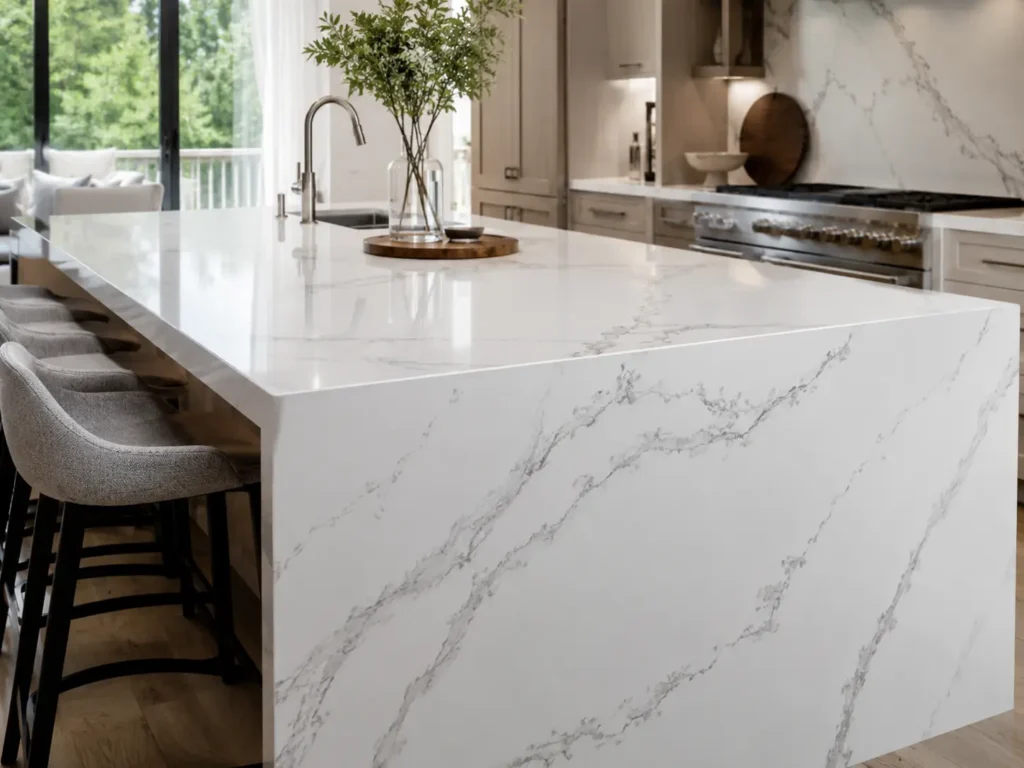
Step-by-Step Guide to Designing a Seamless Waterfall Island
Step 1 — Define the Visual Goal Before Choosing the Slab
Before selecting material, define the island’s design role. Should it feel bold, calm, warm, minimal, dramatic, architectural, or timeless? A small apartment kitchen may need soft veining and broad appeal. A villa kitchen may support bold linear movement. A showroom kitchen may need high contrast. Do not choose the slab first and force the design later. That is how very expensive chaos is born.
Step 2 — Choose the Right 3D Full Body Slab Pattern
Select a slab with suitable vein scale and direction. Large islands can handle stronger movement, while smaller islands usually need more controlled veining. The pattern should work across both horizontal and vertical surfaces. A slab that looks beautiful only as a flat surface may not be suitable for a waterfall island.
For homeowners and designers who want a broader explanation of why full-body designs matter in real spaces, this article on the benefits of Full Body 3D Printed Quartz explains how deeper patterning and edge realism support kitchens, counters, and modern interior applications.
Step 3 — Plan the Vein Flow from Top to Side Panel
The top and waterfall side should look intentionally connected. Use digital slab layout, CAD drawings, marked full slab photos, and vein direction planning before cutting. If multiple slabs are required, slab sequencing becomes even more important. The design team should approve the layout before fabrication begins.
Step 4 — Confirm Mitered Edge Construction
Decide whether the project will use a 45-degree mitered edge, a built-up edge, or another edge style. For the most seamless modern look, the mitered edge is usually preferred. However, it requires accurate cutting, careful adhesive selection, edge polishing, and skilled installation.
Step 5 — Verify Support Structure and Island Base
Quartz slabs are heavy. Cabinet bases, side supports, floor levelness, and installation access must be checked before installation. Overhangs need support planning. Large slabs require proper handling equipment and trained installers. A beautiful slab cannot rescue a weak structure.
Step 6 — Inspect Before Final Installation
Before final approval, inspect seam alignment, edge polishing, vein flow, adhesive colour, panel alignment, chipping, scratches, and transport damage. Photograph the completed island for quality records. This is especially important for developers, designers, and builders working on multiple units or show kitchens.
Technical Specifications Buyers Should Review Before Ordering Slabs
Key Quartz Performance Parameters
Buyers should evaluate quartz not only by appearance but also by technical performance. Important properties include Mohs hardness, water absorption, apparent density, mineral content, resin binder ratio, flexural strength, compressive strength, slab thickness, thickness tolerance, flatness, finish, and edge performance.
The table below gives typical reference ranges for quality engineered quartz. Actual values vary by manufacturer, slab series, production method, and testing standard. Buyers should request project-specific technical data sheets before placing bulk or custom orders.
| Property | Typical Reference Range for Quality Quartz | Why It Matters for Waterfall Islands |
|---|---|---|
| Mohs Hardness | 6–7 | Scratch resistance for countertop use |
| Water Absorption | ≤0.05% typical | Moisture and stain resistance |
| Apparent Density | 2.30–2.50 g/cm³ | Weight and structural planning |
| Mineral Content | Approx. 88%–94% by weight | Durability and stone-like feel |
| Resin / Binder Content | Approx. 6%–12% by weight | Bonding, flexibility, VOC concern |
| Flexural Strength | 30–60 MPa | Important for handling and fabrication |
| Common Thickness | 2cm / 3cm | Affects edge design and support |
| Slab Size | 3200×1600mm / 3500×2000mm where available | Helps reduce seams |
2cm vs 3cm Slabs for Waterfall Islands
Both 2cm and 3cm quartz slabs can be used for waterfall islands, but the right choice depends on structure, fabrication style, edge design, market expectations, and budget. 2cm slabs can work well with proper support and mitered edge planning. 3cm slabs provide more visual mass and may be preferred for premium kitchens, villas, and high-end showrooms.
| Thickness | Best Use | Advantage | Buyer Caution |
|---|---|---|---|
| 2cm | Supported islands, vanities, apartments | Lighter, efficient, common in projects | Needs good support |
| 3cm | Premium islands, luxury kitchens | Stronger visual mass, premium feel | Heavier and costlier |
| Built-up edge | Custom luxury look | Thick visual appearance | Requires skilled fabrication |
| Mitered 45° edge | Seamless waterfall look | Clean modern design | Needs vein planning |
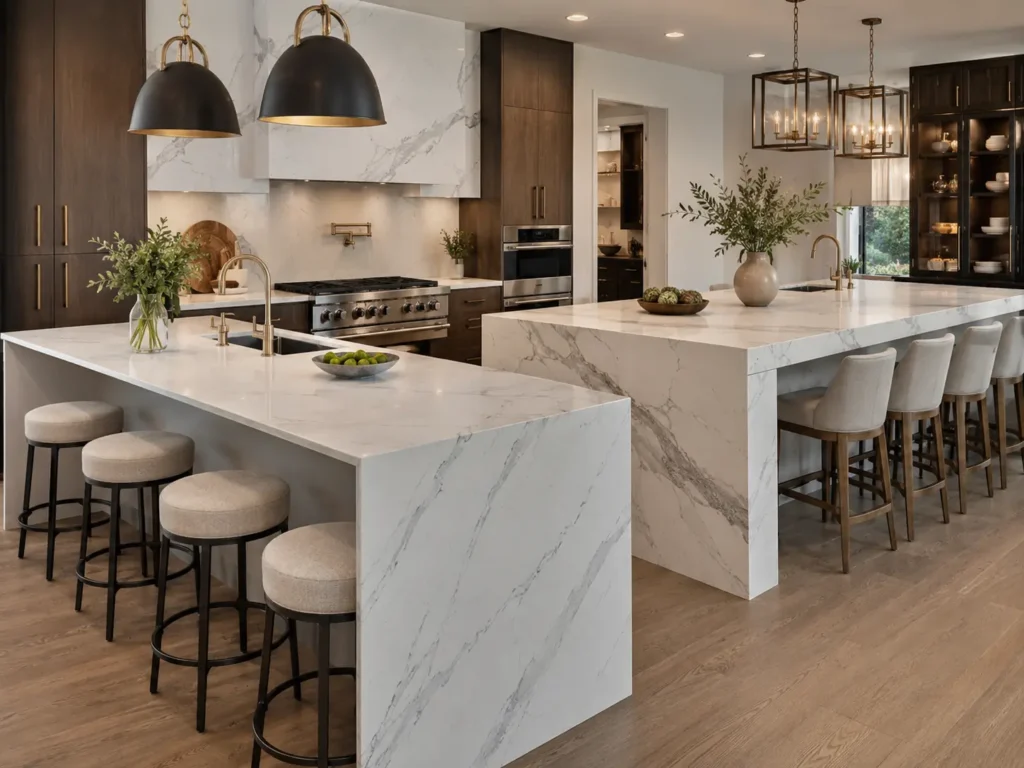
3D Print Quartz Fabrication: What Fabricators Need to Control
Cutting Accuracy
Precision cutting is essential in 3D print quartz fabrication. CNC cutting, bridge saw accuracy, and stable slab handling all affect final results. A small angle error at the mitered edge can create visible gaps, uneven seams, and poor alignment.
Edge Polishing and Seam Finishing
Mitered joints must be polished and joined carefully. Adhesive colour should match the slab background and vein tone as closely as possible. Edge chips should be avoided, and finished edges should look intentional from normal viewing distance.
Vein Layout and Digital Slab Mapping
Digital slab mapping helps control vein flow. Full slab photos should be marked before cutting. Important veins should continue across waterfall sides where possible. Buyers should approve the layout before fabrication starts, especially when bold veins are involved.
Handling and Packing
Waterfall side panels are vulnerable during transport. Reinforced crates, foam protection, panel labels, and slab sequence marking are important. Jobsite handling should also be planned before delivery. Nothing ruins a luxury island faster than a broken side panel five minutes before installation.
Best 3D Full Body Slab Patterns for Waterfall Island Design
Soft Vein Calacatta for Minimalist Kitchens
Soft veining is ideal for minimalist apartments, modern homes, hotel suites, and broad-market projects. It creates calm elegance and reduces the risk of dramatic mismatch at waterfall edges. It is especially suitable when the buyer wants subtle luxury rather than strong visual drama.
Bold Linear Vein Quartz for Statement Islands
Bold linear vein quartz works well in large kitchens, villas, open-plan interiors, and luxury showrooms. Strong directional veins can make the island feel architectural. However, this pattern requires careful mitered edge vein planning. If the vein breaks at the corner, the entire design loses its power.
Warm Gold Vein Quartz for Soft Luxury
Gold, champagne, taupe, and beige veining support the 2026 soft luxury trend. These patterns pair well with brass, oak, walnut, cream cabinetry, warm lighting, and natural-toned interiors. They are ideal for luxury apartments, boutique interiors, and high-end residential kitchens.
High-Contrast Marble-Look Quartz for Commercial Showrooms
High-contrast quartz creates strong visual identity for show kitchens, retail interiors, and commercial display spaces. It is powerful but risky in small kitchens. Buyers should inspect full slabs, not just samples, because strong vein scale can look very different at island size.
| Kitchen Style | Best Slab Pattern | Why It Works | Risk to Avoid |
|---|---|---|---|
| Minimalist Apartment | Soft Calacatta | Calm, clean, broad appeal | Too plain for luxury villas |
| Luxury Villa | Bold Linear Quartz | Strong island movement | Poor vein matching |
| Warm Modern | Gold/Taupe Vein Quartz | Soft luxury trend | Gold tone mismatch |
| Commercial Showroom | High-Contrast Quartz | Strong visual impact | Overly busy design |
Waterfall Island Design Mistakes Buyers Should Avoid
Choosing Surface Print Slabs for Exposed Edges
Surface print slabs may work on flat counters, but waterfall sides expose the edge. If the edge looks fake or disconnected, the island will not feel seamless. For exposed sides, 3D full body slabs are usually safer.
Ignoring Mitered Edge Vein Planning
Veins do not magically align after cutting. The design team, supplier, and fabricator must plan vein direction before fabrication. Otherwise, the vein may break at the corner and ruin the waterfall effect.
Approving Only Small Samples
Small samples cannot show full slab movement, vein scale, or layout suitability. Always review full slab photos and videos before approval.
Not Checking Slab Size Before Designing the Island
If the slab is too small for the island design, the project may need extra seams, awkward layout, or material waste. Slab size should be confirmed before finalising dimensions.
Using Bold Veins in a Small Kitchen
Bold veins can overwhelm compact spaces. In small kitchens, soft veining often works better. Save dramatic patterns for larger islands and open interiors.
Underestimating Slab Weight
Quartz is heavy. Cabinet support, transport, lifting, jobsite access, and installation equipment must be planned. A beautiful slab on a weak base is not luxury; it is a future repair invoice.
Choosing a Supplier Without Fabrication Support
A supplier should understand waterfall applications, edge realism, slab layout, and mitered edge requirements. A beautiful slab without fabrication support can still produce a poor installed result.
Compliance, Safety, and Documentation for Quartz Island Projects
Low-VOC and Indoor Air Quality
Quartz contains resin binders, so low-VOC documentation may matter for apartments, hotels, villas, and commercial interiors. Buyers may request GREENGUARD-style or VOC reports depending on project requirements.
Food-Contact and Kitchen Surface Considerations
Kitchen islands are often used for food preparation. NSF certification may matter depending on market and project requirements. Buyers should verify the actual certificate scope, product name, manufacturer name, and validity instead of relying on simple marketing claims.
Fabrication and Installation Safety
Quartz fabrication can create respirable crystalline silica dust if handled improperly. Buyers should work with qualified fabricators who follow applicable safety rules, use wet cutting or dust control methods, provide PPE, and comply with local workplace safety requirements.
| Document | Why It Matters | Buyer Risk If Missing |
|---|---|---|
| Technical Data Sheet | Confirms performance data | Weak specification |
| SDS | Safety and handling information | Compliance gap |
| Water Absorption Report | Supports stain/moisture resistance | Kitchen surface risk |
| Low-VOC Report | Supports indoor air quality | Project approval concern |
| Fabrication Drawing | Controls cut and miter | Poor island result |
How to Choose a Supplier for 3D Full Body Waterfall Island Slabs
What a Reliable Supplier Should Provide
A reliable supplier should provide full slab photos, slab videos, cut-edge samples, 2cm and 3cm options, actual slab size, full-body or surface-print explanation, mitered edge sample support, technical data sheets, water absorption data, stain resistance data, low-VOC reports if needed, NSF certificates if applicable, packing photos, slab sequence labels, fabrication support, CAD layout support, export experience, replacement support, and bulk project planning.
For buyers reviewing company background, production positioning, and project capability, the quartz slab manufacturer profile can help evaluate whether the supplier is suitable for long-term kitchen island and full-body slab projects. For project quotes, samples, slab layout discussion, and waterfall island material support, buyers can contact a quartz slab supplier with island size, thickness, finish, pattern preference, and edge detail requirements.
Supplier Evaluation Scorecard
| Evaluation Factor | Weight | What to Check |
|---|---|---|
| Edge Realism | 20% | Cut-edge sample, vein depth |
| Slab Pattern Quality | 20% | Full slab movement, natural look |
| Fabrication Support | 15% | CAD layout, miter guidance |
| Technical Data | 15% | Absorption, hardness, strength |
| Slab Size & Thickness | 10% | 2cm/3cm, large format options |
| Packing Quality | 10% | Protection and sequence labels |
Practical Recommendation: How to Get a Seamless Waterfall Island Right
Choose 3D Full Body Slabs If
Choose 3D full body slabs if the island has exposed waterfall sides, veins must continue over edges, the project is high-end, the surface uses bold Calacatta or marble-look patterns, mitered edge details matter, and the buyer wants fewer visual fabrication risks.
Surface Print May Work If
Surface print slabs may work if the countertop has simple edges, waterfall sides are not exposed, the project is budget-sensitive, pattern continuity is not a major concern, or the slab is mainly used for flat surfaces or walls.
Use Soft Veins If
Use soft veins if the kitchen is small, broad buyer appeal matters, apartment projects need safer design, or subtle luxury is preferred. Soft veining reduces the risk of harsh visual breaks across mitered corners.
Use Bold Veins If
Use bold veins if the island is large, the kitchen is open-plan, the design needs a strong focal point, and the fabricator can control vein matching. Bold veins are beautiful, but only when they are planned like a serious architectural feature.
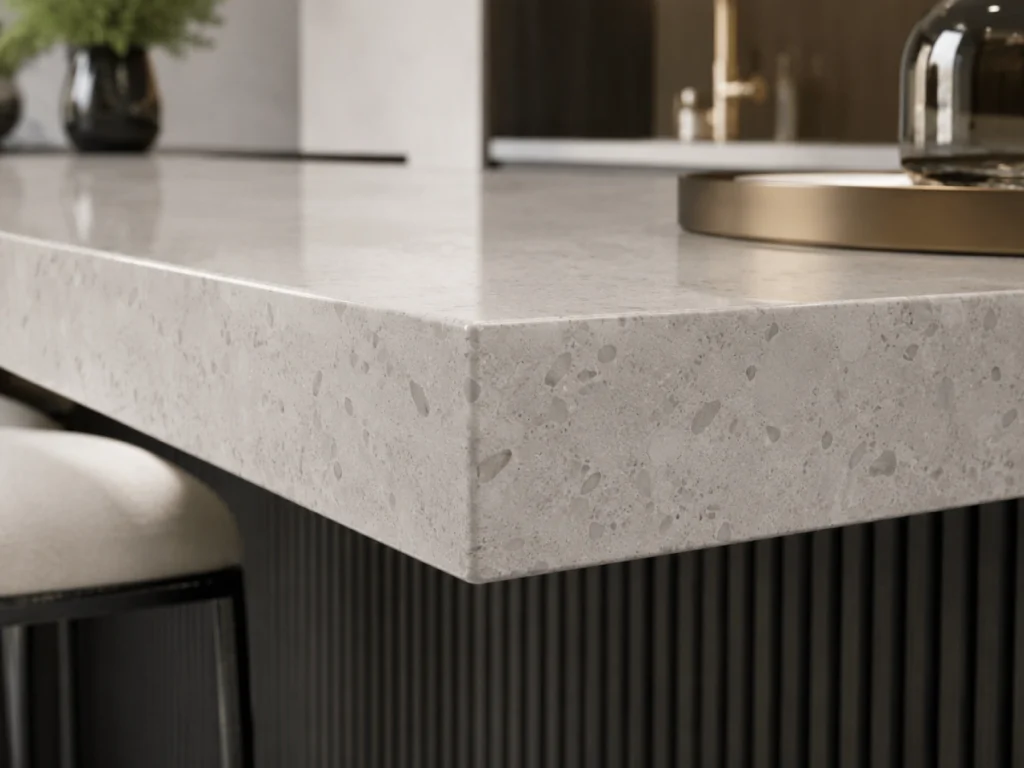
Final Recommendation: A Seamless Waterfall Island Starts Before the First Cut
A seamless waterfall island is not created by the slab alone. It is created by early coordination between the designer, slab supplier, fabricator, installer, and project owner. The best results come from selecting the right 3D full body slab, approving full slab layout, planning mitered edge veins, confirming support structure, matching adhesive colour, and inspecting fabrication quality before installation.
If the island has exposed edges, 3D full body slabs are usually the safer choice. If the design uses bold veins, layout approval is essential. If the project uses surface print slabs, avoid assuming the edge will look seamless. The best waterfall island is not the one that looks good in a sample box. It is the one that still looks seamless after cutting, joining, polishing, transport, and installation.
FAQ About Waterfall Island Design with 3D Full Body Slabs
1. What is a waterfall island?
A waterfall island is a kitchen island where the countertop material continues vertically down one or both sides of the island, creating a continuous visual flow from the horizontal top to the side panel. It is commonly used in luxury kitchens, modern apartments, villas, hotel suites, and showrooms because it turns the island into a sculptural focal point instead of a basic countertop.
2. Can quartz be used for a waterfall island?
Yes, quartz can be used for a waterfall island, especially when the slab has suitable thickness, strong fabrication quality, and good edge performance. 3D full body slabs are often a better choice for waterfall islands because they provide more realistic edge continuity and better mitered edge vein appearance than many surface printed slabs. Buyers should still confirm support structure, slab size, and fabricator capability.
3. What is a mitered edge vein?
A mitered edge vein refers to the visual alignment of the slab pattern across a 45-degree mitered joint, usually where the horizontal countertop meets the vertical waterfall side panel. Good mitered edge vein planning helps the pattern look continuous and natural. Poor planning can make the vein break suddenly at the corner, making the island look disconnected or artificial.
4. Is 2cm or 3cm quartz better for a waterfall island?
Both 2cm and 3cm quartz can work for a waterfall island depending on support structure, fabrication method, edge design, and market preference. 2cm slabs can be efficient and lighter when properly supported, while 3cm slabs offer more visual mass and may feel more premium for luxury kitchens. The best choice should be confirmed with the designer, supplier, fabricator, and installer before cutting.
5. How do I make a quartz waterfall island look seamless?
To make a quartz waterfall island look seamless, start with full slab layout planning, choose suitable 3D full body slabs, confirm vein direction, request cut-edge samples, plan the mitered edge vein, use CAD layout, select colour-matched adhesive, work with an experienced fabricator, verify support structure, and inspect the slab before final installation. Seamless results depend on both material selection and fabrication control.
References
1. Engineered Stone Countertops: Material Properties and Fabrication Guidance, Natural Stone Institute, Technical Resource.
2. Quartz Surfacing Material Specification Guidelines, International Surface Fabricators Association, Industry Guide.
3. Countertop Installation and Fabrication Manual, Natural Stone Institute, Technical Manual.
4. Kitchen Planning Guidelines, National Kitchen & Bath Association, Design Resource.
5. OSHA Respirable Crystalline Silica Standard for Construction, Occupational Safety and Health Administration, Safety Standard.
6. GREENGUARD Certification Criteria for Low Chemical Emissions, UL Solutions, Indoor Air Quality Resource.
7. Engineered Stone Fabrication and Installation Manual, Stone World Technical Resource.
8. Interior Design Materials and Specifications, Lisa Godsey, Fairchild Books.
Strategic Insight: How Buyers Should Plan Waterfall Island Design
What makes Waterfall Island Design difficult? A waterfall island exposes the top surface, vertical side panel, edge profile, and mitered joint at the same time. This means slab layout, vein direction, edge depth, cutting precision, adhesive colour, and support structure all affect the final appearance.
Why do 3D full body slabs matter? 3D full body slabs provide better pattern depth and edge realism than many surface printed slabs. This helps the mitered edge vein look more natural across waterfall sides, thick profiles, and exposed side panels.
How should buyers compare options? If the island has exposed sides or bold veins, choose 3D full body slabs with cut-edge samples. If the surface is flat or budget-sensitive, surface print may be acceptable. If the kitchen is small, use soft veins. If the island is large and open-plan, bold linear veins can create stronger visual impact.
What should buyers verify before ordering? Buyers should check full slab photos, slab videos, cut-edge samples, mitered mock-ups, 2cm or 3cm thickness, slab size, technical data, water absorption, low-VOC documentation if needed, packing quality, CAD layout support, and fabricator experience.
What mistakes should buyers avoid? Avoid choosing surface print slabs for exposed edges, ignoring mitered edge vein planning, approving only small samples, designing before confirming slab size, using bold veins in small kitchens, underestimating slab weight, and choosing suppliers without fabrication support.


