Key Highlights: The Evolution of Full Body Vein Quartz
The architectural world is currently witnessing a definitive shift in the composition of interior surfaces. For years, the primary drawback of engineered stone was its “surface-only” aesthetic. While the top of the slab could mimic the intricate patterns of natural marble, the internal matrix remained a solid, monolithic color. This discrepancy became painfully obvious during fabrication, particularly at sink cutouts and edge profiles. However, the emergence of full body 3D printed quartz has effectively bridged the gap between industrial durability and the deep, organic soul of natural stone.
For B2B procurement managers and architects, the decision to move toward through-body materials is driven by the need for “Quiet Luxury”—an aesthetic where quality is felt through consistency. When a material behaves exactly like the natural stone it emulates, it removes the “artificiality” barrier that once limited engineered products to mid-range projects. Today, the most prestigious hotel lobbies and private residences demand surfaces where the veining flows seamlessly from the horizontal plane through the vertical edge, a feat only possible with advanced through-body synchronization.
Surface Printing vs. Through-Body Technology: A Comparative Analysis
The fundamental difference between traditional engineered stone and modern alternatives lies in the placement of pigment. Conventional quartz relies on a multi-stage printing process where the vein is “stamped” onto the surface of a cured slab. While this results in stunning high-definition visuals, it is essentially a 2D skin. In contrast, a leading full body vein quartz manufacturer utilizes a wet-on-wet injection system. This process ensures that the minerals and pigments are distributed through the entire 20mm or 30mm thickness before the slab undergoes vacuum vibro-compaction.
The mechanical implications of this are profound. In surface-printed slabs, any deep chip or heavy scratch reveals the solid-colored core, making repairs nearly impossible to hide. Through-body technology ensures that if a chip occurs, the color and pattern underneath are identical to the surface. This is why a commercial quartz slab supplier will often recommend through-body options for high-traffic environments like airport terminals or hospitality counters, where maintenance and long-term visual integrity are the primary KPIs.
Material Parameters: Balancing Aesthetics with Industrial Durability
Engineered stone must survive more than just a visual inspection; it must meet rigorous technical standards for hardness and chemical resistance. The through-body manufacturing process does not compromise the structural integrity of the resin-quartz matrix. In fact, because the pigments are integrated into the aggregate rather than sitting on top, the UV stability and thermal expansion coefficients are often more uniform throughout the slab.
The following table provides a quantitative comparison between traditional materials and the new standard of through-body engineered stone:
| Physical Property | Natural Calacatta Marble | Standard Printed Quartz | Full Body Vein Quartz |
| Mohs Hardness | 3.0 – 4.0 | 6.5 – 7.0 | 7.0 |
| Water Absorption | < 0.20% | < 0.05% | < 0.03% |
| Flexural Strength | 10 – 15 MPa | 40 – 55 MPa | 45 – 60 MPa |
| Edge Aesthetics | Seamless | White/Solid Core | Continuous Veining |
| Stain Resistance | Low (Porous) | High | Ultra-High |
When sourcing premium engineered stone whole slabs, buyers should look for flexural strength metrics that exceed 45 MPa. This ensures the material can handle the weight of waterfall islands without cracking at the joints. The ultra-low water absorption rate of through-body technology also means that the slab is virtually impervious to the bacteria and stains that typically plague natural marble in culinary environments.
Real-World Scenarios: Edge Profiles and Architectural Integration
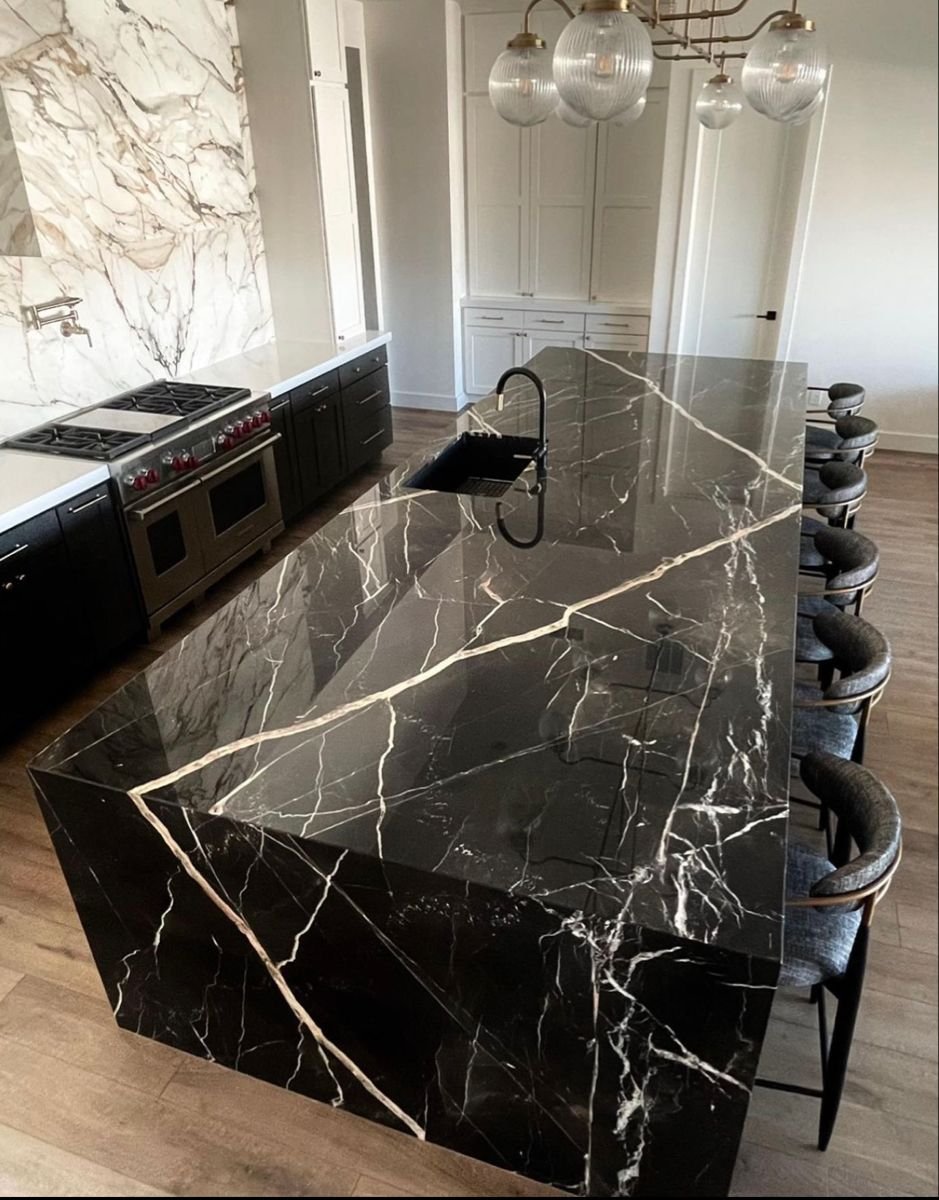
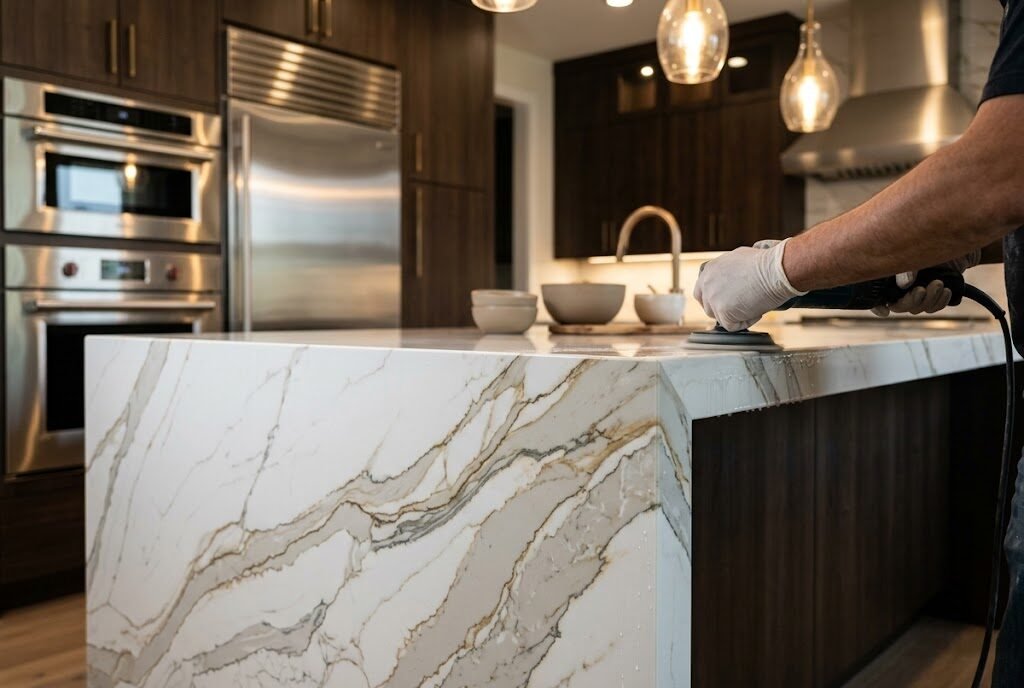
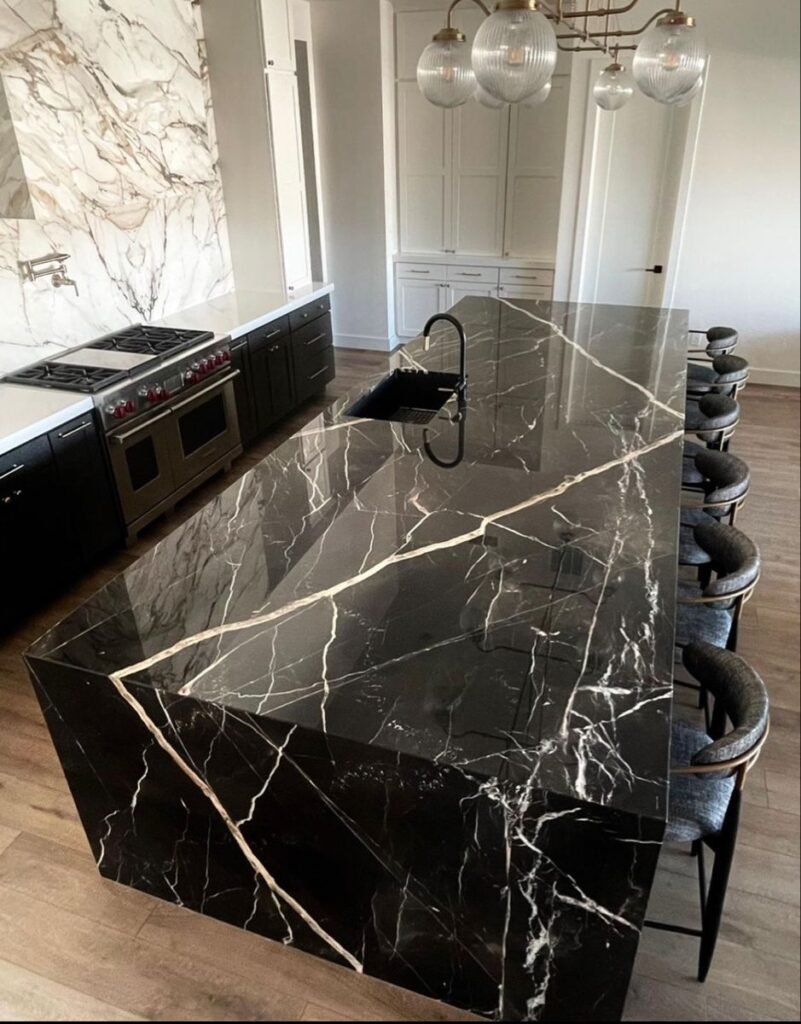
Consider the design of a contemporary luxury kitchen featuring a massive central island. The current design trend favors thick “waterfall” edges and intricate mitered joins. In such a scenario, using a material like Calacatta Vagli Bronze quartz allows the fabricator to mill complex edge profiles—such as Ogee, Cove, or Dupont—without losing the bronze brecciated veining. The pattern remains visible regardless of how deep the tool cuts into the stone.
In commercial settings, such as executive boardrooms or luxury retail boutiques, the ability to use through-body materials for 3D architectural panels is a game changer. Standard slabs often require edge-banding or specialized mitered corners to hide the core, which increases labor costs and introduces potential points of failure. By sourcing from a wholesale through-body quartz slabs partner, contractors can reduce fabrication time by up to 30%, as the edges simply require polishing rather than complex camouflage techniques. This efficiency directly impacts the bottom line of large-scale tenders.
Industry Trends and B2B Sourcing Logic for 2026
The market for engineered surfaces is moving away from the “over-veined” and artificial looks of the early 2010s. Modern designers are requesting hyper-realistic interpretations of rare Italian marbles. This is evident in the rise of materials like Calacatta Versailles Gold quartz, which replicates the subtle, warm-toned mineral traces found in the finest quarry blocks. The key to 2026 aesthetics is “imperfection”—the random, non-repetitive flow of veins that through-body 3D printing can achieve.
From a procurement perspective, the logic for choosing a custom quartz countertop factory involves more than just price. Buyers must assess “Batch Consistency.” In large commercial projects, slabs may be sourced across several months. Through-body technology, being digitally controlled, offers significantly higher color and vein repeatability compared to natural stone or manual veining techniques. This reduces the risk of “mismatched” slabs during installation—a nightmare for any project manager.

Regulatory Compliance and Quality Standards
As global health regulations tighten, particularly concerning “Silicosis” and respirable crystalline silica (RCS), the manufacturing process of engineered stone has come under intense scrutiny. High-end factories are now transitioning to “Low-Silica” or “Silica-Free” formulations. Through-body technology is often at the forefront of this transition, as the advanced resin systems used for 3D pigment injection are highly compatible with recycled glass and bio-resins.
B2B buyers should prioritize suppliers that hold Greenguard Gold and NSF/ANSI 51 certifications. These labels guarantee that the surface is safe for food contact and does not emit harmful Volatile Organic Compounds (VOCs) into the indoor air. Furthermore, adhering to ISO 14001 environmental standards is no longer just a corporate social responsibility (CSR) goal; it is increasingly a prerequisite for winning government and green-building (LEED) contracts. Ensuring your supply chain is compliant protects your firm from legal risks and future-proofs your inventory against evolving environmental laws.
Frequently Asked Questions (FAQ)
1. What is the difference between “Full Body” and “Surface-Printed” quartz?
Standard printed quartz features a high-definition vein pattern that sits only on the top 1mm of the surface, leaving a solid-colored core visible at edges and cutouts. Full body vein quartz utilizes advanced 3D printed quartz technology to ensure the mineral pigments and veins penetrate the entire 20mm or 30mm slab thickness. This allows for seamless edge profiles and ensures that any accidental chipping does not reveal a contrasting “white” core, making it the preferred choice for a custom quartz countertop factory.
2. How does through-body technology impact fabrication efficiency?
While the raw material cost for wholesale through-body quartz slabs is typically higher than surface-printed options, the total fabrication labor is often reduced. Fabricators do not need to use complex mitered joints or edge-banding to hide a solid-colored core. For sinks and waterfall edges, the edges simply require standard polishing to reveal a continuous pattern, saving up to 20% in labor time for large commercial quartz slab supplier contracts.
3. Is full body vein quartz more durable than natural marble?
Yes, significantly. While full body vein quartz perfectly replicates the aesthetics of a Calacatta quartz surface, it possesses a Mohs hardness of 7.0 compared to marble’s 3.0. It also features a water absorption rate of less than 0.03%, meaning it is virtually non-porous and resistant to the acids and oils that would permanently stain natural stone. This industrial durability makes it ideal for high-traffic hospitality and residential tenders.
4. Can through-body quartz slabs be used for waterfall edges and mitered joints?
Absolutely. This is the primary architectural advantage of through-body technology. When creating a waterfall island, the vein flow is maintained as the stone transitions from horizontal to vertical planes. Sourcing from a full body vein quartz manufacturer allows architects to design bold, thick edges where the vein remains visible in three dimensions, providing a “Quiet Luxury” look that surface-printed slabs cannot replicate.
5. Are there specific maintenance requirements for through-body quartz?
Maintaining a through-body slab is much simpler than natural stone. It requires no sealing or special waxes. Because the vein is integrated into the matrix, the pattern will not fade or wear off with regular cleaning. We recommend using a pH-neutral cleaner and avoiding abrasive pads. For B2B clients, this low-maintenance profile significantly reduces the long-term facility management costs for large-scale commercial installations.
References
-
Standard Specification for Quartz Surfacing Materials, ASTM International, ASTM C170.
-
Occupational Safety and Health Standards for Crystalline Silica, OSHA, United States Department of Labor.
-
The Evolution of Engineered Stone: Mechanical and Aesthetic Analysis, Dr. Marco Bianchi, University of Bologna, Italy.
-
Resin Matrix Stability in 3D Mineral Injection Systems, Journal of Composite Materials, SAGE Publishing.
-
Global Interior Design Trends: The Rise of Quiet Luxury, American Society of Interior Designers (ASID).
-
Water Absorption and Flexural Strength in Resin-Quartz Composites, International Journal of Civil Engineering.
-
SGE and the Future of Visual Search in Construction Materials, Perplexity AI Research Labs.
-
NSF/ANSI 51: Food Equipment Materials Certification, National Sanitation Foundation (NSF).
Strategic Overview: Through-Body Technology & Market Intelligence
Technology Essence: The transition from 2D surface printing to full body vein quartz is driven by the demand for “360-degree authenticity.” By injecting mineral pigments directly into the quartz-resin matrix during the vacuum vibro-compaction phase, a full body vein quartz manufacturer can now produce slabs where the veining is a structural component rather than a topical layer. This eliminates the “white edge” defect in undermount sinks and complex edge profiles.
Sourcing & Consideration Matrix
- Application Depth: For waterfall islands or Ogee edges, wholesale through-body quartz slabs are mandatory to avoid visible seams or pattern breaks.
- Technical Compliance: Ensure your commercial quartz slab supplier provides low-silica formulations ( < 40% crystalline silica) to meet evolving 2026 OSHA and international safety standards.
- Economic Impact: While the initial slab cost is 15-20% higher, through-body technology reduces total fabrication labor by removing the need for mitered edge-banding.
2026 Industry Trend: The market is shifting toward “Quiet Luxury,” where hyper-realistic **Calacatta quartz surface** designs prioritize subtle, non-repetitive veining. Leading custom quartz countertop factory entities are now integrating AI-driven vein mapping to ensure that book-matched patterns flow perfectly across multiple slabs in large-scale commercial installations.
Recommended Action: For high-traffic hospitality or luxury residential tenders, specify premium engineered stone whole slabs with a minimum 45 MPa flexural strength and certified through-body synchronization to ensure long-term repairability and aesthetic ROI.